
The Magic of the Key Sketch#
Moving from a bandwidth of ideas to a single production theme is a process of narrowing the “development funnel”. Peter Schreyer, Chief Design Officer of Kia/Hyundai, emphasizes that while a studio may have a wall full of renderings, there is always one “key sketch” that captures the magic and becomes the target for the entire team. This “moment when the hand moves across the page” is a human quality that can be lost if a designer works too much in Photoshop or relies on pre-existing data. The transition from two dimensions to three is where the “sorcery” of the craft truly begins, as designers and modelers interrogate the clay to every last detail. For the 2015 Ford Mustang, this meant taking the model outdoors to evaluate how natural light played across its “Sexy Rebel” proportions.
The Thesis of Validated Reality#
The central claim of the development phase is that “success through failure” is achieved by iteratively cycling through a four-stage modeling loop to ensure a theoretical concept can survive the transition into a tangible reality. This matters because 85% of all product costs are committed at the concept stage, and mistakes in three-dimensional spatial relationships can cost millions to correct later.
The Mechanism of the Modeling Loop#
The industry standard for transferring imagery into the three-dimensional world involves an iterative loop: 2-D sketching, virtual 3-D data development, 3-D milling in clay or foam, and handwork adjustment. Digital tools like Alias use NURBS (Non-Uniform Rational Basis Splines) to construct mathematical curves that provide ease of control over sections. Once digital data is released, CNC (Computer Numerical Controlled) machines mill the armature, which is then packed with special automotive clay for master sculptors to refine by hand. “Dynoc,” a slick plastic material, is wrapped over the clay to simulate a painted, glossy finish, allowing the team to read reflection highlights and transitions as if the vehicle were a manufactured prototype.
The Crucible of Selection and Vetting#
Selection is often a “global competition” between studios, where a “Go for One” decision is made based on senior leadership intuition and qualitative market research. Designers must balance three directions: a market-focused proposal, a “sentiment-based” designer proposal, and a disruptive outlier. The disruptive outlier is the proposal that pushes boundaries and embraces the unknown, often turning out to be “pure magic”. However, the process is plagued by “time and resource constraints,” and transferring data back and forth from digital to analog can become tedious. Furthermore, “market research clinics” can be dangerous because most consumers are not visionaries; when forced to respond rapidly, they often choose the familiar over a superior new alternative.
The Cascade of the Autonomous Shift#
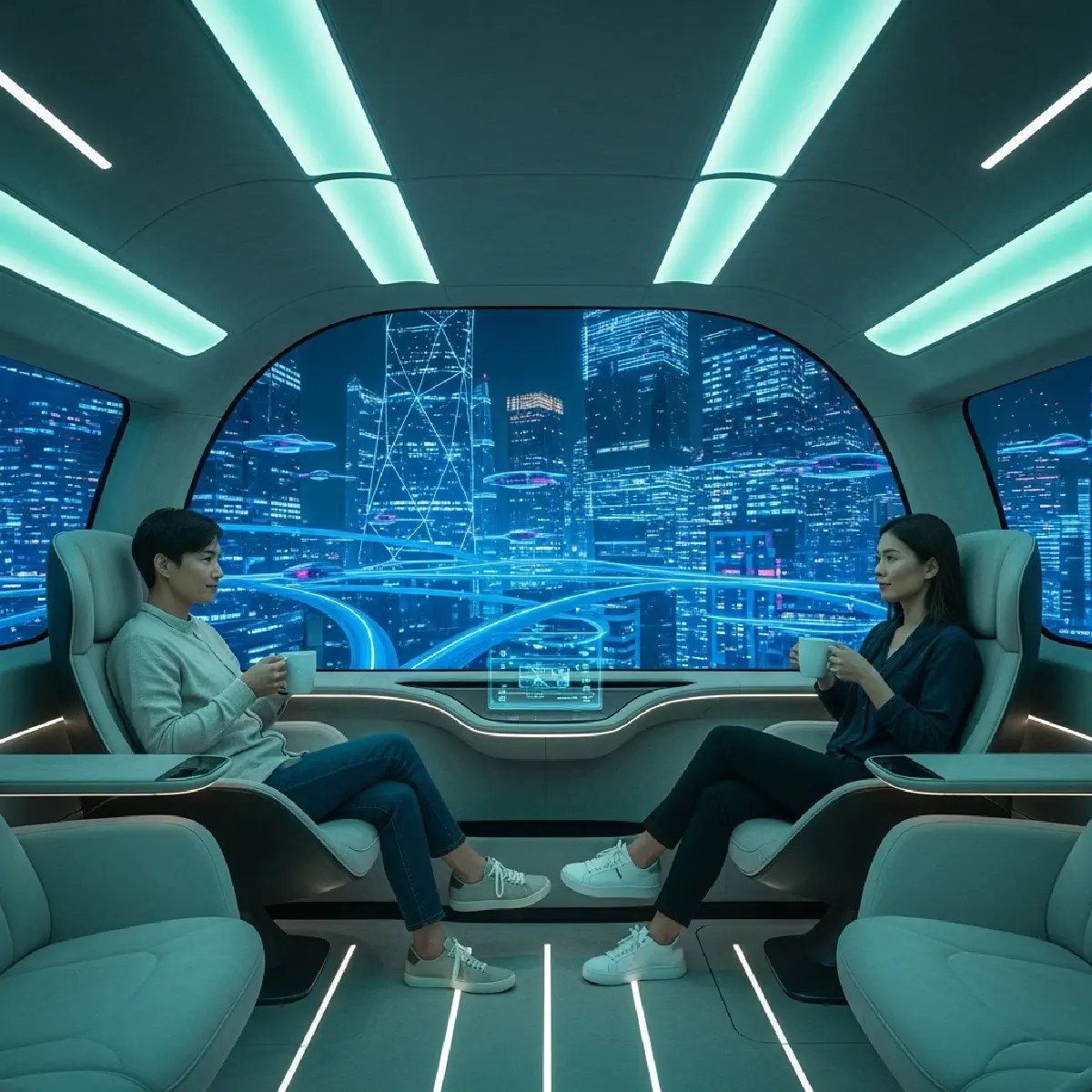
The ripple effect of the “Autonomous Paradigm” is the most radical shift in a century, as machines traditionally controlled by humans begin to navigate independently. This eliminates constraints like “center consoles” and “gearshifts,” allowing passengers to “face each other” and rethink “ingress and egress” without a steering wheel. Five factors—population growth, new mobility paradigms (ridesharing), connectivity, zero emissions, and autonomy—are upending traditional business models. To remain competitive, manufacturers must evolve from hardware providers to service and experience providers, monetizing mobility through partnerships and innovation.
The Synthesis of a Better Tomorrow#
The journey of transportation design concludes with the realization that design is a cyclical process of “continuous improvement”. While the landscape is shifting rapidly, the human need for transportation and “visual meaning” remains deep and constant. Designers must use the “Three-Act Structure” to pitch their ideas: Act I sets up the unmet need, Act II presents the confrontation through design, and Act III offers the resolution that is differentiated and meaningful. We are all “citizens of one global village” on a “small spaceship called Earth,” and it is up to designers to deliver the “magic” of trust and well-being. The longest journey of design begins with a single step, but it is the persistence of vision that ensures we reach a better tomorrow.