
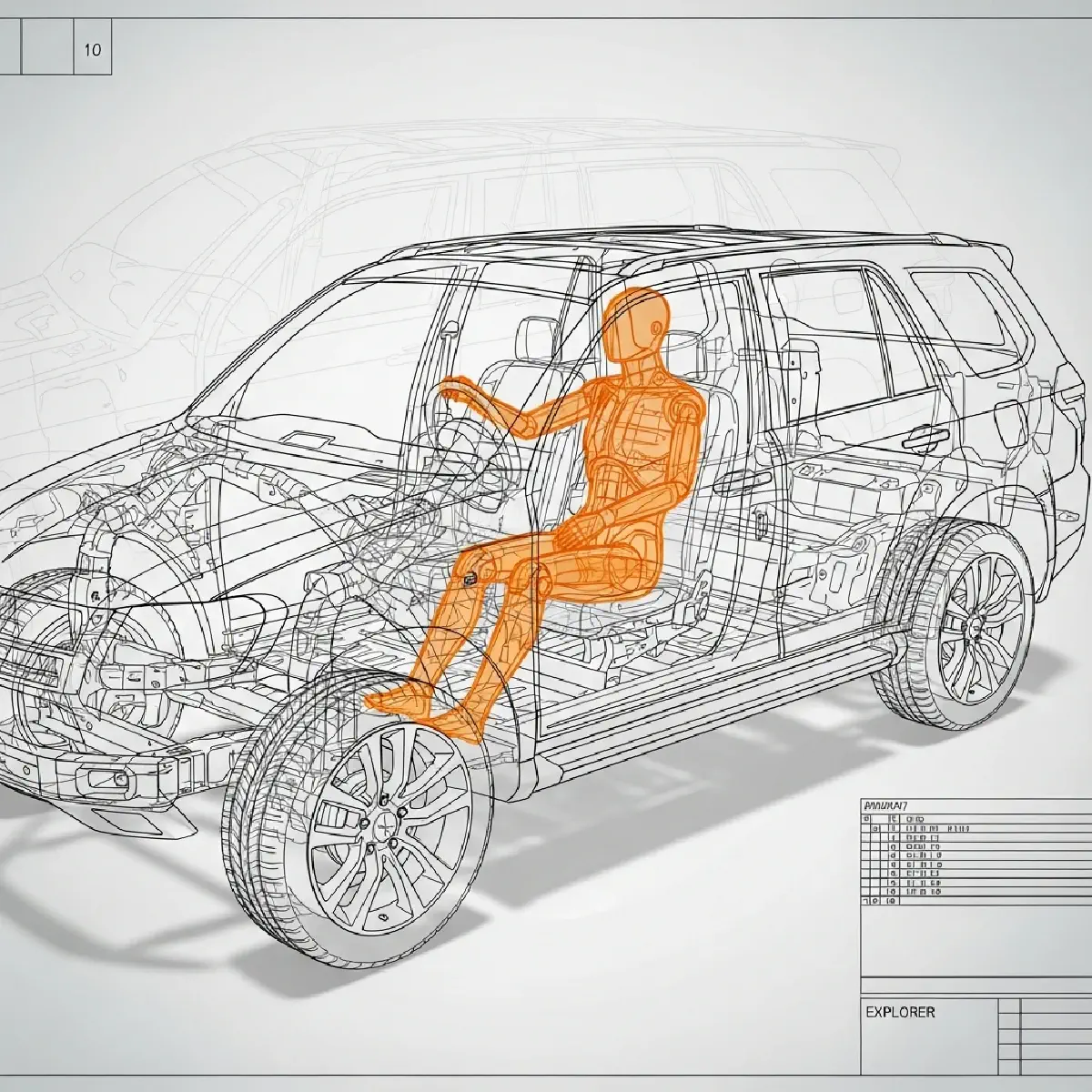
The Architecture of the Hip-Point#
Ideation is the daunting point in the journey where a designer commits a concept to a blank page. To bridge the gap between heart and head, the designer must identify a literal architecture for the idea, letting the archetype of the user define the structure of the vehicle. This is the science of “packaging,” which orchestrates three core variables: people, the stuff they carry, and the power required to propel them. Central to this is the “H-point” or hip point, the theoretical pivot between the torso and upper leg. If a designer is creating for a “Hero” archetype, the H-point is low-slung for high-performance handling; for an “Explorer,” it is drawn in an upright posture for superior vision angles and command of the road. A flawed package is the most direct route to a disappointing user experience, regardless of how “cool” the vehicle appears.
The Thesis of Proportional Dominance#
The central claim of architectural design is that the “first read” of a vehicle is its proportion and architecture, which must communicate an intended action or “affordance” before any surface detail is noticed. This matters because the geometry of the vehicle acts as a mechanical organism where the structure serves as the bones and the powertrain as the organs.
The Mechanism of Packaging Variables#
Vehicle engineering is broken into five areas: occupant placement, powertrain systems, interior features, structure, and suspension. Most automobiles are understood in “side view,” where the silhouette section—or Y-zero—is established. The “tumble home,” or the angle of the side glass in end view, establishes the visual center of gravity; boxy off-roaders like the Jeep Wrangler use minimal tumble home to maximize interior space. Powertrain selection further dictates architecture; combustion engines require front-end “crush zones,” whereas battery electric vehicles (BEVs) utilize a “skateboard” frame that offers endless flexibility for radically new silhouettes. These decisions lock in the “glass planes” and windshield angles that define the speed and character of the vehicle.
The Crucible of the Triad of Constraints#
Designers must navigate a “triad of limitations”: safety, technical feasibility, and business viability. Regulatory requirements for bumper beams, airbags, and rollover protection define the thickness of pillars and the shape of the roof rails. Aerodynamics also play a “calculating” role, where high-performance cars require spoilers and diffusers, while low-speed city vehicles may disregard these forms. Furthermore, the “MAYA” principle (Most Advanced Yet Acceptable) suggests that if a design is too “shocking” or departs too far from known proportions, the consumer may be unwilling to accept it. Designers must also manage “carryover components” like gauge clusters and ventilation registers to keep costs manageable while trying to deliver a fresh aesthetic.
The Cascade of Visual Morphology#
When proportion and architecture are arranged correctly, the viewer reads the vehicle in a sequential three-phase process: first the architecture, then the surface language, and finally the textures and details. Surface language, such as angular or chiseled sections, communicates an aggressive, sporty statement that aligns with the user’s narrative. If the composition is poorly balanced—such as using fluid graphics on fluid forms—the elements may become too repetitious and lose their impact. In the case of the Jeep Wrangler Unlimited, identifying a latent need for passenger space led to an extended wheelbase that now significantly outsells the traditional two-door model. Every millimeter matters because a vehicle is a sculpture that must be touched and walked around to be truly appreciated.
The Synthesis of Integrated Design#
The geometry of desire concludes with the realization that a vehicle is not just driven; it is worn. Successful ideation creates a range of choices—a bandwidth of solutions—that adjust both architectural and formal assumptions to find the perfect combination. As Freeman Thomas of Ford notes, nature is the ultimate reference because its forms, like a river stone, tell the story of their own evolution. When we fall in “love” with a design, we protect and defend it, transcending its status from an appliance to a living object. The next phase of the journey is to move from the white page into the physical “sorcery” of the modeling studio, where vision becomes reality.