
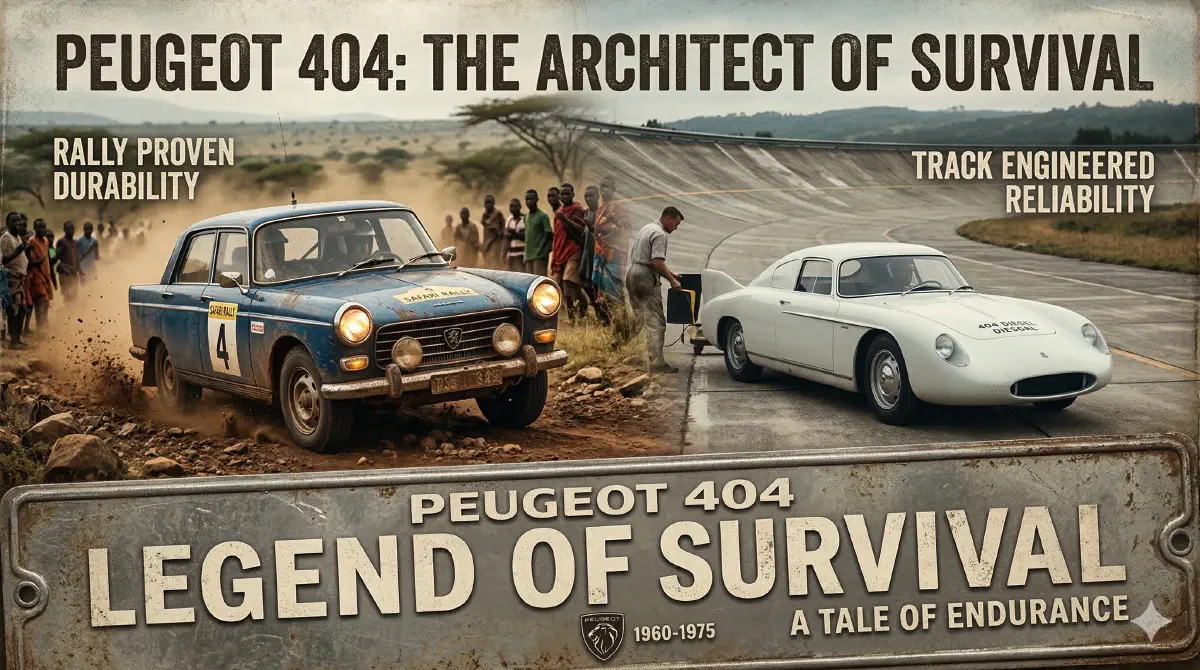
There was a time when automotive engineering was judged not only by brochures, specifications, and showroom appeal, but by what happened after years of use on bad roads, in harsh weather, with imperfect maintenance. By that standard, the Peugeot 404 belongs among the most serious production cars of the twentieth century. It was not defined by spectacle. It was defined by survival.
The modern tendency is to equate progress with technical complexity. The Peugeot 404 suggests a different measure. Its greatness came from the careful combination of proven architecture, selective innovation, and structural integrity. Peugeot did not try to reinvent the automobile from scratch. Instead, it refined known systems until they became unusually resilient. The car’s monocoque construction, robust engine family, well-resolved suspension, and torque-tube drivetrain were not dramatic in isolation. Together, however, they created a vehicle capable of exceptional endurance.
Its rally record makes that point with brutal clarity. In the East African Safari Rally, the 404 became famous not because it overwhelmed rivals with power, but because it simply kept going. This is perhaps the most important engineering compliment a car can receive. Reliability means a car works. Durability means it keeps working after punishment. The 404 achieved both. It could function consistently in varied conditions, and it could retain structural and mechanical integrity across time, distance, and abuse. The distinction matters, and the 404 embodied it.
The diesel record car at Montlhéry reinforced the same theme from another direction. Here, the question was not rough-terrain survival but high-speed endurance over 72 consecutive hours. Again, the lesson was that sustained performance requires more than headline figures. It requires thermal control, mechanical regularity, and a system-level design philosophy that values stability. Peugeot’s success in that record attempt showed that the 404 platform was not merely tough in primitive conditions; it was also fundamentally sound under prolonged mechanical stress.
Its afterlife across Africa and other global markets completed the argument. A vehicle does not remain in service for decades across difficult environments unless it solves real problems better than its replacements. The 404 pickup, taxis, and saloons became tools of continuity because they were legible to mechanics, tolerant of hardship, and structurally serious. They represented a kind of industrial honesty that is increasingly rare: the machine did not pretend to be more than it was, but it consistently delivered more than expected.
The Peugeot 404 therefore stands for something larger than nostalgia. It represents a lost design ethic. It reminds us that engineering quality is not always loud, futuristic, or digitally mediated. Sometimes it is embedded in the quieter virtues: repairability, structural discipline, mechanical tolerance, and the refusal to fail when conditions become hostile. In that sense, the 404 was not just a successful car. It was a durable answer to the real world.