
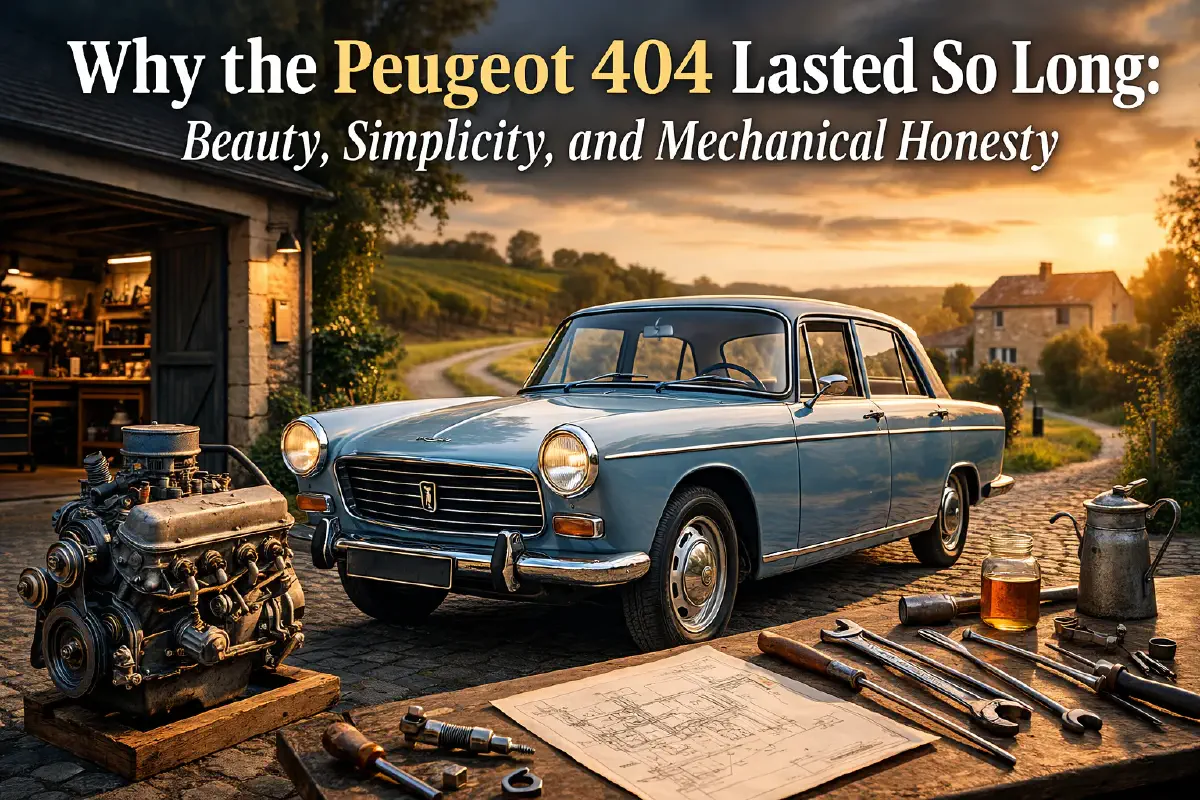
Most cars disappear because they fail one of two tests. Either they become technically obsolete too quickly, or they are too fragile to remain useful once newer alternatives appear. The Peugeot 404 largely escaped both traps. Its long production life and enduring global reputation came from a design philosophy that favored balance over excess. It was neither radically experimental nor crudely utilitarian. It was a disciplined synthesis of form, serviceability, and durability.
The first layer of that synthesis was visual. Peugeot’s collaboration with Pininfarina gave the 404 a crisp, modern silhouette at a time when many post-war forms were becoming dated. The design belonged to what could be called a transatlantic modernist language: angular but not harsh, elegant but not flamboyant, contemporary without becoming disposable. This mattered because appearance affects market reach. A car that looks serious, modern, and well-proportioned can travel across class boundaries and national markets more easily than one that is too eccentric or too rooted in a single local taste.
But style alone never explains longevity. The deeper reason lies in the 404’s mechanical honesty. Peugeot engineers made important practical choices to preserve both proportions and reliability. The engine was tilted 45 degrees to achieve the low hood line without abandoning the robust pushrod architecture. That decision is emblematic of the entire car. Rather than redesign everything around fashion, Peugeot adapted proven mechanical fundamentals to a new visual era. The result was not technological conservatism as stagnation, but conservatism as controlled refinement.
The XC engine series illustrates this point clearly. It was accessible, durable, and relatively easy to service. The engine’s tilted layout made key accessories more reachable. Wet cylinder liners, while requiring informed maintenance, also reflected an engineering logic aimed at repairability. Later upgrades, including the stronger five-main-bearing crankshaft, improved durability further. The engine became known not because it was exotic, but because it could endure. This distinction is central to understanding why the 404 remained valuable in regions where downtime was costly and mechanical simplicity was not a preference but a necessity.
The rest of the vehicle followed the same logic. The suspension and torque-tube rear arrangement helped maintain composure on poor surfaces. The gearbox and final-drive system were rugged if properly maintained. The cooling system, braking updates, and chassis layout all reflected an engineering culture that valued sustained function over short-term spectacle. Even the fuel-injection system, while advanced for its era, was integrated in a way that supported performance without turning the car into a temperamental machine.
This is why the 404 lasted. It was beautiful enough to attract buyers, simple enough to maintain, and durable enough to justify loyalty. In an age increasingly obsessed with novelty, the Peugeot 404 reminds us of a more serious industrial ideal: a machine should not only impress at launch, it should continue to serve long after its first applause. The 404 did exactly that.