
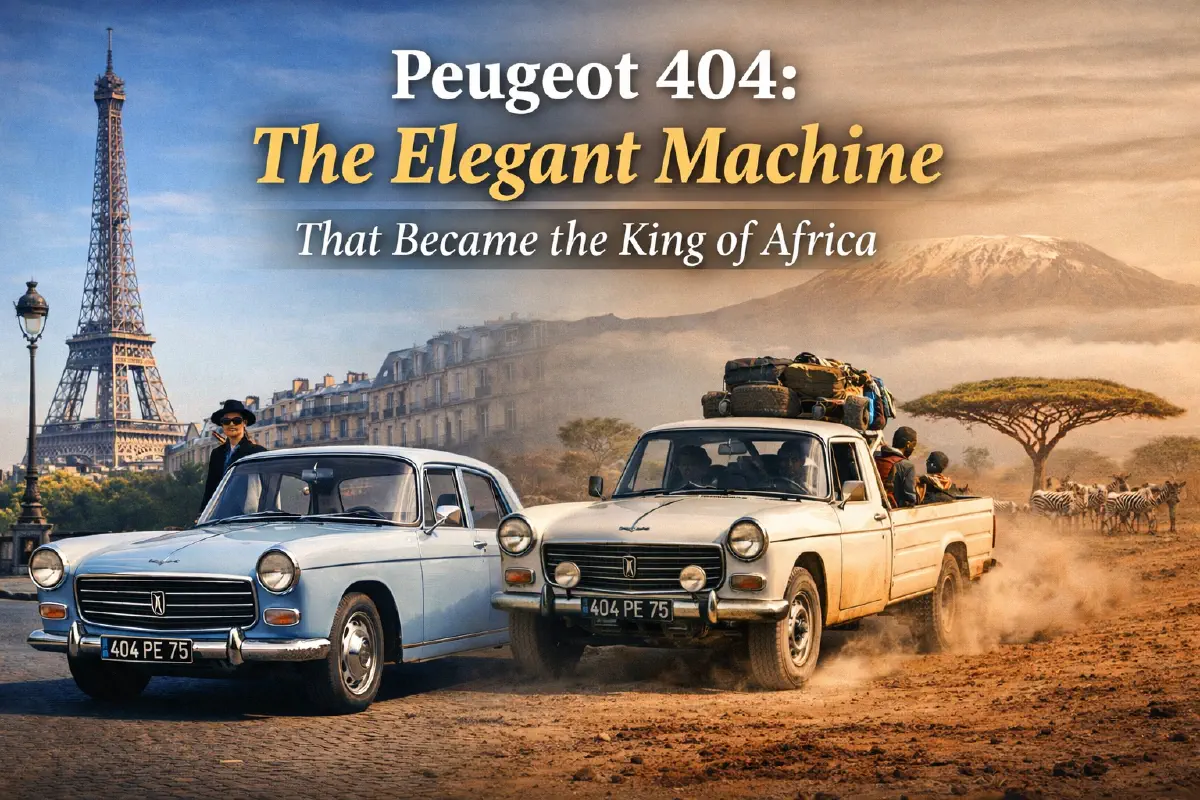
The Peugeot 404 occupies a rare place in automotive history because it united two qualities that usually do not coexist for long: elegance and survival. When it debuted in Paris on May 9, 1960, it represented a decisive break from the older post-war Peugeot aesthetic. Styled with Pininfarina’s restrained modernism, the 404 appeared international, composed, and sophisticated. Yet its deeper historical importance did not emerge on European boulevards. It emerged later, on rough roads, in hot climates, and under conditions that destroyed weaker machines.
That is the central paradox of the 404. In one form, it was refined enough to stand in the same visual and price conversation as high-style European grand tourers. In another, especially as a pickup and working saloon, it became one of the most trusted tools of the developing world. This was not accidental. Peugeot created a car whose beauty was not detached from function. The 404 succeeded because its mechanical conservatism was not backwardness. It was disciplined engineering.
Its global reputation rested on several interlocking choices. The platform was structurally robust. The monocoque body improved rigidity while keeping weight under control. The drivetrain evolved from proven Peugeot mechanical lineage rather than chasing novelty for its own sake. The XC engine series, especially after the move to the stronger five-main-bearing crankshaft, developed a reputation for long service life and dependable operation under stress. This is why the 404 could move from Paris to Nairobi, from family transport to rural labor, without losing its identity.
The East African Safari Rally transformed that engineering credibility into legend. The 404 did not dominate because it was the most powerful machine in the field. It dominated because it remained intact when others failed. That distinction matters. Many cars can be fast in ideal conditions. Far fewer can endure impact, vibration, heat, mud, poor fuel, and neglect while still functioning predictably. The Peugeot 404 built its myth by proving that resilience is a higher form of performance. It earned the nickname “Simba” precisely because it survived brutality without drama.
Its production history confirms the same principle. European production ended in 1975, but the 404’s useful life continued for years afterward through decentralized manufacturing and assembly across multiple countries. In Kenya, production lasted until 1991. That is an extraordinary industrial lifespan. It means the 404 was not merely sold globally; it was absorbed globally because local conditions validated its design logic. In many regions, it outlived more modern-looking competitors because it was easier to maintain, harder to kill, and more adaptable to real-world transport demands.
The Peugeot 404 therefore deserves to be understood not simply as a classic French sedan, but as a global industrial archetype. It shows that true automotive greatness is not always measured by speed, luxury, or technical spectacle. Sometimes it is measured by how long a machine remains useful after fashion has moved on. The 404 was elegant enough to be admired, but durable enough to be needed. That is why it remains unforgettable.