The Ghost in the Factory#
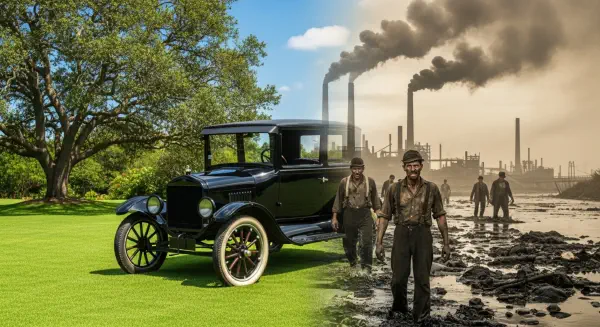
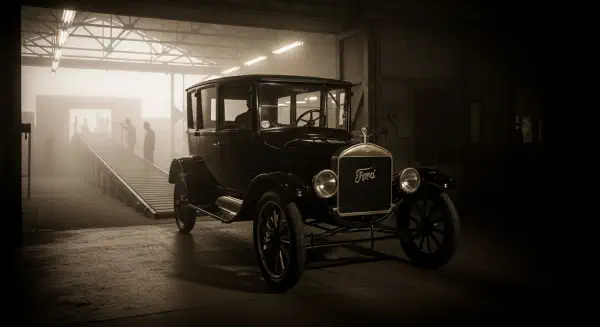
Highland Park’s assembly line fell silent in 1927, replaced by the massive River Rouge complex. The original plant deteriorated for decades, its windows broken, its machines scrapped, its floors empty. By the 1980s, it was a ruin—a monument to an industrial era that had passed.
Yet the line never truly died. Its logic propagated through every factory built afterward. Its principles shaped Toyota’s lean production system, General Motors’ flexible manufacturing, and Tesla’s automated assembly halls. Its ghost haunted the factories that replaced it, visible in every conveyor belt, every timed operation, every worker performing a task designed by engineers who had never performed it themselves.
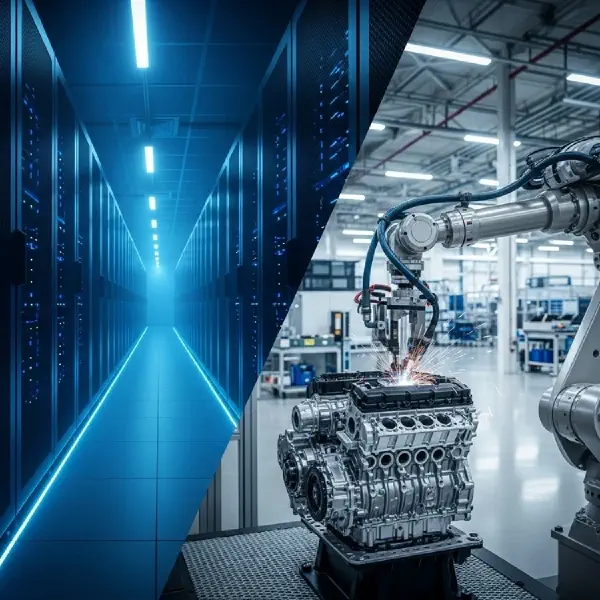
Today, that ghost has found new embodiment. Ford’s modern factories employ digital twins—virtual replicas of production lines that simulate every operation before a single physical component is installed. Engineers optimize workflows in silicon before committing steel to concrete. The line that once ate time now exists outside time entirely, running millions of simulated cycles while the physical factory waits.
Understanding how we arrived at digital twins requires tracing the assembly line’s evolution from Ford’s Highland Park to Toyota’s Toyota City to Tesla’s Fremont factory—and beyond, to the factories that do not yet exist but are already being designed in virtual space.
Thesis: The Line’s Logic Outlasts Its Form#
The moving assembly line that Ford perfected was a specific technological configuration: conveyor belts, stationary workers, timed operations, centralized control. That configuration proved remarkably durable, dominating manufacturing for more than half a century.
But the line’s deeper logic—the principle that work can be analyzed, decomposed, synchronized, and optimized—proved more durable still. That logic survived the line’s physical form, adapting to new technologies, new industries, and new geographies. It shaped lean manufacturing, just-in-time production, and flexible automation. It now shapes digital manufacturing, where the line exists as information before it exists as matter.
Understanding this evolution reveals not only where manufacturing has been, but where it is going—and what challenges await as the line’s logic confronts twenty-first-century constraints.
The Japanese Adaptation#
Toyota Studies Ford#
In 1950, Eiji Toyoda spent three months studying Ford’s River Rouge complex. He observed everything: the scale, the flow, the organization, the waste. What he saw impressed him—and troubled him.
Ford’s system produced enormous volume, but it also produced enormous inventory. Parts stacked in warehouses, components waiting for assembly, finished cars awaiting shipment—all represented capital tied up in things that were not moving. Toyoda recognized that Ford’s flow stopped everywhere except the line itself.
Returning to Japan, Toyoda and production engineer Taiichi Ohno began developing what would become the Toyota Production System. They preserved Ford’s flow principle but eliminated Ford’s inventory. Parts arrived exactly when needed—“just in time”—rather than accumulating in warehouses. Workers could stop the line if problems appeared, rather than letting defects continue downstream.
The Lean Revolution#
Toyota’s innovations transformed Ford’s system. Where Ford had optimized for throughput, Toyota optimized for flexibility. Where Ford had required massive batch sizes, Toyota enabled small batches and frequent changeovers. Where Ford had treated workers as interchangeable, Toyota trained workers to solve problems and improve processes.
These differences reflected different constraints. Postwar Japan lacked space for massive inventory, capital for large batch production, and markets for standardized products. Toyota needed a system that could produce small quantities of many models efficiently. They found it by preserving Ford’s flow logic while inverting almost everything else.
The Return to America#
American manufacturers discovered Toyota’s system in the 1980s, when Japanese imports were capturing quarter after quarter of the U.S. market. Studies revealed that Japanese plants required half the labor, half the space, and half the inventory of American plants—while producing higher quality.
Ford Motor Company, the original source of mass production, became a student of lean manufacturing. The company studied Toyota, implemented just-in-time systems, reduced inventory, and empowered workers. By the 1990s, Ford’s plants had transformed—not by abandoning Ford’s principles, but by adapting them to Toyota’s innovations.
The Digital Transformation#
From Lean to Digital#
Lean manufacturing represented the assembly line’s evolution within physical constraints. Digital manufacturing represents its evolution beyond those constraints. Where lean optimized material flow, digital optimizes information flow. Where lean reduced physical inventory, digital reduces the need for physical experimentation.
Computer-aided design, simulation software, and production planning systems allow manufacturers to design and test production lines virtually. Engineers can simulate thousands of operating conditions, identify bottlenecks, optimize worker assignments, and validate equipment choices before spending a dollar on physical infrastructure.
The Digital Twin Emerges#
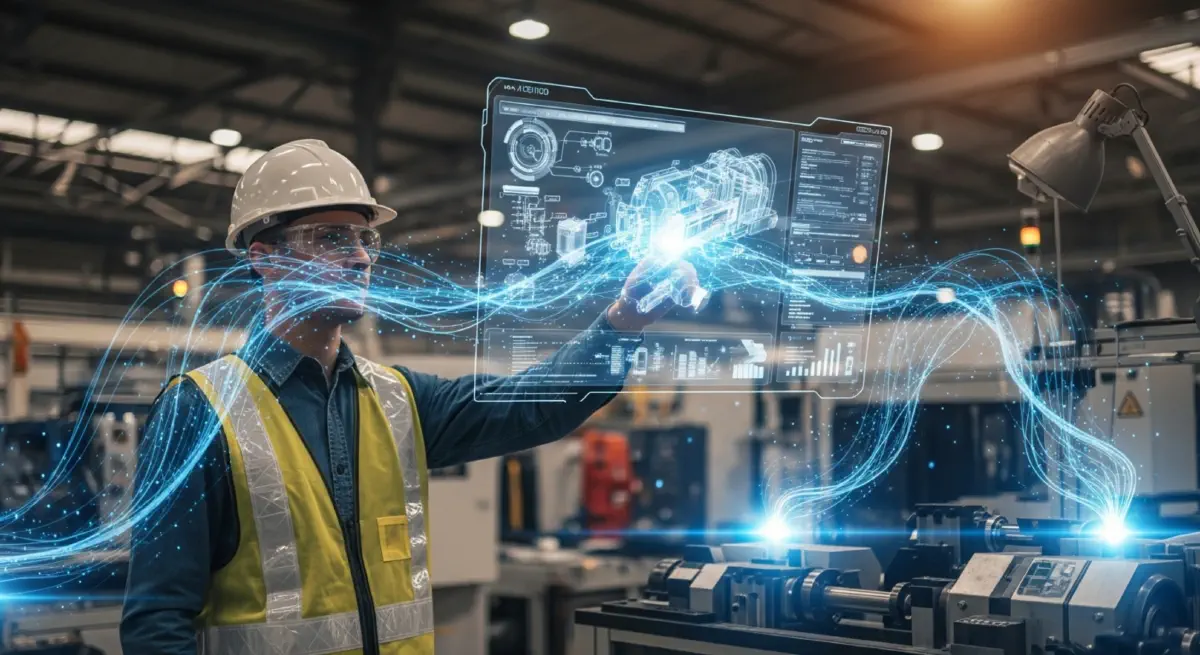
The digital twin extends this logic to the factory’s entire lifecycle. Every physical asset—every conveyor, robot, workstation, and tool—has a virtual counterpart that mirrors its behavior in real time. Sensors stream data from physical to digital, while simulations flow from digital to physical, creating continuous feedback loops.
Ford’s modern plants employ digital twins extensively. Engineers can monitor production remotely, predict maintenance needs before failures occur, and simulate changes before implementing them. The line that once required physical experimentation now runs experiments in silicon, testing thousands of variations while the physical line continues producing vehicles.
The Quantified Gains#
The results justify the investment. Studies of digital twin implementation in automotive assembly report efficiency improvements of 6 percent and downtime reductions of 87 percent. These gains compound, generating savings that dwarf the original investment.
More significantly, digital twins enable continuous optimization. Physical lines can be reconfigured based on simulation results, tested virtually, and implemented with minimal disruption. The line learns, adapts, and improves in ways that Ford’s original designers could not have imagined.
The Human Question#
Automation and Employment#
Digital manufacturing raises questions that Ford never faced. When lines optimize themselves, what happens to the workers who once optimized them? When robots perform tasks that required human judgment, what happens to human employment?
Current evidence suggests complex effects. Automation eliminates some jobs but creates others—maintenance, programming, supervision, and improvement. The net effect on employment depends on how quickly displaced workers can acquire new skills and how readily new jobs materialize.
Ford’s original system eliminated craft skills but created semi-skilled jobs. Digital manufacturing eliminates semi-skilled jobs but creates technical positions. The pattern repeats: each technological transition displaces workers whose skills no longer match requirements, while creating opportunities for those whose skills align with new systems.
The Persistence of Human Labor#
Despite predictions of workerless factories, human beings remain essential to manufacturing. Robots cannot yet match human flexibility, judgment, or problem-solving. Digital twins optimize systems, but humans design, interpret, and improve them.
Ford’s Highland Park plant employed thousands of workers performing simple operations. Modern automotive plants employ fewer workers performing complex operations. The ratio of human to machine has shifted, but the human presence persists—and likely will persist for the foreseeable future.
The New Deskilling#
Digital manufacturing creates its own forms of deskilling. Workers who once understood entire production processes may now monitor screens without understanding underlying systems. Knowledge that resided in skilled trades now resides in software, inaccessible to those who lack programming expertise.
This shift reproduces Ford’s original deskilling at a higher technological level. Then as now, efficiency requires knowledge to be encoded in systems rather than carried by workers. Then as now, workers adapt to systems rather than systems adapting to workers.
The Sustainability Challenge#
The Limits of Optimization#
Digital twins optimize for efficiency, but efficiency is not sustainability. A perfectly efficient factory can still deplete resources, generate waste, and damage environments. Optimization within current boundaries perpetuates systems that may be unsustainable regardless of how well they perform.
Ford’s original system optimized throughput without accounting for externalities. Digital systems optimize throughput more precisely, but they still operate within accounting boundaries that exclude most environmental costs. The ghost in the machine remains blind to consequences beyond the factory gates.
The Circular Economy#
Some manufacturers are attempting to expand optimization’s boundaries. Circular economy principles design products for disassembly, reuse, and recycling—internalizing costs that linear production externalized. Digital twins can support circular design by simulating end-of-life processes alongside production processes.
Ford has experimented with these approaches, designing vehicles for recyclability and establishing take-back programs for end-of-life products. The company that once built cars to be driven until they broke now builds cars to be reclaimed, dismantled, and reborn as new vehicles.
The Energy Transition#
Digital manufacturing’s most significant sustainability contribution may be energy optimization. Smart factories can shift production to times when renewable energy is abundant, reduce consumption during peak demand, and optimize processes for minimum energy use.
Ford’s modern plants increasingly run on renewable energy, with solar arrays, wind turbines, and energy storage systems supplementing grid power. The line that once consumed coal without计 now consumes kilowatt-hours tracked to their renewable sources.
The Next Line#
From Centralized to Distributed#
Ford’s system centralized production in massive factories. Digital technology enables distributed production—smaller facilities closer to customers, flexible enough to adapt to local markets. Three-dimensional printing, automated assembly, and digital design tools make distributed manufacturing increasingly feasible.
The COVID-19 pandemic accelerated this trend, exposing the fragility of long supply chains and the value of local production capacity. Manufacturers who had outsourced everything found themselves unable to obtain critical components. Those with flexible, distributed capacity adapted more readily.
From Standardized to Personalized#
Ford’s system produced identical products for mass markets. Digital manufacturing enables personalized products—customized to individual preferences without sacrificing efficiency. The same tools that enable distributed production enable mass customization, as software configures designs for individual orders.
Automotive manufacturers are exploring these possibilities. Customers may soon configure vehicles online, with factories producing unique vehicles for each order rather than batches of identical cars. The line that Ford designed for standardization may ultimately enable its opposite.
From Physical to Virtual#
The ultimate evolution may be the line’s disappearance entirely. Three-dimensional printing can produce complete objects without assembly. Digital manufacturing can create products that never touch a production line. The logic of flow, synchronization, and optimization may persist, but the physical form—the line itself—may become optional.
This possibility returns us to Ford’s original insight: that work can be analyzed, decomposed, and recomposed for efficiency. That insight does not require conveyor belts, stationary workers, or timed operations. It requires only the willingness to treat production as a problem to be solved, with the solution taking whatever form technology enables.
The Ghost’s Future#
The line that began at Highland Park in 1913 has not ended. It has multiplied, transformed, and diffused into every corner of manufacturing. Its ghost haunts factories that Ford never imagined—factories that build computers, pharmaceuticals, aircraft, and artificial limbs using principles that Ford’s team first codified.
That ghost will continue evolving as technology advances. Artificial intelligence may soon optimize lines without human intervention. Robots may work alongside humans in seamless collaboration. Factories may reconfigure themselves overnight for new products. The line’s logic will persist through each transformation.
But the ghost carries Ford’s original blindnesses as well as his insights. It optimizes within boundaries that exclude most human and environmental costs. It values efficiency above resilience, speed above flexibility, throughput above sustainability. These priorities, baked into the line’s original design, persist through each technological generation.
The question facing twenty-first-century manufacturing is whether the ghost can learn new tricks—whether the line’s logic can expand to encompass costs that Ford excluded, values that Ford ignored, and futures that Ford could not imagine. The answer will determine whether the line that changed the world changes it again, this time toward sustainability rather than simply toward speed.