The Silence After the Whistle#
When the factory whistle fell silent at the end of each shift, the noise did not truly stop. It merely relocated. Workers carried the line’s rhythms home in their bodies—the repetitive motions echoing through aching shoulders, the line’s pace replaying in dreams, the foreman’s voice lingering in memory.
Medical researchers who studied automotive workers in subsequent decades documented what Ford’s employees felt immediately: chronic pain, disabling injuries, and the slow accumulation of physical damage from years of machine-paced labor. The assembly line consumed bodies as surely as it consumed coal and steel, but the bodies left through hospital doors rather than shipping bays.
These human costs were not incidental to Ford’s system. They were structural—built into the line’s logic of fragmentation, repetition, and speed. Understanding the Model T’s legacy requires examining not only what the assembly line produced, but what it destroyed: worker health, craft knowledge, community stability, and eventually the environmental systems that sustained industrial civilization.
Thesis: Efficiency Externalizes Its Costs#
Every production system generates costs that its designers do not pay. Environmental economists call these “externalities”—burdens shifted onto workers, communities, or future generations. Ford’s assembly line was extraordinarily efficient at producing cars, and equally efficient at displacing costs beyond the factory gates.
Some costs were borne by workers’ bodies, consumed by repetitive motion and machine pacing. Some were borne by communities, transformed by industrial pollution and automobile dependency. Some were deferred to future generations, who would inherit depleted resources, contaminated sites, and infrastructure designed around assumptions that could not persist indefinitely.
These displaced costs were not accidents. They were the logical consequences of a system optimized for speed and throughput, with no mechanism for accounting what the optimization destroyed.
The Body as Input#
The Epidemiology of Repetition#
Decades after the Model T’s production ended, occupational health researchers documented what Ford’s workers knew in 1914: repetitive motion destroys bodies. Assembly line workers suffered carpal tunnel syndrome at rates far exceeding general populations. Back injuries, tendon damage, and chronic pain syndromes were endemic.
The line’s design caused these injuries systematically. Workers performed the same motions thousands of times per shift—twisting a screwdriver, inserting a bolt, reaching for a part. Muscles and tendons never rested, never varied, never recovered. The body, unlike a machine, required recovery time that the line did not provide.
Ford’s early ergonomic interventions—raising line heights, improving lighting, reducing lifting weights—addressed only the most visible injuries. They left the fundamental problem untouched: a production system designed for machines could not accommodate human biological needs without fundamental redesign.
The Psychological Toll#
The line’s psychological costs proved harder to measure but equally real. Workers described the “Ford stare”—a vacant expression that developed after years of repetitive work, reflecting what psychologists later termed “dissociation”. The mind, unable to engage with work, retreated into private space while the body continued its mechanical tasks.
Alcoholism rates among Ford workers attracted company attention. The Sociological Department, investigating workers’ home lives, found heavy drinking widespread. Investigators interpreted this as moral failure. A later generation would recognize it as coping—an attempt to escape the line’s grip during off-hours.
Turnover rates before the $5 day testified to the line’s intolerability. Workers abandoned $2.34 jobs despite having no better options, simply because they could not endure the conditions. The wage increase bought tolerance but did not eliminate suffering.
The Deskilling of Labor#
Beyond physical and psychological damage, the line destroyed something less tangible but equally valuable: craft knowledge. Workers who had spent years acquiring skills found those skills worthless. The line required no judgment, no variation, no expertise—only obedience to the line’s pace.
This deskilling had generational effects. Sons who might have learned trades from fathers instead learned to perform single operations for eight hours. Craft knowledge that had accumulated over centuries disappeared within a decade. The assembly line did not merely use labor; it transformed labor into something it had never been before—interchangeable, expendable, and infinitely replaceable.
The Environmental Shadow#
Resource Extraction Without Accounting#
The Model T’s production consumed resources at unprecedented scale. Each car required steel, glass, rubber, copper, wood, and leather—materials extracted from mines, forests, and plantations across the globe. Ford’s vertical integration strategy extended to ownership of rubber plantations in Brazil, iron mines in Michigan, and lumber operations in the Upper Peninsula.
This extraction generated environmental costs that never appeared in Ford’s accounting ledgers. Deforestation, soil erosion, water pollution, and habitat destruction accumulated across continents, borne by ecosystems and communities with no claim on the company’s profits.
The scale was staggering. By 1927, Ford had produced 15 million Model Ts, each requiring approximately 2,500 pounds of steel. Total steel consumption exceeded 37 billion pounds—equivalent to building 185 Hoover Dams. The energy required to mine, smelt, and shape this steel released millions of tons of carbon dioxide, though no one measured such things in 1927.
The Pollution of Production#
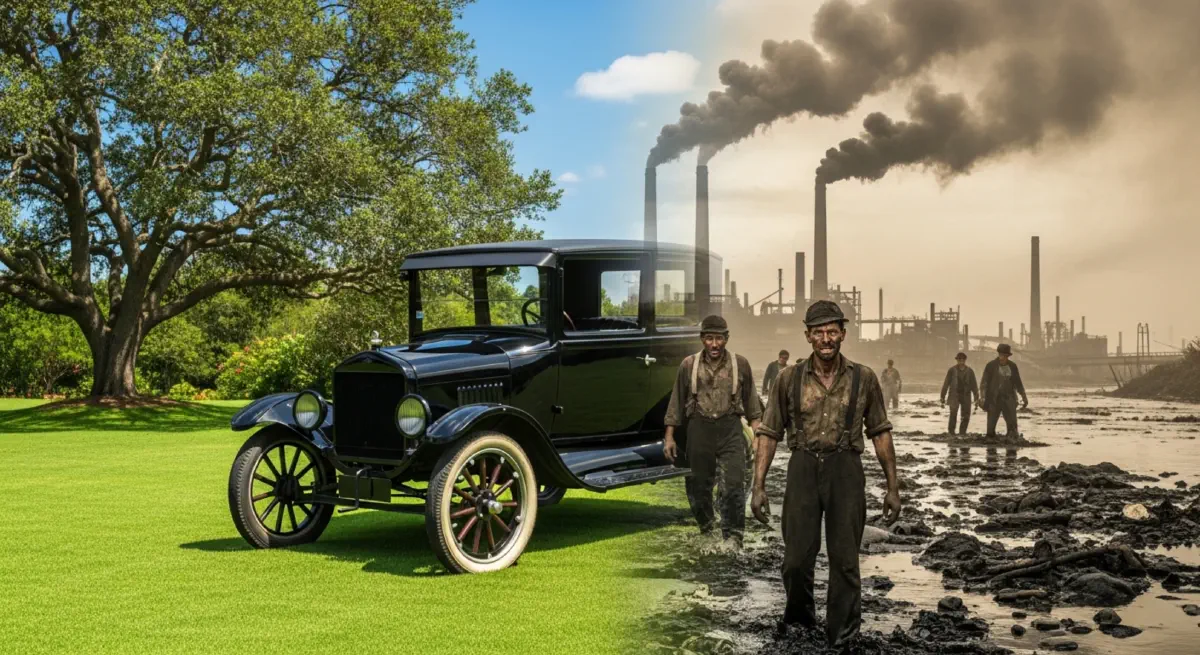
Ford’s factories generated waste on a corresponding scale. The River Rouge complex, opened in 1927, was the world’s largest industrial facility, processing raw materials into completed vehicles without external suppliers. Its coke ovens, blast furnaces, and foundries emitted smoke, dust, and chemical fumes that blanketed surrounding communities.
Workers developed respiratory diseases at elevated rates. Residents near factories complained of soot damaging gardens and laundry. The Rouge River, from which the complex took its name, received industrial discharges that killed aquatic life and made the water unusable downstream.
These effects were considered normal. Industrial pollution, like workplace injuries, was an expected cost of progress. Neither regulators nor communities possessed legal tools to demand reduction. Ford’s factories operated with environmental freedom that no modern manufacturer could imagine.
The Automobile’s Consumptive Logic#
The Model T’s most significant environmental impact came not from its production but from its use. Each car, once sold, began consuming fuel, oil, rubber, and roads—resources that would continue flowing for the vehicle’s lifetime.
Ford’s early cars burned gasoline with appalling inefficiency by modern standards. The Model T achieved approximately 13 to 21 miles per gallon, depending on driving conditions. Multiplied by 15 million vehicles and billions of miles driven, this fuel consumption released atmospheric carbon at scales that climate scientists would later identify as transformative.
The infrastructure required to support automobile travel amplified these effects. Roads, bridges, parking lots, and service stations covered millions of acres that had previously been farmland, forest, or prairie. The automobile’s mobility came at the price of landscape transformation that erased ecosystems and fragmented habitats.
The Community Costs#
The Destruction of Urban Fabric#
Before the automobile, American cities were dense, walkable, and organized around human scale. After the automobile, they became dispersed, highway-oriented, and organized around vehicle movement. The Model T was not solely responsible for this transformation, but it was the catalyst that made large-scale suburbanization possible.
Detroit’s experience illustrated the pattern. The city’s population grew rapidly as Ford expanded, but its density declined. Workers who could now commute by car moved to outlying areas, abandoning the dense streetcar neighborhoods that had characterized nineteenth-century cities.
This decentralization had consequences that became apparent only decades later. Public transit systems, losing riders, deteriorated and eventually collapsed. Commercial districts oriented toward pedestrians declined as shoppers drove to suburban stores. Tax bases fragmented as wealthier residents moved beyond city limits, leaving older communities with shrinking resources and expanding needs.
Racial Segregation and Suburban Exclusion#
The automobile enabled a new form of racial segregation. Before mass automobility, Black and white workers often lived in close proximity, separated by block rather than by municipality. After the automobile, white workers could move to all-white suburbs while Black workers remained in central cities, confined by housing discrimination and limited transportation options.
Detroit’s 1943 race riot, which killed 34 people, was partly a product of this geography. Black workers who had migrated for wartime jobs found themselves crowded into the Paradise Valley neighborhood, denied access to housing in white areas. Tensions over space, jobs, and mobility exploded into violence that the city’s dispersed geography made nearly impossible to contain.
The Loss of Alternatives#
Perhaps the deepest cost of the Model T’s success was the elimination of alternatives. Before Ford, Americans moved by multiple means: walking, streetcars, bicycles, horses, trains, and boats. After Ford, they moved by automobile—or they did not move at all.
Public transit systems, once profitable private enterprises, became public burdens as ridership declined. Streetcar tracks were paved over, removed, or abandoned. Bicycle use, widespread in the 1890s, collapsed to negligible levels. The flexibility that the automobile offered came at the price of the flexibility that multiple modes had provided.
By 1930, American transportation policy had committed to automobile dominance. Federal and state governments built highways, funded roads, and subsidized suburban development while transit received nothing. These choices, once made, became irreversible—locked in by infrastructure investments that could not be unmade and development patterns that could not be undone.
The Deferred Reckoning#
The Limits of Twentieth-Century Accounting#
Ford’s production system operated within accounting boundaries that excluded most costs. Worker health, community disruption, and environmental damage appeared nowhere in the company’s ledgers. They were externalities in the purest sense: costs borne by others, invisible to those who made decisions.
This accounting system reflected its era’s assumptions. Nineteenth-century economists had taught that natural resources were infinite, that labor was a commodity like any other, and that environmental damage was an acceptable price for progress. Ford’s generation inherited these assumptions and built industries around them.
The Accumulation of Consequences#
By the late twentieth century, the deferred costs had accumulated beyond ignoring. Contaminated industrial sites required billions in cleanup. Retired workers needed medical care for injuries sustained decades earlier. Suburban infrastructure required maintenance that tax bases could not support. Atmospheric carbon threatened global climate stability.
Each of these costs represented a claim against the productivity that Ford’s system had generated. The wealth created by mass production had been distributed to shareholders, workers, and consumers. The costs had been deferred to future generations, who now faced bills they had not incurred.
The Sustainability Paradox#
Contemporary manufacturers face a paradox that Ford never imagined: they must maintain productivity while internalizing costs that their predecessors externalized. Environmental regulations, worker safety standards, and community accountability require investments that Ford would have considered unnecessary.
Automakers now measure carbon footprints, track supply chain sustainability, and design for recyclability. The Model T, designed for ease of manufacture, was nearly impossible to recycle efficiently. Its materials—steel, wood, leather, brass—required separation and processing that no disassembly line performed.
Ford’s descendants at the company that bears his name now work to undo the environmental damage that his system created. They design vehicles for circular economies, build factories powered by renewable energy, and calculate lifecycle emissions with precision that would have mystified their predecessors.
The Unpaid Bill#
The assembly line’s efficiency was real. It produced abundance that earlier generations could not have imagined, at prices that made abundance available to ordinary people. That achievement should not be dismissed.
But the efficiency was purchased partly on credit—with costs deferred to workers’ bodies, to communities’ environments, to future generations’ atmosphere. The bill for that credit is now coming due.
Workers’ compensation systems pay for injuries that Ford’s line caused. Superfund sites require remediation that Ford never performed. Climate change demands mitigation that Ford’s generation could not foresee. Each of these payments represents a cost that the original accounting omitted.
The line that changed the world changed it in ways its creators never intended. They built a system for producing cars. They also built a system for producing consequences—consequences that will continue unfolding long after the last Model T has crumbled to rust.