The Paradox of the 12-Hour Car#
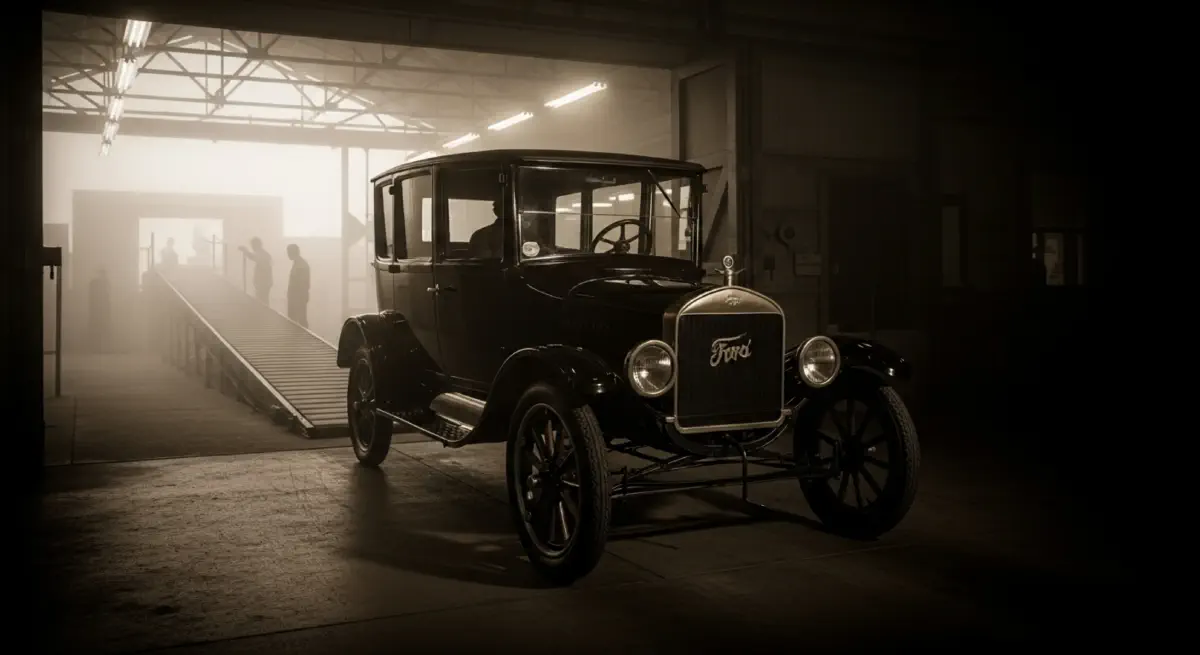
In 1908, if you had $850—roughly $24,000 in today’s currency—and a great deal of patience, you could purchase a Ford Model T. What you could not do was watch it being built in a single day. Each car required 12 to 14 hours of skilled labor, performed by craftsmen who moved between workstations, fitting parts that often required individual filing and adjustment. The automobile was a bespoke product, available only to the wealthy.
Five years later, that same vehicle rolled off a line in 93 minutes. The price had dropped to $550. By 1924, a Model T cost $260—barely three months’ wages for a Ford employee. The company that produced 10,000 cars in 1909 was manufacturing 2 million annually by 1923.
How did a complex machine comprising thousands of parts become cheaper than a horse-drawn wagon? The answer lies not in a single invention, but in a systematic reimagining of how work itself is organized. The moving assembly line was less a technological breakthrough than an epistemological one: Ford’s team learned to treat time as a raw material that could be compressed, controlled, and ultimately commoditized.
Thesis: Efficiency Was Not Discovered—It Was Engineered#
The common narrative credits Henry Ford with a flash of genius: the moving assembly line as a bolt-from-the-blue innovation. The historical evidence tells a different story. Ford’s achievement was synthetic, not inventive. He and his team aggregated four distinct innovations—interchangeable parts, scientific management, continuous-flow precedents, and mechanized power systems—into a unified production system ,.
This synthesis created something unprecedented: a manufacturing process that treated the worker as a variable to be optimized, the product as a flow rather than an object, and time as a resource subject to industrial discipline. Understanding how these elements fused at Ford’s Highland Park plant between 1913 and 1914 reveals not just the origins of mass production, but the template for every efficiency-driven system that followed—from Toyota’s lean manufacturing to Amazon’s fulfillment centers.
The Architecture of Speed#
Standardization as the Prerequisite#
The assembly line could not function without interchangeable parts. Before Ford, even “mass-produced” items required skilled fitters who filed and adjusted components until they matched. This artisanal bottleneck made continuous flow impossible—you cannot have a moving line if workers must stop to make parts fit.
Ford inherited the concept of interchangeability from nineteenth-century innovators like Samuel Colt, who used machine tools to produce standardized firearm components. But Ford extended the principle ruthlessly. By 1910, his company had developed gauging systems and specialized machine tools capable of producing thousands of identical parts with tolerances measured in thousandths of an inch.
The effect was invisible but transformative. A worker installing a bolt no longer needed to check whether it fit—it always fit. This predictability allowed Ford to decompose assembly into dozens of microscopic operations, each lasting seconds rather than minutes. The car ceased to be a unique artifact and became an aggregation of identical, replaceable components.
Scientific Management Meets the Factory Floor#
Frederick Winslow Taylor’s principles of scientific management, published in 1911, provided the intellectual framework for Ford’s experiments. Taylor argued that work could be analyzed into constituent motions, timed with stopwatches, and optimized for maximum efficiency.
Ford’s engineers applied this logic with religious intensity. They filmed workers, timed each gesture, and redesigned tasks to eliminate wasted motion. A magneto assembly that had required one worker performing multiple operations was broken into 29 separate steps performed by 29 workers along a moving belt. Production time per magneto fell from 20 minutes to 13 minutes per worker—and because 29 workers now produced simultaneously, output increased 400 percent.
The division of labor reached extremes that Adam Smith could not have imagined. Some workers spent eight hours installing a single bolt. Others did nothing but attach the left rear wheel. This fragmentation served two purposes: it eliminated the need for skilled craftsmen, and it allowed the line’s speed to be calibrated with mathematical precision.
The Meatpacking Precedent and the Flow Revolution#
Ford’s team did not invent the concept of moving work past stationary workers. They had observed Chicago’s meatpacking plants, where animal carcasses traveled on overhead trolleys from butcher to butcher in a “disassembly line”.
What Ford added was mechanization and synchronization. Earlier flow systems relied on manual movement—workers pushed carts or pulled products. Ford’s engineers installed electrically powered conveyor belts, chains, and overhead trolleys that moved the Model T chassis at a consistent, controllable speed.
This created what manufacturing theorists call “flow”—the continuous movement of work-in-progress through a production system. Flow eliminated the walking time that had consumed perhaps 30 percent of a worker’s day in traditional shops. More importantly, it imposed a collective rhythm. The line set the pace, not the worker.
Ergonomic Experimentation as Competitive Weapon#
Between 1913 and 1914, Ford’s team conducted hundreds of small experiments. They raised the line to waist height, reducing the bending that slowed workers. They adjusted conveyor speeds, added and removed workers, and repositioned stations based on time-study data.
These adjustments produced cumulative gains that dwarfed any single innovation. A change that saved three seconds per operation, multiplied by thousands of operations per day and hundreds of days per year, translated into millions of dollars in savings. Ford was not merely building cars; he was mining time from the factory floor with the intensity of a gold prospector.
The Human Cost of Compression#
Deskilling and the New Worker#
The assembly line’s efficiency came at a measurable human price. Craftsmen who had spent years acquiring skills found themselves replaced by unskilled laborers who could be trained in hours. The work required no judgment, no creativity, and no variation—only relentless repetition.
Ford’s solution to the monotony problem was not to redesign jobs but to redesign workers’ compensation. The $5 day, introduced in 1914, doubled the prevailing wage and stabilized a workforce plagued by 370 percent annual turnover. Workers tolerated the boredom because the pay exceeded anything available elsewhere.
But the wage carried strings. Ford dispatched investigators to workers’ homes, enforcing standards of domestic conduct. The company’s Sociological Department dictated how employees should live, whom they could board with, and whether they deserved profit-sharing. The assembly line’s discipline extended beyond the factory gates.
The Body as Machine#
Medical researchers later documented what Ford’s workers felt immediately: repetitive motion injuries, chronic fatigue, and the psychological toll of machine-paced labor. The line did not merely use workers’ time; it used their bodies, consuming physical capacity as surely as it consumed coal and steel.
Ford responded with early ergonomic interventions—raising lines, providing better lighting, reducing lifting weights. But these measures addressed symptoms, not causes. The line’s logic required human beings to function as interchangeable components, as standardized as the parts they assembled.
Racial Segmentation in the Workplace#
Ford’s labor practices contained contradictions that historians continue to analyze. The company hired Black workers when competitors would not, and paid them equally under the $5 day policy. Yet those workers faced systematic occupational segregation, confined to the hardest and dirtiest jobs—foundries, paint shops, and other assignments that white workers rejected.
The assembly line’s efficiency depended on this segmentation. By channeling Black workers into high-turnover, physically demanding positions, Ford maintained a flexible labor supply for the worst tasks while preserving the appearance of equal pay. The line was colorblind in its operation but deeply racialized in its human allocation.
The Productivity Numbers That Reshaped an Industry#
Quantifying the Unprecedented#
The assembly line’s impact can be measured in numbers that still astonish. Between 1908 and 1913, Ford produced approximately 250,000 Model Ts. Between 1914 and 1927, the company produced 15 million. Output per worker increased roughly twentyfold.
Labor hours per car fell from 12.5 to 1.5 within six months of the line’s introduction. By 1925, Ford’s River Rouge complex was producing a completed vehicle every 49 seconds—a cadence so fast that finished cars sometimes waited for drivers to move them.
These gains translated directly into price reductions. The Model T’s cost fell 58 percent between 1910 and 1916, and continued dropping until the car’s discontinuation in 1927. No manufactured product had ever become cheaper so quickly while maintaining constant quality.
The Limits of Standardization#
Yet even at its peak, the Model T revealed the assembly line’s inherent constraint: inflexibility. Ford famously offered the car “in any color, so long as it’s black.” Black paint dried fastest, allowing the line to move without interruption.
This optimization for throughput created vulnerability. By the mid-1920s, General Motors was winning customers with annual model changes, color options, and features that Ford’s system could not accommodate. The line that had conquered time could not adapt to variety. Standardization, which had enabled the assembly line, became its prison.
The Line’s Shadow Across a Century#
The Highland Park assembly line closed decades ago, but its logic propagates through every modern factory. Toyota’s lean production system, developed in the 1950s, explicitly studied Ford’s methods—preserving the flow principle while adding flexibility through smaller batch sizes and quicker changeovers. Amazon’s fulfillment centers, where workers walk miles per shift while algorithms optimize every movement, represent the line’s digital evolution.
The line’s influence extends beyond manufacturing. Fast food restaurants adopted assembly-line techniques to produce standardized meals. Hospitals applied flow principles to emergency rooms. Software development borrowed “assembly line” metaphors to describe continuous integration and deployment pipelines.
Each adaptation carries Ford’s original insight: that work can be analyzed, decomposed, and recomposed for maximum speed. And each carries the original trade-off: efficiency purchased at the price of flexibility, and productivity achieved through human compression.
In 1913, a visitor to Highland Park watched the line for an hour and reportedly asked Ford: “What do you do with all these cars?” Ford replied: “Someday, everyone will have one.”
He was right. But the line that made universal car ownership possible also created the template for a world where speed is the only metric, where human beings adapt to machines rather than machines to humans, and where time itself becomes a commodity to be extracted and sold. The machine that ate time is still eating.