The Line That Changed the World: Unpacking the Ford Model T's Century of Influence
Key Insights#
The assembly line was not a single invention but a synthesis of four existing innovations: interchangeable parts, scientific management, continuous-flow precedents, and mechanized power systems. Ford’s achievement was integration, not creation.
The $5 day functioned as an engineering solution to a production problem—unbearable turnover—rather than an act of benevolence. Its effects on consumer culture and labor markets were unintended consequences of solving for throughput.
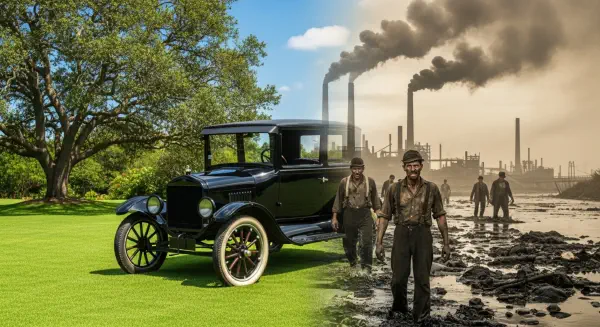
The line’s efficiency depended on externalizing costs—to workers’ bodies, communities’ environments, and future generations’ atmosphere. These displaced costs now demand repayment through worker compensation, environmental remediation, and climate mitigation.
Ford’s system contained fundamental contradictions: standardization enabled efficiency but prevented adaptation to consumer variety; high wages stabilized workforce but intensified exploitation; equal pay coexisted with systematic racial job segregation.
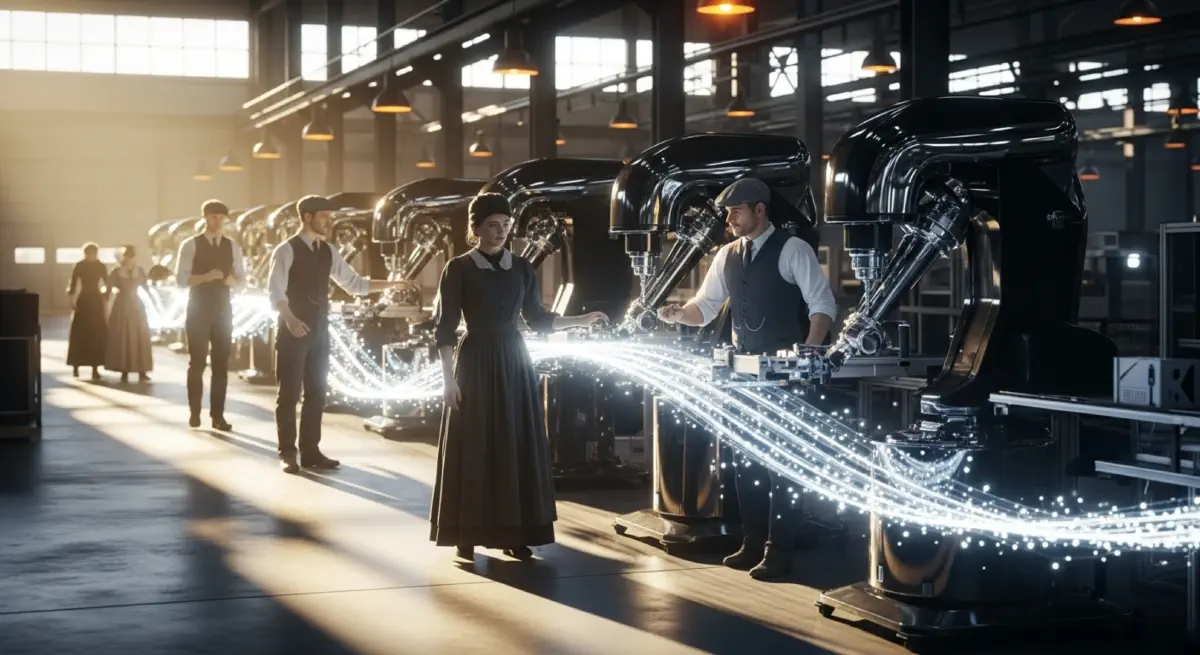
The line’s logic proved more durable than its physical form, propagating through lean manufacturing, just-in-time production, and digital twins. Each technological generation preserved Ford’s flow principle while adapting to new constraints.
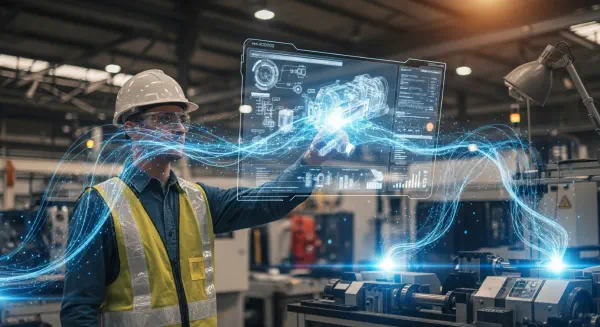
Digital manufacturing reproduces Ford’s original blind spots—optimizing within boundaries that exclude most human and environmental costs. Sustainability requires expanding optimization’s boundaries, not merely refining optimization’s techniques.
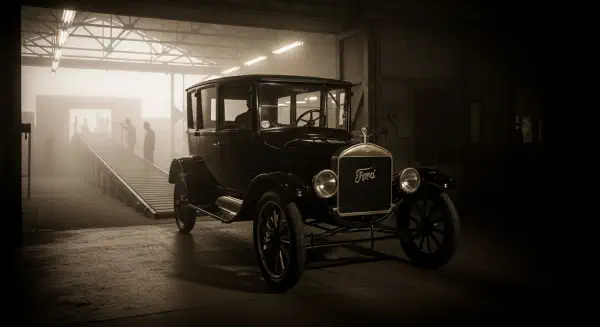
The ghost of Highland Park haunts every modern factory, carrying both the productivity and the pathologies that Ford’s team encoded into industrial production. Understanding this inheritance is essential for designing manufacturing systems that serve human needs without destroying human futures.
References#
Brayshay, M. (2009). Capitalism and division of labor. International Encyclopedia of Human Geography. https://doi.org/10.1016/B978-008044910-4.00355-2
Williams, K., Haslam, C., & Williams, J. (1992). Ford versus ‘fordism’: The beginning of mass production? Work, Employment & Society, 6(4). https://doi.org/10.1177/095001709264001
Raff, D. M. G. (1988). Wage determination theory and the five-dollar day at Ford. The Journal of Economic History, 48(2). https://doi.org/10.1017/S0022050700004988
Eli, S., Hausman, J. K., & Rhode, P. W. (2025). The Model T. Journal of Economic History. https://doi.org/10.1017/S0022050725000014
Nieuwenhuis, P., & Katsifou, E. (2015). More sustainable automotive production through understanding decoupling points in leagile manufacturing. Journal of Cleaner Production, 95. https://doi.org/10.1016/j.jclepro.2015.02.084
Benrós, D., & Duarte, J. P. (2009). An integrated system for providing mass customized housing. Automation in Construction, 18(3). https://doi.org/10.1016/j.autcon.2008.09.006
Napper, R. (2014). Modular route bus design. Transportation Research Part C: Emerging Technologies, 48. https://doi.org/10.1016/j.trc.2013.11.002
Nieuwenhuis, P., & Wells, P. (2003). Introduction. The Automotive Industry and the Environment. https://doi.org/10.1016/B978-1-85573-713-6.50004-4
Alizon, F., Shooter, S. B., & Simpson, T. W. (2009). Henry Ford and the Model T: Lessons for product platforming and mass customization. Design Studies, 30(5). https://doi.org/10.1016/j.destud.2009.03.003
Paxton, J. (2009). Engineering, management and economics. International Journal of Continuing Engineering Education and Life-Long Learning, 19(2-3). https://doi.org/10.1504/IJCEELL.2009.023060
Channell, D. F. (2019). New methods of production. History of Mechanism and Machine Science, 37. https://doi.org/10.1007/978-3-319-95606-0_10
Manji, J. F. (1988). Ergonomics in automotive assembly. Automation, 35(7).
Graham, R. B., Sadler, E. M., & Stevenson, J. M. (2011). Automotive assembly and low back pain. Automotive Industry: Technical Challenges, Design Issues and Global Economic Crisis.
Tseng, M. M., Wang, Y., & Jiao, R. J. (2019). Mass customization. CIRP Encyclopedia of Production Engineering. https://doi.org/10.1007/978-3-662-53120-4_16757
Bortolini, M., Galizia, F. G., Naldi, L. D., & Regattieri, A. (2024). Managing mass customization through delayed product differentiation. Procedia CIRP, 128. https://doi.org/10.1016/j.procir.2024.10.235
Weber, A. (2013). The moving assembly line turns 100. Assembly, 56(5).
Alizon, F., Shooter, S. B., & Simpson, T. W. (2009). Henry Ford and the Model T. Design Studies, 30(5). https://doi.org/10.1016/j.destud.2009.03.003
Lanning, J. A., & Reynolds, C. L. (2022). The impact of Ford Motor Company’s voluntary equal wage policy on Detroit’s wage gap in the 1940s. Journal of Labor Economics, 40(S1). https://doi.org/10.1086/715118
Mullin, J. R. (1982). Henry Ford and field and factory. Journal of the American Planning Association, 48(4). https://doi.org/10.1080/01944368208976814
Varrier-Jones, P. (1935). Papworth Village Settlement. Diseases of the Chest, 1(5). https://doi.org/10.1378/chest.1.5.8
Maloney, T. N., & Whatley, W. C. (1995). Making the effort: The contours of racial discrimination in Detroit’s labor markets, 1920–1940. The Journal of Economic History, 55(3). https://doi.org/10.1017/S0022050700041607
Foote, C. L., Whatley, W. C., & Wright, G. (2003). Arbitraging a discriminatory labor market. Journal of Labor Economics, 21(3). https://doi.org/10.1086/374957
Cazort, M. J. A. (2008). Automotive industry: It’s time to roll. Automotive Industries AI, 188(3).
Joo, J. (2007). The impact of the automobile and its culture in the U.S. International Area Studies Review, 10(1). https://doi.org/10.1177/223386590701000103
Holweg, M. (2007). The genealogy of lean production. Journal of Operations Management, 25(2). https://doi.org/10.1016/j.jom.2006.04.001
Candelo, E. (2019). Back from the brink: Europe’s surprisingly strong recovery. International Series in Advanced Management Studies. https://doi.org/10.1007/978-3-030-15999-3_5
Condel, J. L., Sharbaugh, D. T., & Raab, S. S. (2004). Error-free pathology. Clinics in Laboratory Medicine, 24(4). https://doi.org/10.1016/j.cll.2004.07.001
Schneider, W. F. (1994). Implementation strategies for the Ford waste minimization program. SAE Technical Papers. https://doi.org/10.4271/940543
Schmidt, W.-P. (2000). Experiences of implementing design for recycling. VDI Berichte, 1543.
Bello, K. A., & Maladzhi, R. W. (2025). Innovative and best practices in sustainable strategies for waste reduction in additive manufacturing. Hybrid Advances, 9. https://doi.org/10.1016/j.hybadv.2025.100527
MacLean, H. L., & Lave, L. B. (1998). A life-cycle model of an automobile. Environmental Science and Technology, 32(13). https://doi.org/10.1021/es970972i
Paton, B. (2001). Efficiency gains within firms under voluntary environmental initiatives. Journal of Cleaner Production, 9(2). https://doi.org/10.1016/S0959-6526(00)00068-8
Liu, P., Miao, Y., Jiao, L., et al. (2025). A dynamic assembly and fusion approach for digital twin logic models based on Petri nets. Results in Engineering, 25. https://doi.org/10.1016/j.rineng.2025.105527
Biswas, P., Kim, T. M., & Kim, W. S. (2026). Integration of digital twins and physical AI in cyber-physical systems. Intelligent Systems with Applications, 20. https://doi.org/10.1016/j.iswa.2026.200649
Fathi, M., Sepehri, A., Ghobakhloo, M., et al. (2024). Balancing assembly lines with industrial and collaborative robots. Computers and Industrial Engineering, 195. https://doi.org/10.1016/j.cie.2024.110254
Ding, P., Liu, S. Q., Chen, D., & He, Y. (2025). A novel real-world human-robot collaboration scheduling problem. Transportation Research Part E: Logistics and Transportation Review, 195. https://doi.org/10.1016/j.tre.2025.104299
Carlaw, K. I., & Lipsey, R. G. (2002). Externalities, technological complementarities and sustained economic growth. Research Policy, 31(8-9). https://doi.org/10.1016/S0048-7333(02)00065-3
Johnson, A. (2014). Design approach, philosophy, and normal approach design model. Sustainability in Engineering Design. https://doi.org/10.1016/B978-0-08-099369-0.00002-9
England, L. A., & Miller, S. D. (2016). The history and evolution of business process management. Maximizing Electronic Resources Management in Libraries. https://doi.org/10.1016/B978-1-84334-747-7.00004-2
Sternberg, R. J., Pretz, J. E., & Kaufman, J. C. (2003). Types of innovations. The International Handbook on Innovation. https://doi.org/10.1016/B978-008044198-6/50011-5
Zafar, M. H., Langas, E. F., & Sanfilippo, F. (2024). Exploring the synergies between collaborative robotics, digital twins, augmentation, and industry 5.0 for smart manufacturing. Robotics and Computer-Integrated Manufacturing, 89. https://doi.org/10.1016/j.rcim.2024.102769
Zhang, L. (2023). Introduction to customized manufacturing. Customized Production Through 3D Printing in Cloud Manufacturing. https://doi.org/10.1016/B978-0-12-823501-0.00007-9
Hudson, R. (2020). Fordism. International Encyclopedia of Human Geography (2nd ed.). https://doi.org/10.1016/B978-0-08-102295-5.10068-X
Hudson, R. (2009). Fordism. International Encyclopedia of Human Geography. https://doi.org/10.1016/B978-008044910-4.00166-8
Ilhami, Y., & MacEachern, C. (2018). Historical aspects of energy. Comprehensive Energy Systems, 1. https://doi.org/10.1016/B978-0-12-809597-3.00102-4
Nye, D. E. (2004). Electricity use, history of. Encyclopedia of Energy, 2. https://doi.org/10.1016/B0-12-176480-X/00047-4
Brayshay, M. (2020). Capitalism and the division of labor. International Encyclopedia of Human Geography (2nd ed.). https://doi.org/10.1016/B978-0-08-102295-5.10453-6
Lexa, F. J. (2017). Motivation and leadership. Leadership Lessons for Health Care Providers. https://doi.org/10.1016/B978-0-12-801866-8.00027-5
Sanidas, E. (2006). The open system of four dynamic bio-socio-economic processes of the firm. Journal of Socio-Economics, 35(1). https://doi.org/10.1016/j.socec.2005.11.017
Routley, M., Phaal, R., & Probert, D. (2013). Exploring industry dynamics and interactions. Technological Forecasting and Social Change, 80(6). https://doi.org/10.1016/j.techfore.2012.04.015
Dassbach, C. H. A. (1991). The origins of Fordism: The introduction of mass production and the five-dollar wage. Critical Sociology, 18(1). https://doi.org/10.1177/089692059101800105
Mao, Z., Sun, Y., Fang, K., et al. (2024). Model and metaheuristic for human-robot collaboration assembly line worker assignment and balancing problem. Computers and Operations Research, 167. https://doi.org/10.1016/j.cor.2024.106605
Weckenborg, C., Thies, C., & Spengler, T. S. (2022). Harmonizing ergonomics and economics of assembly lines using collaborative robots and exoskeletons. Journal of Manufacturing Systems, 62. https://doi.org/10.1016/j.jmsy.2022.02.005
van Hoek, R. (2022). Lessons from CSCMP Supply Chain Hall of Famer Henry Ford and the research that they call for in modern supply chains. International Journal of Physical Distribution and Logistics Management, 52(1). https://doi.org/10.1108/IJPDLM-10-2020-0315
Buesa, R. J. (2009). Adapting lean to histology laboratories. Annals of Diagnostic Pathology, 13(5). https://doi.org/10.1016/j.anndiagpath.2009.06.005
Geels, F. W. (2006). Major system change through stepwise reconfiguration. Technology in Society, 28(4). https://doi.org/10.1016/j.techsoc.2006.09.006
Buesa, R. J. (2009). Adapting lean to histology laboratories. Annals of Diagnostic Pathology, 13(5). https://doi.org/10.1016/j.anndiagpath.2009.06.005
Hazarika, M., Dixit, U. S., & Davim, J. P. (2018). History of production and industrial engineering through contributions of stalwarts. Manufacturing Engineering Education. https://doi.org/10.1016/B978-0-08-101247-5.00001-0
Atack, J., Margo, R. A., & Rhode, P. W. (2024). De-skilling: Evidence from late nineteenth century American manufacturing. Explorations in Economic History, 92. https://doi.org/10.1016/j.eeh.2023.101554
You, J., Xu, X., Liao, D., & Lin, C. (2024). International comparison of the impact of digital transformation on employment. Journal of Asian Economics, 94. https://doi.org/10.1016/j.asieco.2024.101820
Belloc, F., Burdín, G., Cattani, L., et al. (2022). Coevolution of job automation risk and workplace governance. Research Policy, 51(3). https://doi.org/10.1016/j.respol.2021.104441
Nilsson, K. H., Matilla-Santander, N., Lee, M. K., et al. (2025). Algorithmic management and occupational health. Safety Science, 176. https://doi.org/10.1016/j.ssci.2025.106863