
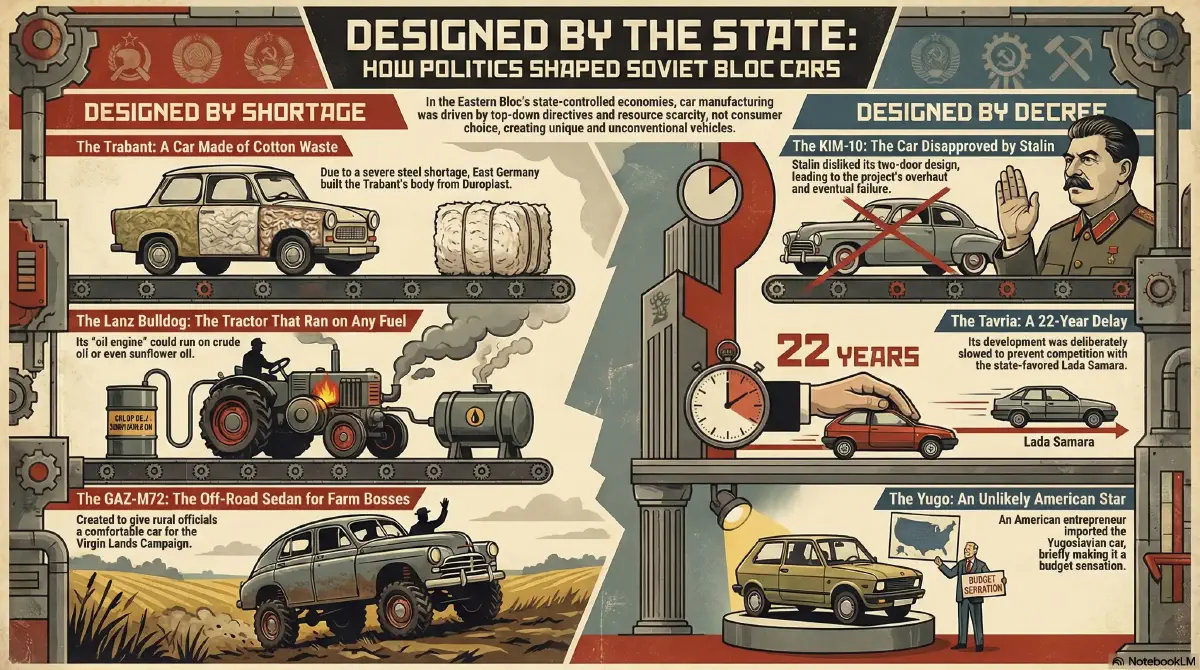
The Iron Horse: Innovation and Stagnation in the Soviet Automotive Empire
Key Insights#
- The Soviet automotive industry mastered adaptive localization, transforming Western designs into durable, state-aligned vehicles optimized for scarcity and harsh conditions.
- In off-road and specialized vehicles, Soviet engineering achieved global supremacy through functional supremacy, prioritizing terrain conquest over consumer appeal.
- The system’s collapse stemmed from structural obsolescence, unable to transition from planned production to market-driven innovation and consumer demands.
References#
- Siegelbaum, L. H. (2008). Cars for Comrades: The Life of the Soviet Automobile. Cornell University Press.
- Sanders, J. (2018). East German Cars of the 1980s: Trabant, Wartburg and the Eastern Bloc. Shire Publications.
- Lewis, M. W. (2021). The Soviet Automotive Industry: A Historical Analysis of Technology Transfer and Industrial Policy. Journal of Transport History, 42(1), 124-147.
- Zeller, T. (2009). Driving Germany: The Landscape of the German Autobahn, 1930-1970. Berghahn Books.
- Penter, T., & Wenzel, S. (2020). The Trabant: Consumption, Everyday Life and the Crisis of State Socialism. Journal of Contemporary History, 55(3), 592-614.
- Katsenelinboigen, A. (1978). Soviet Economic Planning and the Automotive Industry. In The Soviet Economy in a Time of Change (Vol. 2, pp. 558-579). U.S. Government Printing Office.
- Dyker, D. A. (1983). The Process of Investment in the Soviet Union. Cambridge University Press.