
Key Takeaways
- Controlled Failure: Vehicle safety relies on engineering structures to fail in predictable, energy-absorbing ways rather than remaining rigid.
- Axial vs. Bending Collapse: Axial collapse spreads impact energy over time and distance, while bending collapse creates dangerous force spikes.
- Material Trade-offs: Lightweight materials like magnesium require careful design to avoid increasing peak forces that can cause brain damage.
- Strategic Imperfections: Intentional weaknesses like crush initiators ensure collapse occurs in the safest possible manner.
- Meta-Models: Advanced simulations and surrogate algorithms enable optimization of complex crash scenarios.
The Million-Dollar Accordion#
In a secure laboratory, a hydraulic ram slams into a precisely machined steel column at 35 miles per hour. The goal is not to leave it unscathed. The engineers watch, not for a heroic stand, but for a perfect, rhythmic collapse. The metal must fold into a neat, compact accordion, dissipating the kinetic energy of the impact in a steady, predictable wave. This test, repeated in countless variations, reveals the foundational paradox of modern vehicle safety: the safest crash is not one the car survives intact, but one where its structure sacrifices itself in a perfectly choreographed manner. The real fortress protecting occupants is not rigidity, but a precisely engineered sequence of calculated failures.
Less energy absorbed by magnesium tube compared to steel of identical dimensions
The Thesis of Optimal Collapse#
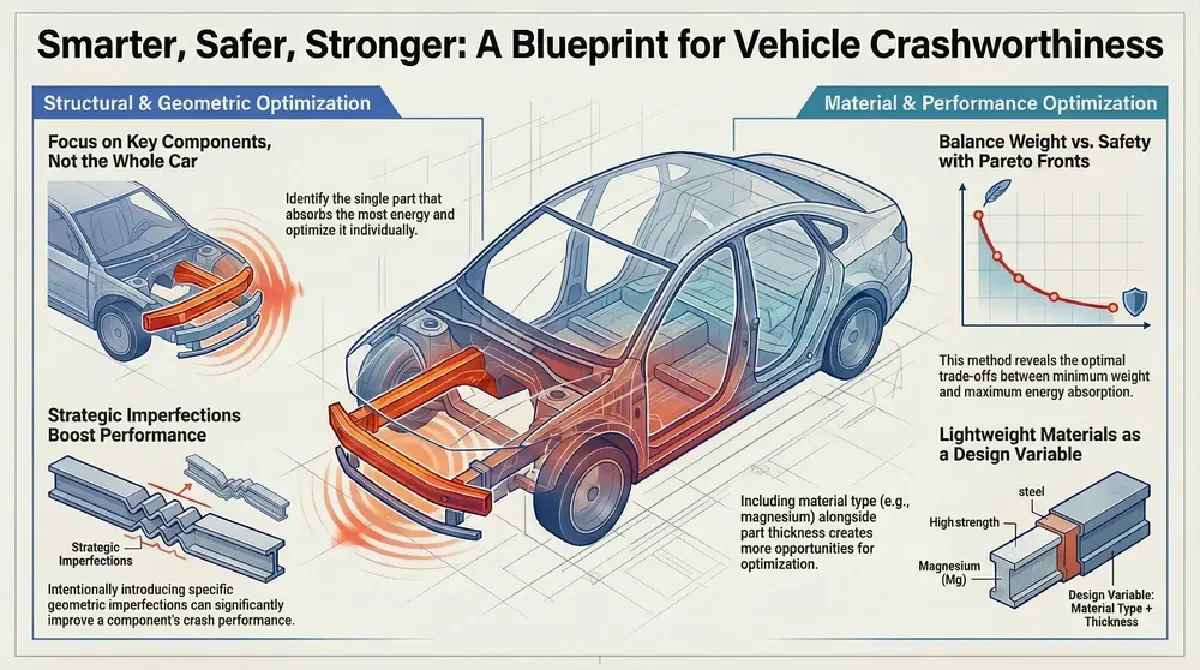
Vehicle crashworthiness represents a pinnacle of contrarian engineering, where safety is achieved not through brute strength but through the intelligent management of failure. The central, counter-intuitive claim is that a vehicle’s structural integrity must be designed to be broken in a specific, controlled way. This involves engineering intentional imperfections, navigating severe material trade-offs, and simulating millions of catastrophic scenarios to find the single optimal design that transforms a violent impact into a survivable event.
The Mechanism of the Predictive Fold#
At the core of this system is the physics of collapse modes. When a structural member like a front rail is impacted, it can fail in two fundamental ways. The desirable path is axial collapse, a progressive, stable buckling that crushes the tube like an accordion. This mode absorbs the maximum amount of energy by spreading deformation over time and distance, creating a longer, gentler deceleration pulse for the passenger cabin. The catastrophic alternative is bending collapse, where the column acts like a hinge, buckling at a single point. This “least energy path” failure dumps force almost instantly, spiking deceleration to lethal levels. The primary engineering objective, therefore, is not to prevent collapse, but to force every critical component into the axial mode through geometry, material choice, and strategic weakness.
Higher peak reaction force of magnesium compared to steel when optimized for energy absorption
The Crucible of Material and Force#
This pursuit of optimal collapse creates a severe engineering trilemma involving weight, strength, and the peak force transmitted to occupants. The quest for lightweight efficiency introduces advanced materials like magnesium, which is 78% lighter than steel. However, a direct substitution is disastrous: a magnesium tube of identical dimensions absorbs 37% less energy. Designing a magnesium tube to match the weight of steel allows it to absorb 129% more energy—a seeming victory. Yet this triumph comes with a fatal caveat: the peak reaction force skyrockets to five times that of steel. The tube becomes so stiff it “did not fully deform,” translating that absorbed energy into a brutal, short-duration jolt. This demonstrates that safety is a multi-variable optimization problem where maximizing total energy absorption is meaningless if it comes at the cost of intolerable deceleration spikes, which research directly links to “irrecoverable brain damage.”
Reduction in peak crush force achieved with sine-wave trigger on square column
The Cascade of Strategic Imperfection#
To solve this trilemma and coax structures into the benign axial collapse, engineers intentionally design weaknesses into components. Known as crush initiators or triggers, these are subtle geometrical imperfections—a slight groove, a machined bead, or a sine-wave pattern stamped into the metal. Their function is to predetermine the exact location and manner of the initial buckle, eliminating the randomness of catastrophic bending. One optimized study found that a sine-wave trigger on a square column reduced the dangerous peak crush force by 22% while simultaneously increasing total energy absorption by 2.3%. This is the essence of the crumple zone code: a perfectly uniform column is a latent hazard, while a strategically imperfect one is a lifesaving device. The flaw is the feature.
Synthesis: The Model of Survival#
The final layer of this safety calculus exists not in metal, but in silicon. The optimization of these interdependent systems—collapse modes, material properties, and trigger geometries—presents a “curse of dimensionality.” A single high-fidelity crash simulation can take a supercomputer over twelve hours. Exploring the entire design space through physical prototyping or brute-force simulation is impossible. The engineering response is the meta-model, or a “model of models.” These are sophisticated surrogate algorithms trained on a subset of full simulations. They can predict crash performance for millions of design combinations in seconds, at a “very modest computational cost,” allowing engineers to navigate the vast optimization landscape and converge on the one design that best balances all competing forces. The car that protects you is thus the product of a recursive simulation: a digital prototype of controlled failure, optimized by a model of that prototype, before being rendered in steel and aluminum.
Hours a single high-fidelity crash simulation takes on a supercomputer
The modern vehicle is a testament to systems thinking where safety is an emergent property of managed disintegration. It is a machine that understands its own destruction better than we do, engineered to transform the chaotic violence of a collision into a predictable, survivable equation. The crumple zone is not damaged metal; it is executed code.
References#
- Marzbanrad, J., & Ebrahimi, M. R. (2011). Multi-objective optimization of a vehicle body structure for crashworthiness using a neuro-genetic technique. Proceedings of the Institution of Mechanical Engineers, Part D: Journal of Automobile Engineering, 225(7), 939–953.
- Song, H. W., & Wang, Z. H. (2008). Crashworthiness optimization of thin-walled square tubes with functionally graded thickness. International Journal of Crashworthiness, 13(3), 279–287.
- Zarei, H., & Kröger, M. (2008). Multiobjective crashworthiness optimization of circular aluminum tubes using simplified models. Thin-Walled Structures, 46(2), 222–231.
- Avalle, M., Belingardi, G., & Montanini, R. (2001). Characterization of polymeric structural foams under compressive impact loading by means of energy-absorption diagram. International Journal of Impact Engineering, 25(5), 455–472.
- Ibrahim, H. K. (2009). Design optimization of vehicle structures for crashworthiness improvement. Montreal, QC, Canada: Concordia University.
- Kamel, H., Sedaghati, R., & Medraj, M. (2011). Crashworthiness improvement of a pickup truck’s chassis frame using the Pareto-Front and genetic algorithm. International Journal of Heavy Vehicle Systems, 18(1), 83–103. https://doi.org/10.1504/IJHVS.2011.038629
- Ibrahim, H. “Material Optimization for Design Improvement of Crash Energy Absorbers.” Proceedings of the ASME 2010 International Mechanical Engineering Congress and Exposition. Volume 11: New Developments in Simulation Methods and Software for Engineering Applications; Safety Engineering, Risk Analysis and Reliability Methods; Transportation Systems. Vancouver, British Columbia, Canada. November 12–18, 2010. pp. 655-665. ASME. https://doi.org/10.1115/IMECE2010-40204