
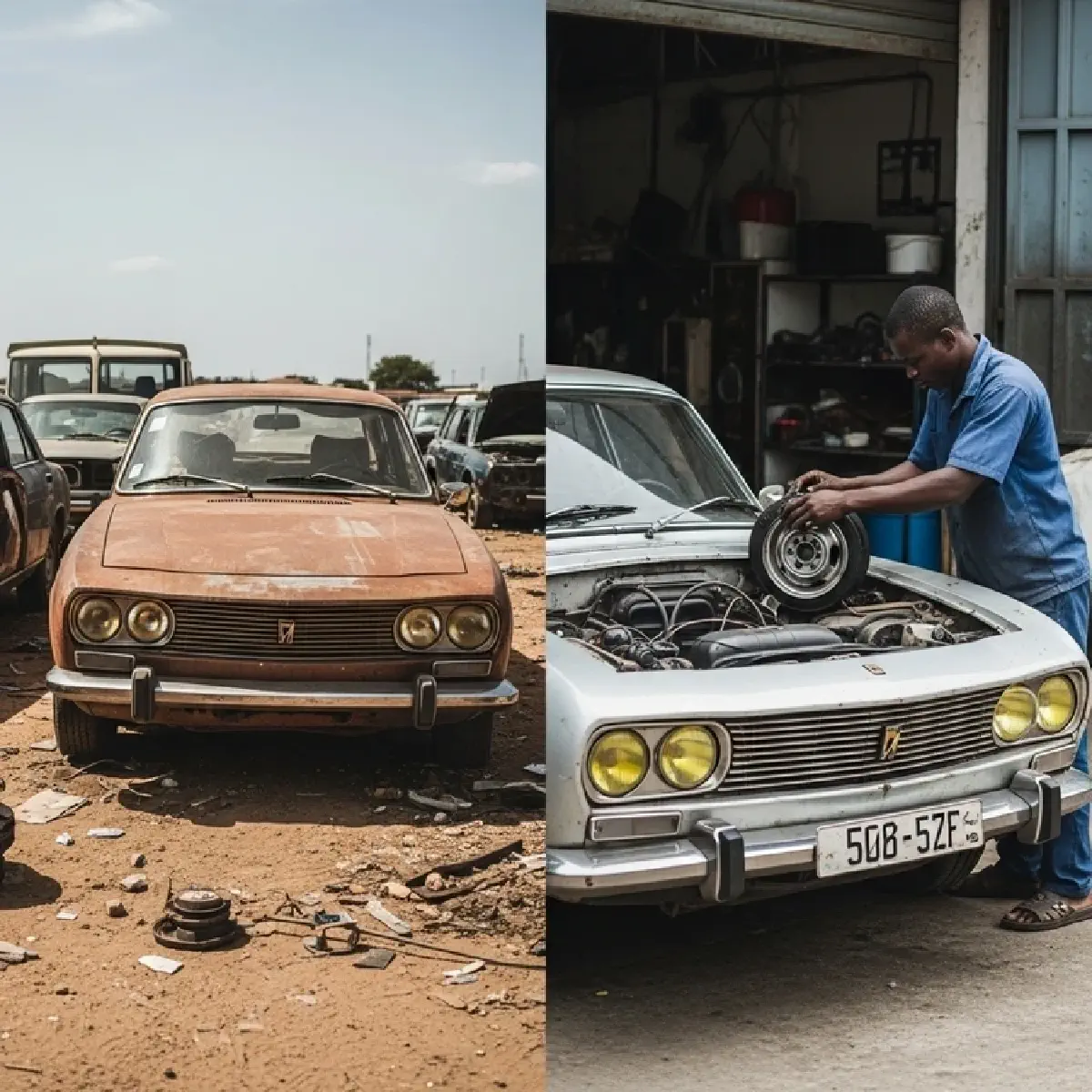
The End of Production and the Beginning of Legend#
Official production of the Peugeot 504 sedan ended in France in 1983, but its story was just beginning its second act in Africa. CKD assembly continued in Nigeria and Kenya into the 2000s, with the last new 504s rolling off the line in Nigeria around 2006—nearly 40 years after its debut. This staggering production run was a testament not to stubbornness, but to unabated demand. There was simply nothing that could replace it on its own terms. Newer cars were more complex, more fragile, and more dependent on proprietary diagnostics and parts. The 504 had become institutionally irreplaceable.
This longevity created a new phenomenon: the 504 as a temporal capsule. A 504 on the road in 2010 was not just a car; it was a rolling archive of African economic history. Its condition told a story—of the owner’s resourcefulness, the skill of local mechanics, the ebbs and flows of the spare parts market. The car itself became a site of memory and continuity in rapidly changing urban landscapes. Its eventual disappearance from the roads would not be due to mechanical failure, but to the physical exhaustion of the donor parts ecosystem or regulatory pressure against older vehicles.
The period spanning the end of European production to the final assembly in Africa
The Successor That Couldn’t Succeed: The 505 and the Broken Formula#
Peugeot attempted a successor with the 505, launched in 1979. It was, by most measures, a better car: more modern styling, improved comfort, and more powerful engines. Yet, it never achieved the 504’s iconic status. The 505 was more complex. It used more electronics, had a more sophisticated (and less robust) rear suspension, and was generally harder for roadside repair. It was a car designed for a more developed, more formalized market. It succeeded the 504 in European showrooms, but it could not replace it in the African ecosystem.
The 504’s dominance highlighted a critical, often ignored principle of product design: maximum success in a harsh environment often comes from a design that is one technological step behind the cutting edge of its home market. The 504 was that step behind at its launch, which became its greatest strength. The 505 was contemporary, which became its weakness. The failed succession proved that the 504’s reign was not a fluke, but the result of a perfect, non-replicable alignment of a product’s inherent characteristics with a continent’s systemic realities.
The 505 failed to achieve the 504’s iconic status despite being technically superior for developed markets
The Legacy: Infrastructure, Not Automobile#
Today, the Peugeot 504’s legacy is clear. It was the last and greatest of the “Africanized” European saloons—cars that could be fully absorbed, understood, and maintained by the informal economies and practical genius of the continent. It demonstrated that the ultimate form of automotive sustainability is socio-mechanical integration.
Its story offers a final, poignant lesson for a globalizing world. In an age where manufacturers sell identical, software-laden vehicles from Berlin to Bangkok, the 504 stands as a monument to the power of local adaptation and systemic resilience. It was not a global car imposed on a local market; it was a local institution that grew from a global platform. It became king not by conquest, but by faithful, indispensable service. The true measure of its iconicity is that long after the last one stops running, the phrase “504 mechanic” will still be understood, and the memory of its upright, indomitable shape will evoke an era of mobile, mechanical optimism in the complex story of modern Africa.
The 504’s legacy as a monument to local adaptation and systemic resilience