The Workshop at the End of the Export Chain#
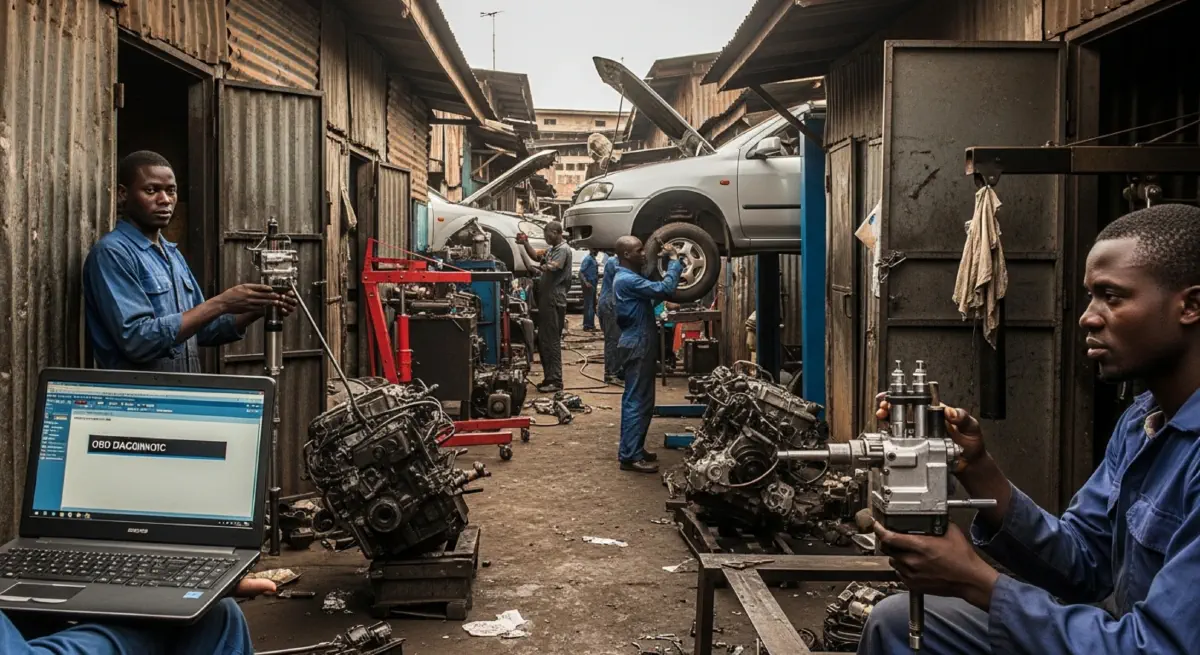
Suame Magazine is not a magazine. The name is a relic of colonial administrative classification for what is, functionally, the world's most concentrated informal automotive repair ecosystem. Located in Kumasi, Ghana, it covers approximately 1.2 square kilometres and employs an estimated 80,000 artisans in some 12,000 small workshops — fabricators, mechanics, welders, body repair specialists, engine rebuilders, and parts dealers working across a total annual turnover estimated by Ghanaian government surveys at approximately $600 million. Suame Magazine has been operating for more than a century. Its workforce is multi-generational; skills are transmitted through apprenticeship systems operating in parallel with and occasionally in dialogue with Ghana's formal technical and vocational training institutions. The UNEP and UNCTAD have independently identified it as the most sophisticated informal automotive repair cluster in sub-Saharan Africa.
What Suame Magazine repairs is determined by what the export chains deliver. Through the 1990s and into the 2000s, the dominant vehicle types arriving in Kumasi were mechanically governed diesel engines — Toyota Hilux pickup trucks with 2L or 3L diesel engines, Nissan pickups, Land Rovers, and various Japanese-market minivans. These powertrains are serviceable with precision hand tools, a compression tester, and mechanical knowledge that can be transmitted through demonstration. An apprentice in Suame can learn to rebuild a 2L diesel engine to working specification within two to three years. The engine's failure modes are observable, its components are replaceable with parts sourced from the same trade streams that deliver the vehicles, and its repair does not require diagnostic software, proprietary interfaces, or a laptop with a valid software licence.
The vehicles arriving now are different. The 2015–2022 European export surge that followed Dieselgate delivered primarily Euro 5 and Euro 6 diesel vehicles with Engine Control Units managing every combustion parameter. The ECU is not a serviceable component using workshop tools. It is both the vehicle's brain and its lock.
The Designed-In Repairability Gap#
The ECU as a Maintenance Barrier#
Engine Control Units in post-2005 vehicles manage ignition timing, fuel injection quantity and timing, exhaust gas recirculation, turbocharger boost control, NOₓ aftertreatment, and in modern Euro 6 systems, multiple emission control systems in simultaneous coordination. They are calibrated to the specific injector specifications, sensor readings, and mechanical tolerances of the factory-assembled powertrain. When a component drifts — an injector nozzle wearing, a sensor producing degraded readings, a timing chain stretching — the ECU either compensates electronically or generates a diagnostic fault code and enters limp mode.
Accessing those fault codes requires an OBD-II diagnostic interface connected to software that can interpret the manufacturer-specific fault code library. There are generic OBD-II readers that cover standardised codes — approximately 40% of the fault code space. The remaining 60% consists of manufacturer-specific codes that require licensed software: Bosch's ESI[tronic], VCDS for Volkswagen Group vehicles, Launch CRP diagnostic platforms with subscription-based code libraries. Each of these requires an ongoing software licence, costs $300–$3,000 for the hardware, and requires periodic updates that assume reliable internet access and credit card or digital payment infrastructure.
Suame Magazine's capacity to service ECU-governed vehicles is growing but remains structurally constrained. International surveys conducted by Practical Action between 2018 and 2022 found that approximately 15–22% of Suame workshops had invested in OBD diagnostic tools — mostly generic readers, not manufacturer-licensed platforms. The workshops that had invested in this equipment reported that it covered approximately 40–55% of the fault codes they encountered on European export vehicles. The remaining 45–60% required either workaround repairs — replacing components speculatively without confirmed diagnosis — or referral to dealer-affiliated service networks, of which there are seven in greater Kumasi for the 80,000-worker repair cluster.
The result is a structured performance gap. A vehicle arriving in Kumasi with a mechanical failure — worn brake pads, a cracked injection line, a leaking head gasket — will be repaired to workable standard by a Suame mechanic. A vehicle arriving with an ECU fault — a malfunctioning diesel particulate filter, a stuck EGR valve generating a fault code that triggers limp mode, a failing NOₓ sensor — will either sit undrivable until an authorised diagnostic interface confirms the fault, or have the emissions control component physically bypassed by removal. Removal of a DPF, an EGR valve, or a NOₓ sensor solves the immediate drivability problem and eliminates the emissions system the European buyer believed was operational.
Knowledge Erasure as a Lifecycle Cost#
The shift from mechanically governed to electronically governed vehicles is accelerating knowledge obsolescence rather than generating knowledge transfer. An apprenticeship system that transmitted diesel mechanical expertise across three generations at Suame over 50 years cannot pivot to ECU diagnostics through informal transmission, because ECU diagnostic competence requires hardware and software infrastructure that the apprenticeship model cannot replicate without institutional investment.
UNCTAD's 2021 Technology and Innovation Report quantified this dynamic globally: the technology intensity of imported vehicles is increasing, while the local capacity to service those vehicles is not keeping pace. The Report's automotive case studies showed that a 10-year-old European vehicle exported in 2012 required approximately 45–55 man-hours of total lifetime maintenance that could be performed by informal sector mechanics with existing tools. A comparable 10-year-old European vehicle exported in 2022 requires approximately the same total maintenance hours, but approximately 30–40% of those hours now require diagnostic software access.
The consequence is a structured increase in vehicle abandonment rates. A UNEP survey of vehicle fleets in five West African capitals found average vehicle abandonment rates — vehicles that became inoperative and were not repaired — of approximately 12–18% within the first five years of operation for vehicles arriving in the 2016–2020 cohort, compared with approximately 6–9% for vehicles arriving in the 2005–2010 cohort. The newer, more regulated vehicles are failing at higher rates when exported, not because they were mechanically inferior but because the maintenance infrastructure they require does not exist at the destination.
The SDR Correction for Shortened Destination Service Life#
The SDR calculation in Post 1 estimated remaining destination-market service life at 7–12 years for exported vehicles. That estimate was derived from UNEP fleet survival data that predates the current wave of ECU-governed exports. If the abandonment rate for ECU-governed vehicles is approximately double that of their mechanical predecessors, the expected remaining service life shortens — and with it, the SDR numerator also shrinks.
This appears, at first glance, to be good news: a shorter export service life reduces the SDR displacement. It is not good news in any dimensional measure that matters. A vehicle abandoned within 2 years of export has provided approximately 2 years of mobility rather than 8. Its value to the buyer who purchased it — and who borrowed to do so, in many documented cases — was not delivered. Its stranded debt is real. Its abandonment generates a hulk that the informal parts economy will strip, and the remaining structure will join the unregulated end-of-life stream. The environmental gain from the short SDR is not a gain; it is the conversion of a emissions-displacement problem into a premature abandonment and informal disposal problem.
The Double Failure: SDR Above 1 and Shortened Service Life#
An exported vehicle that fails early produces a compound bad outcome: it displaces the domestic scrappage saving without delivering the mobility years the destination purchaser expected, and it generates an informal disposal event rather than a managed end-of-life stream. This double failure is the worst case within the SDR framework — and it is the case that ECU lock-in makes more likely for the post-2015 export cohort.
The policy implication for the originating market is direct: scrappage programmes that target vehicles by age or engine standard, without distinguishing between vehicles that have received the repairability infrastructure their export destination requires and vehicles that have not, are exporting not just emissions displacement but service-life collapse. A Euro 6 diesel exported to a market with no authorised service network is a worse SDR outcome than a Euro 4 diesel exported to a market with established informal mechanical capacity. The emissions standard of the originating country certification is not a proxy for the destination-market utility of the vehicle. Designing scrappage programmes as if it were is the category error this post documents.
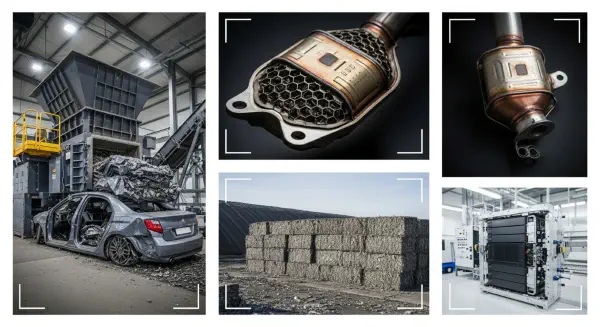
The next post examines the endpoint of the export chain that does function as designed: the formal shredder economy, where the catalytic converters, the structural steel, and the shredder residue produce a set of material recovery incentives whose structure explains both the theft economy that follows precious metals and the waste disposal crisis that follows the residue.