A Container Ship in the Port of Tema#
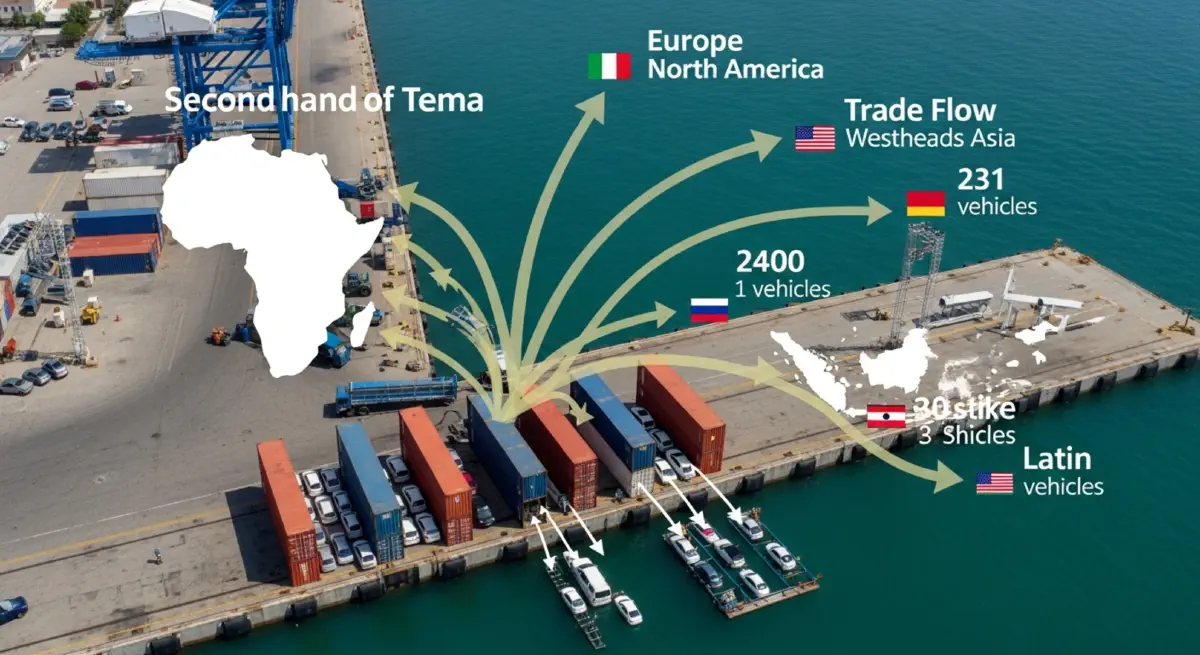
In the port of Tema, Ghana, a container ship offloads vehicles. Not new vehicles — these are second-hand, shipped from Europe, Japan, and North America through a network of dealers, wholesalers, and export brokers operating in a market that moves approximately 14 million used vehicles across international borders every five years. Ghana is one of the major receiving markets, alongside Nigeria, Côte d'Ivoire, and Senegal. The vehicles arriving in Tema carry documentation of previous registration in Germany, the Netherlands, Belgium, and Japan. They arrive because they were removed from those markets — through private resale, fleet replacement, or government scrappage programmes — and because the arbitrage between the residual value in the originating market and the purchase price accessible in the receiving market creates a profitable trade.
In 2020, the United Nations Environment Programme published the most comprehensive audit of this trade ever compiled. Commissioned under the Clean Vehicles Programme, the report documented 14 million used light-duty vehicles exported from high-income countries to low- and middle-income countries between 2015 and 2020. It found that 40 per cent of the exported vehicles would fail to meet safety or emissions standards of the destination country if those standards were systematically enforced. It found that most destination countries had either no age restriction, no emissions standard, or no testing infrastructure that could enforce such standards at the border. And it found that the environmental and safety reporting frameworks of the exporting countries — the Euro emissions standards, the US CAFE system, the Japanese shaken vehicle inspection — had no mechanism for tracking whether the vehicles removed from their domestic fleets were destroyed or exported.
The UNEP report identified the global south-bound used vehicle flow as one of the most significant undercounted sources of transport-sector emissions in the world. International climate accounting did not count it. It still does not.
The Displacement That Carbon Accounting Misses#
The Scrappage Displacement Ratio, introduced in Part 1 of this series, measures the ratio of remaining emissions generated by exported vehicles in destination markets against the domestic emissions saved by removing them from originating markets:
$$SDR = \frac{\text{Remaining lifetime emissions of exported vehicle class in destination market}}{\text{Domestic emissions avoided by scrapping}}$$In a global emissions accounting framework, the numerator of the SDR — the exported vehicle's ongoing emissions — is assigned to the destination country's transport sector rather than to the originating country's climate responsibility. This is the Scrappage Displacement Ratio's most important institutional implication: the vehicles removed from European or North American fleets generate domestic reporting gains, while the emissions they continue to produce in Accra, Lagos, or Manila are counted in the transport sector carbon inventories of Ghana, Nigeria, or the Philippines. The accounting boundary of the vehicle exactly matches the political boundary of the regulatory system. The emissions do not disappear. They disappear from the ledger of the country that removed them.
Reading the Export Vectors#
Europe to West Africa: The Diesel Legacy#
The European export vector is structurally distinct from its American and Japanese counterparts. European exports are disproportionately diesel-powered: the combined effect of the Dieselgate revelations (2015), subsequent low emission zones across major European cities (Berlin, Paris, London, Brussels), and diesel scrappage incentives offered by several EU member states following the Dieselgate settlements, accelerated the removal of diesel vehicles from European urban fleets. Between 2015 and 2022, approximately 1.2 million diesel vehicles were replaced with petrol or electric alternatives through European government incentive programmes, with the replaced vehicles entering the secondary market. UNED data, cross-referenced with Dutch, Belgian, and German export registration records, shows that a significant fraction of these diesel vehicles — particularly those with Euro 4 and Euro 5 certification that failed real-world NO₂ emissions tests under post-Dieselgate scrutiny — were exported to West Africa.
The SDR for European diesel scrappage programmes is structurally worse than for equivalent petrol vehicle programmes, for a specific reason: diesel vehicles generate not only CO₂ but nitrogen dioxide and particulate matter at rates that European urban environments specifically restricted. When those vehicles are exported to cities with weaker ambient air quality monitoring and less-enforced emissions standards, the health-adjusted environmental cost of the export displacement is higher per vehicle than a CO₂-only accounting suggests. A Euro 5 diesel that fails real-world NO₂ compliance in Amsterdam does not become a Euro 5 diesel when it arrives in Dakar. It becomes the highest-emitting vehicle class in the Dakar fleet, operating in a city with ambient PM₂.₅ concentrations already exceeding WHO guidelines by a factor of three to four.
Japan and the Pacific Basin: The JDM Export Architecture#
Japan's used vehicle export system is the most institutionally developed in the world. The Japanese domestic market's combination of strict shaken inspection requirements (biennial from the vehicle's third year), high registration and maintenance costs for older vehicles, and a cultural preference for new vehicles creates a large, managed flow of vehicles with remaining mechanical life. The Japan Used Motor Vehicle Exporters Association (JUMVEA) documented approximately 1.3 million authorised exports in 2022 alone — to destinations across Southeast Asia, the Pacific Islands, Central Asia, and East Africa.
The JDM export vehicles are frequently better-maintained than comparable vehicles lost in domestic end-of-life processing, because the Japanese inspection system has kept them in operational condition up to the export point. This creates an apparent paradox in SDR terms: a better-maintained export vehicle has a longer remaining service life, which increases the numerator of the SDR calculation. A vehicle that would have operated in Japan for 2 more years before scrapping, but instead operates in Fiji for 8 more years, generates substantially more remaining lifetime emissions in the destination market than the domestic saving from its replaced Japanese vehicle. Better maintenance creates a higher SDR.
North America and Latin America: The Proximity Vector#
The U.S.-Mexico used vehicle trade is the world's highest-volume bilateral used vehicle flow, in terms of individual units. México, operating with a 10-year age restriction on imported vehicles enforced from the U.S. border, absorbs the transition cohort of U.S. vehicles aged 8–12 years — vehicles too old for the premium used market but young enough to satisfy the import rule. The result is a systematic pipeline that accepts approximately 600,000–800,000 used vehicles annually, with a composition reflecting the U.S. light-duty preference for pickup trucks and SUVs. The average fuel economy of this flow: approximately 16–19 mpg (12.4–14.7 litres per 100 km). The average for new vehicles sold in Mexico: approximately 30 mpg. The trade absorbs vehicles that would not be purchased new in either market, extends their service life by 8–12 years in Mexican urban and rural conditions, and generates CO₂ emissions that are counted in Mexico's transport sector inventory.
The NEPF calculation in Part 1 of this series applied SDR to the Cross-Border export surge following Cash for Clunkers. The same methodology, applied to the continuous bilateral flow rather than the surge, produces similar SDR values in the range of 1.3–2.1 depending on what vehicle the export is assumed to have replaced in the Mexican market.
The Verification Gap That Makes SDR Invisible#
The fundamental reason SDR is not calculated by the scrappage programmes that most need it is institutional: exporting-country emissions inventories do not track exported vehicles. UNFCCC national inventory reporting for the transport sector uses domestic vehicle registration data, domestic fuel sales data, and domestic vehicle kilometre travelled surveys as its primary inputs. Vehicles that leave the domestic fleet disappear from the national inventory at the point of export. Their subsequent emissions are assigned to the destination country.
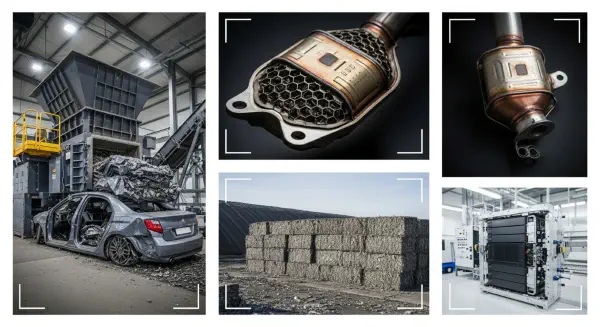
This creates a structural incentive for scrappage-adjacent policy. A government that removes a vehicle from its domestic fleet reports a domestic emissions reduction. A government that requires that vehicle to be genuinely destroyed — not sold, shredded to material recovery, with the catalytic converter destroyed and the powertrain permanently decommissioned — imposes a cost on the scrappage programme that it cannot recoup through the export market. The export sale of the scrapped vehicle's stripped carcass to a salvage broker, or the intact export of the vehicle before destruction, is the financially rational response to the incentive structure of domestic-only carbon accounting.
The UNEP 2020 report recommended that exporting nations implement minimum age and emissions standards for exported vehicles. As of 2024, the Netherlands and Belgium have implemented voluntary guidelines. No EU member state has implemented binding export standards. The IMO and ICAO both have emissions accounting frameworks that track vessels and aircraft internationally. No equivalent framework exists for road vehicles crossing national boundaries — the most numerous international fleet in operation.
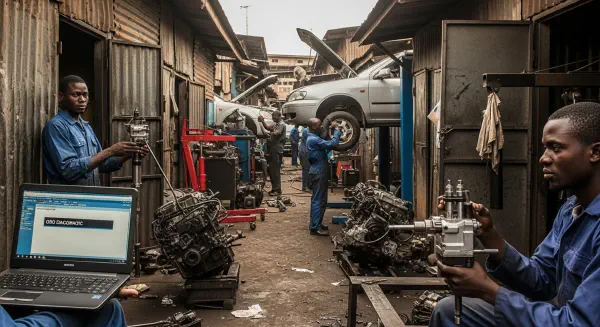
The next post examines what happens when the exported vehicle arrives: the informal economy of maintenance, knowledge transfer, and repair that determines whether the SDR vehicle lives out its potentially long remaining service life or becomes an immobilised hulk within two years of arrival, generating economic costs rather than mobility.