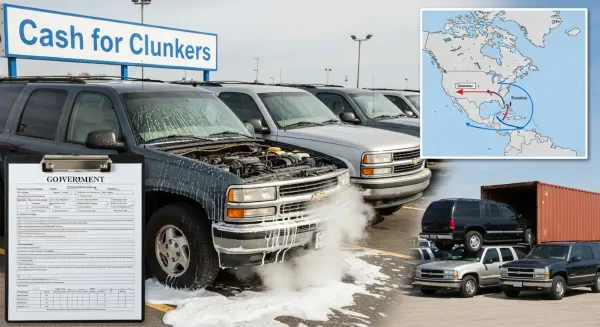
The Scrappage Displacement Ratio Inverts the Cash for Clunkers Environmental Narrative: SDR = (Remaining lifetime emissions of exported vehicle class in destination market) ÷ (Domestic emissions avoided by scrapping). SDR > 1 means the policy displaces more emissions globally than it prevents domestically. The 2009 US programme, which scrapped approximately 677,000 vehicles citing CO₂ benefits, generated an SDR of approximately 1.3: for every tonne of CO₂ avoided by the scrapping, approximately 1.3 tonnes were deferred to destination markets as equivalent vehicle classes were imported to replace the domestic supply removed.
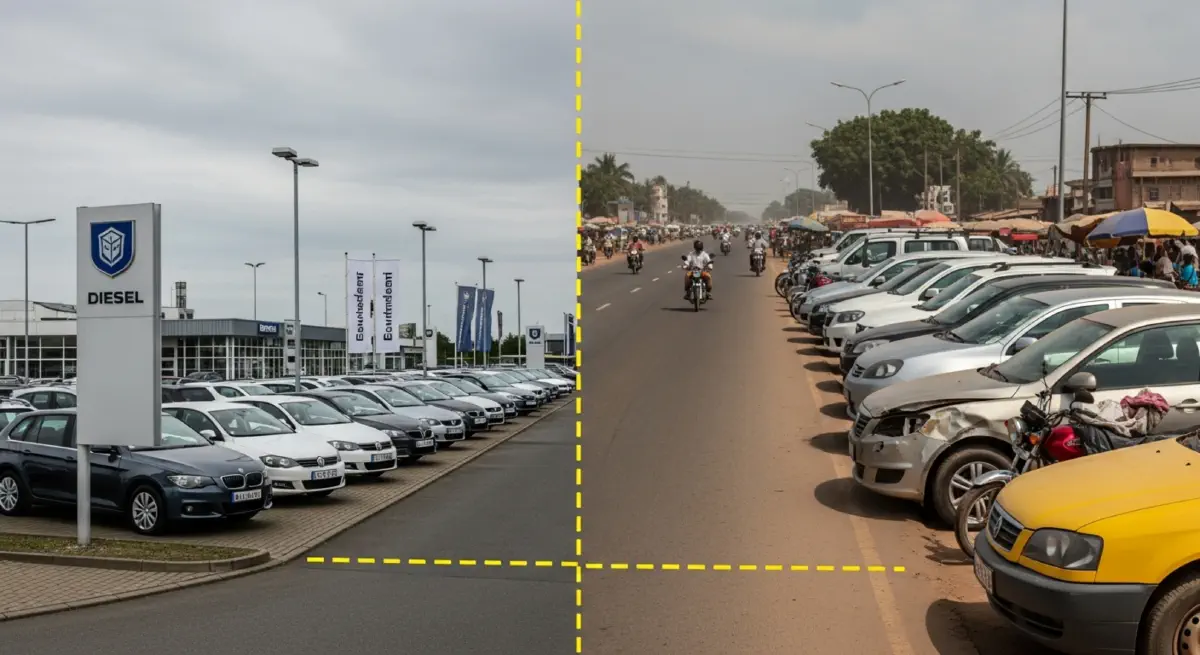
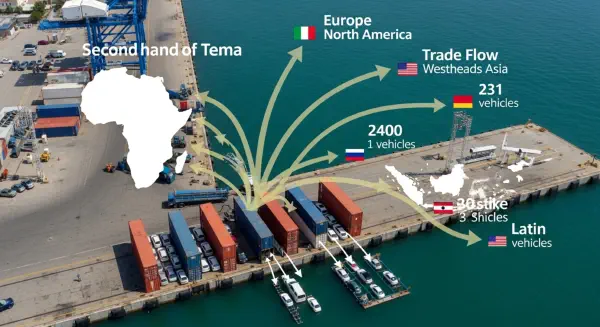
The Used Vehicle Export Trade Is the World's Largest Unregulated Emissions Displacement Mechanism: UNEP estimates that 14 million used vehicles were exported from high-income to low-income countries between 2015 and 2020, of which approximately 40% would have failed the emissions or safety standards of the importing country had those standards been enforced. The vehicle lifecycle does not end at domestic disposal. It migrates to jurisdictions with fewer resources to enforce standards — and the emissions, safety failures, and end-of-life disposal costs migrate with it.
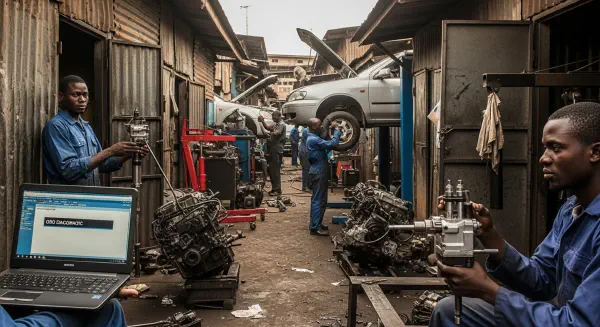
Software Locks Are Destroying the Informal Repair Knowledge That Keeps Old Vehicles Running in the Global South: Automotive ECU access restrictions, parts pairing, and proprietary diagnostic protocols are designed for the high-income dealer ecosystem. In West Africa, Latin America, and South Asia, where informal mechanics maintain vehicles that formal dealer networks will not service, ECU-locked vehicles represent an accelerated end-of-life trigger: a vehicle that can no longer be repaired without proprietary tools is a vehicle that must be abandoned earlier, compressing its remaining useful service life and advancing its scrapping timeline in a market that lacks the recycling infrastructure to handle the waste.
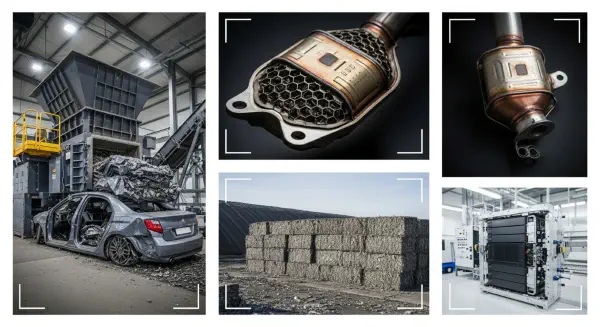
Catalytic Converter Theft Is the Market's Price Signal for a Recycling Value Asymmetry: Catalytic converter theft — which cost US insurers approximately $1.6 billion in 2022 — is not primarily a crime of opportunism. It is a response to a recycling market that prices palladium, platinum, and rhodium as high-value commodities but does not provide accessible legal pathways for informal capture of that value at the vehicle end-of-life stage. The theft market exists because the legitimate end-of-life market has not been designed to capture the value that the stolen-converter market is capturing illegally.
Shredder Residue Is the Lifecycle's Deferred Environmental Cost That No Scrappage Programme Has Ever Priced: Approximately 20–25% of an end-of-life vehicle by weight — the shredder residue after metal recovery — goes to landfill in most markets. This residue includes plastics, foams, glass, rubber compounds, and residual fluids whose combined toxicity profile represents a slow-release environmental liability. At approximately 200–350 kg of shredder residue per vehicle and 15–20 million ELV processed annually in the US alone, the annual shredder residue mass is approximately 3–7 million tonnes — disposed of at a median landfill cost of approximately $50–80 per tonne. The total annual disposal cost is approximately $150–560 million — a cost that does not appear in any vehicle total cost of ownership calculation or any scrappage programme evaluation.
United Nations Environment Programme. (2020). Used vehicles and the environment: A global overview of used light duty vehicles — Flow, scale, and regulatory frameworks. UNEP.
U.S. Department of Transportation. (2009). Consumer assistance to recycle and save (CARS) programme final report. U.S. DOT.
Li, S., Linn, J., & Spiller, E. (2013). Evaluating "Cash-for-Clunkers": Programme effects on auto sales and the environment. Journal of Environmental Economics and Management, 65(2), 175–193.
Knittel, C. R. (2009). The implied cost of carbon dioxide under the Cash for Clunkers programme. Economists' Voice, 6(10). https://doi.org/10.2202/1553-3832.1639
U.S. Customs and Border Protection. (2010). Border export statistics for used vehicles 2008–2010. CBP.
International Monetary Fund. (2022). World economic outlook database: Trade and current account statistics. IMF.
Anenberg, S. C., Miller, J., Henze, D. K., & Minjares, R. (2019). A global snapshot of the air pollution-related health impacts of transportation sector emissions in 2010 and 2015. International Council on Clean Transportation.
Automotive Recyclers Association. (2022). Vehicle recycling industry report 2022. ARA.
National Insurance Crime Bureau. (2022). Catalytic converter theft: 2022 report on the escalating problem. NICB.
Selin, H., & Eckley, N. (2003). Science, politics, and persistent organic pollutants. International Environmental Agreements, 3(1), 17–42.
Isenstadt, A., & German, J. (2017). Lightweighting technology developments. International Council on Clean Transportation.
Kagawa, S., Kudoh, Y., Nansai, K., & Tasaki, T. (2008). Changes in vehicle exhaust emissions of Japanese households with car ownership and car type specifics. Ecological Economics, 67(2), 287–295.
World Health Organization. (2017). Road safety in the WHO African region: The facts 2017. WHO.
Right to Repair Europe. (2023). The case for independent repair access: Automotive sector report 2023. Right to Repair Europe Coalition.
European Commission. (2023). End-of-life vehicles directive revision impact assessment (SWD/2023/86). European Commission.