The Rare Earth Gambit

Key Insights Across the Series
#

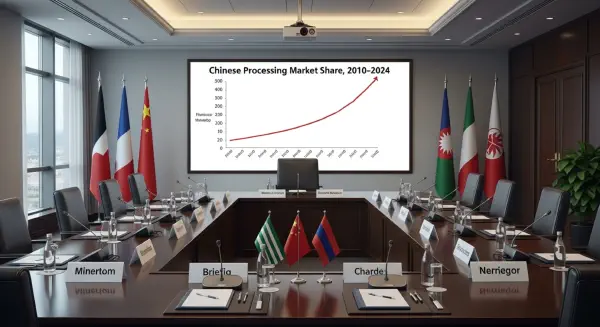
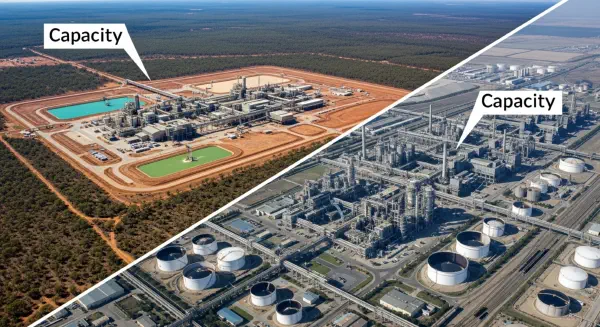
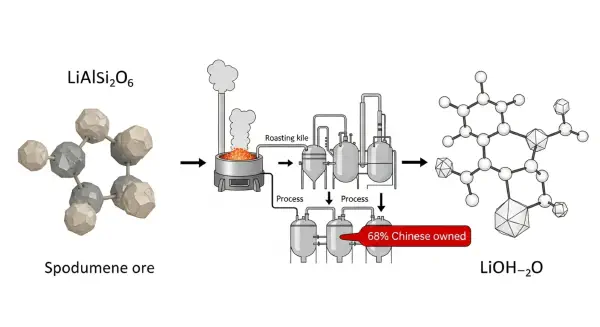
  • The Processing Concentration Index (PCI = Σ(s²ᵢ × processingᵢ ÷ miningᵢ)) corrects the standard HHI’s failure to distinguish between geographic market power at the mining stage and at the processing stage; for lithium hydroxide, the PCI is approximately 6,800 against a mining-stage HHI of 2,400 — a 2.8× amplification that reflects China’s 68% share of processing against its 22% share of mining, making lithium’s effective supply-chain concentration nearly three times what standard market power metrics report.
  • The IRA’s domestic content requirements for battery critical minerals — requiring 40% (escalating to 80% by 2027) of the value of critical minerals to be extracted or processed in the United States or a free-trade agreement partner country — are calibrated to mining origin, which is the less concentrated stage of the supply chain; the processing chokepoint, where concentration is 2.8× higher, is not specifically targeted by any IRA provision, creating a policy that addresses a real vulnerability while missing the more binding one.
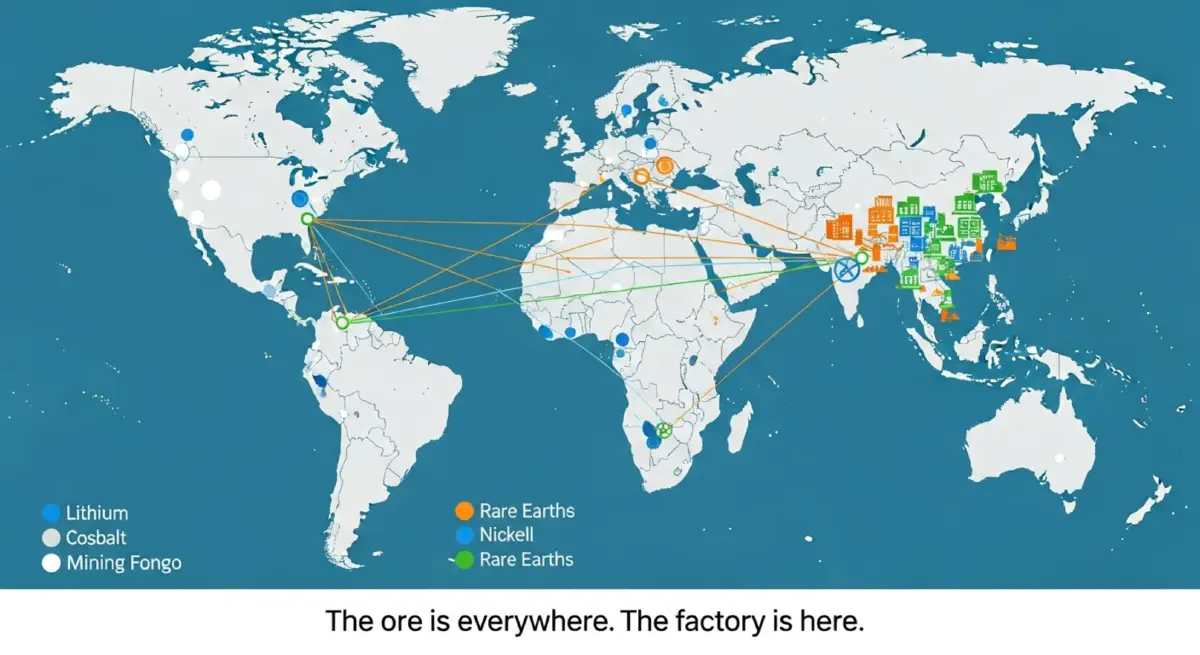
  • China’s monopoly position in rare earth permanent magnet processing — used in EV traction motors, wind turbine generators, and industrial robots — is more extreme than its lithium position: China processes approximately 90% of rare earth oxides globally, against approximately 60% of rare earth mining; its PCI for neodymium-iron-boron magnet precursor processing exceeds 8,500, against a mining HHI of approximately 5,800, an amplification of 1.47×.
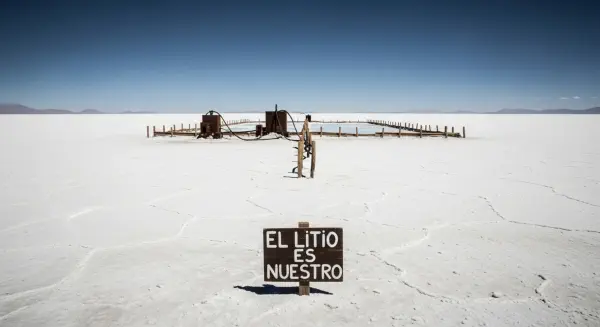
  • Resource nationalism cycles in critical mineral supply chains follow a consistent pattern: ore discovery and initial exploitation by foreign capital; domestic political coalescence around resource revenue; nationalisation or renegotiation of extraction terms; partial or full exclusion of foreign processing investment; price spike in downstream processing as supply concentrates; investment in alternative processing capacity outside the nationalising state, often requiring 8–15 years to reach production scale.
  • The minimum timeline from greenfield lithium processing facility announcement to first commercial production — including environmental permitting, construction, commissioning, and qualification of output for battery manufacturers — is approximately 7–12 years for a facility in a jurisdiction with established regulatory processes; in the United States, NEPA environmental review timelines for mining projects have averaged approximately 4.5 years in recent decades, and permitting for associated processing facilities runs on separate tracks; the supply-chain resilience measures announced by the U.S. government in 2021–2022 will not reach production scale before the mid-2030s electric vehicle deployment volumes require the capacity.

  1. Fortier, S. M., Nassar, N. T., Lederer, G. W., Brainard, J., Gambogi, J., & McCullough, E. A. (2018). Draft critical mineral list — Summary of methodology and background information: U.S. Geological Survey technical input document in response to Secretarial Order No. 3359. U.S. Geological Survey. https://doi.org/10.3133/ofr20181021
  2. Nassar, N. T., Brainard, J., Gulley, A., Manley, R., Matos, G., Coger, G., Efthimiadis, T., Harper, E., Hendren, P., Langenohl, K., McNulty, M., Pellegrino, K., Quindry, G., & Warren, R. (2012). Criticality of the geological copper family. Environmental Science & Technology, 46(2), 1071–1078. https://doi.org/10.1021/es203535z
  3. Graedel, T. E., Harper, E. M., Nassar, N. T., & Reck, B. K. (2015). On the materials basis of modern society. Proceedings of the National Academy of Sciences, 112(20), 6295–6300. https://doi.org/10.1073/pnas.1312752110
  4. International Energy Agency. (2021). The role of critical minerals in clean energy transitions. IEA. https://www.iea.org/reports/the-role-of-critical-minerals-in-clean-energy-transitions
  5. Benchmark Mineral Intelligence. (2023). Critical mineral supply chain tracker: Annual review 2023. Benchmark Mineral Intelligence.
  6. Gulley, A. L., McCullough, E. A., & Shedd, K. B. (2019). China’s domestic and foreign influence in the global cobalt supply chain. Resources Policy, 62, 317–323. https://doi.org/10.1016/j.resourpol.2019.03.015
  7. Auty, R. M. (1993). Sustaining development in mineral economies: The resource curse thesis. Routledge.
  8. Sachs, J. D., & Warner, A. M. (1995). Natural resource abundance and economic growth (NBER Working Paper No. 5398). National Bureau of Economic Research. https://doi.org/10.3386/w5398
  9. Ross, M. L. (2012). The oil curse: How petroleum wealth shapes the development of nations. Princeton University Press.
  10. Helveston, J. P., & Nahm, J. (2019). China’s key role in scaling low-carbon energy technologies. Science, 366(6467), 794–796. https://doi.org/10.1126/science.aaz1014
  11. Fu, X., Beatty, D. N., Gaustad, G. G., Ceder, G., Roth, R., Kirchain, R. E., Bustamante, M., Babbitt, C., & Olivetti, E. A. (2020). Perspectives on cobalt supply through 2030 in the face of changing demand. Environmental Science & Technology, 54(5), 2985–2993. https://doi.org/10.1021/acs.est.9b04975
  12. Mancheri, N. A., Sprecher, B., Bailey, G., Ge, J., & Tukker, A. (2019). Effect of Chinese policies on rare earth supply chain resilience. Resources, Conservation and Recycling, 142, 101–112. https://doi.org/10.1016/j.resconrec.2018.11.017
  13. Simon, B., Ziemann, S., & Weil, M. (2015). Potential metal requirement of active materials in lithium-ion battery cells of electric vehicles and its impact on reserves: Focus on Europe. Resources, Conservation and Recycling, 104, 300–310. https://doi.org/10.1016/j.resconrec.2015.07.011
  14. Jerez, B., Garcés, I., & Torres, R. (2021). Lithium extractivism and water injustices in the Salar de Atacama, Chile: The colonial shadow of green electromobility. Political Geography, 87, 102382. https://doi.org/10.1016/j.polgeo.2021.102382
  15. Watari, T., McLellan, B. C., Giurco, D., Dominish, E., Yamasue, E., & Nansai, K. (2019). Total material requirement for the global energy transition to 2050: A focus on transport and electricity. Resources, Conservation and Recycling, 148, 91–103. https://doi.org/10.1016/j.resconrec.2019.05.015