The City That Is Warming From the Ground Up#
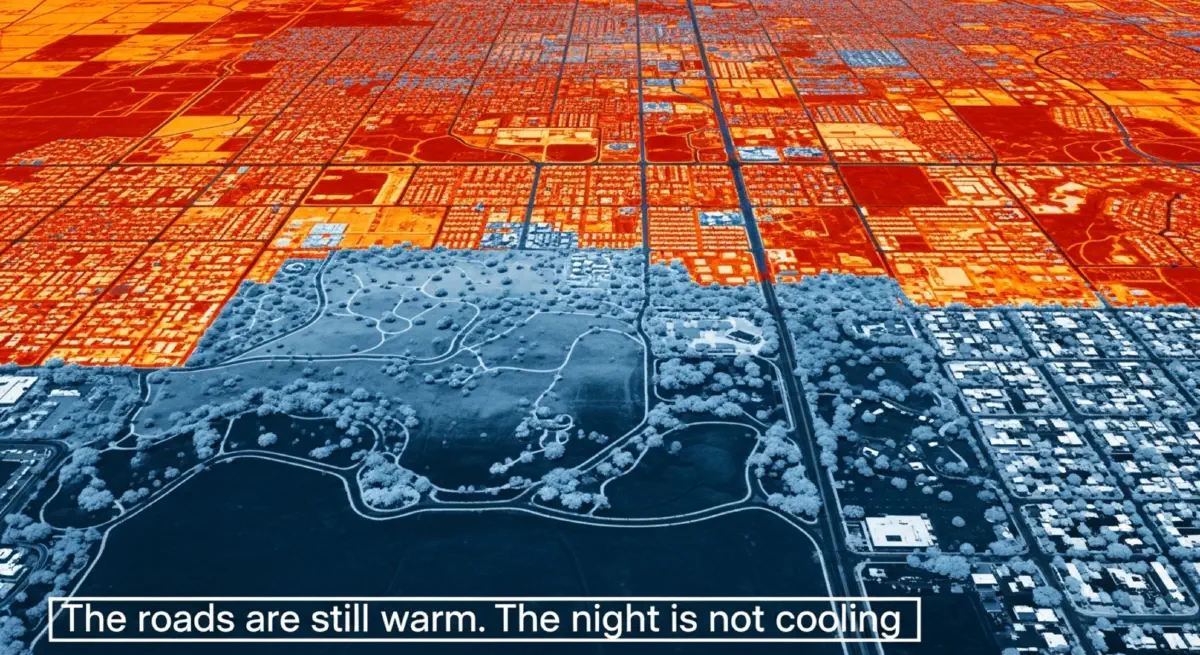
Phoenix, Arizona, holds a distinction that urban climate researchers cite consistently: it is the hottest large city in America, with a documented urban heat island intensity — the temperature differential between urban core and surrounding rural land — of approximately 6–8°C in evening hours, among the most extreme in the Western Hemisphere. Phoenix is also one of the most car-dependent metropolitan areas in the world, with approximately 89% of residents commuting by single-occupancy vehicle and a road network covering approximately 11% of the metropolitan land area in impervious sealed surface. The correlation is not coincidental, and it is not primarily a consequence of building density, waste heat from air conditioning, or industrial activity.
The primary driver of Phoenix’s urban heat island is the impervious surface fraction — asphalt road surfaces and concrete parking infrastructure — and the thermodynamic properties of those surfaces. Asphalt absorbs approximately 80–95% of incoming solar radiation and re-emits it as thermal infrared. Its albedo of 0.05–0.10 compares with 0.35–0.50 for vegetated suburban surfaces and 0.10–0.20 for dry soil. The higher solar absorption and the elimination of evapotranspiration that vegetated surfaces provide creates two compounding thermal effects: surfaces reach midday temperatures of 55–75°C, and the thermal mass of the asphalt stores that energy through the evening hours rather than releasing it convectively. Phoenix does not cool at night because its road network has stored the day’s solar input and is re-radiating it through the hours when human cardiovascular systems attempt to recover. The road infrastructure is not a passive element of the urban thermal environment. It is its primary transformer.
The Thermal Arithmetic of Road Coverage#
Impervious Surfaces and the Albedo Deficit#
Urban heat island effects attributable to transportation infrastructure are calculable at city scale through the urban energy balance equation, which partitions incoming solar radiation into reflected energy (determined by albedo), evapotranspiration (determined by vegetated surface fraction), and sensible heat (stored and re-emitted from hard surfaces). Cities with high road and parking coverage fractions have structurally lower albedo and structurally reduced evapotranspiration relative to the pre-development landscape.
The Texas Transportation Institute’s analysis of road surface coverage in the 50 largest U.S. metropolitan areas found an average impervious surface fraction attributable to road and parking infrastructure of approximately 8–14%, with Phoenix, Houston, Dallas, and Los Angeles at the upper end of that range. In London, road and parking surfaces cover approximately 9% of the Greater London area. In Paris, approximately 7%. These fractions appear modest as percentages of total metropolitan land. Their thermal effect is disproportionate because roads and parking are distributed across the urban fabric — they are not concentrated in industrial zones where population density is low. They run through every residential street, every commercial district, and every school approach, imposing a thermal footprint on the most densely occupied land.
The health consequence of elevated urban temperatures is well-characterised. Excess mortality during European heat events — the 2003 heatwave killing approximately 70,000 people across the continent, the 2019 event killing approximately 2,500 in France alone in a single week — is concentrated in dense urban areas with high impervious surface fractions and low tree canopy coverage. Epidemiological analysis of heat-mortality relationships in Paris, London, and Madrid shows excess mortality beginning at urban temperatures approximately 3–5°C above the rural baseline, a threshold the urban heat island intensity in city centres routinely exceeds during heatwaves. The road infrastructure contributes to that threshold being crossed.
The EV Fleet’s Thermal Profile#
The thermal contribution of road infrastructure does not change with fleet electrification. The sealed impervious surface absorbs solar radiation regardless of the vehicle powertrain using it. The displacement of ICE waste heat — approximately 70% of the fuel energy in a petrol engine is lost as heat through the engine cooling system and exhaust — by BEV drivetrain waste heat (approximately 10–15% of battery energy lost as heat through the inverter, motor, and thermal management) does reduce the direct waste heat contribution of the vehicle fleet itself. For a city with 2 million vehicles, this is a calculable heat reduction — but it is a first-order effect on the fleet’s direct heat output, not on the road surface’s thermal storage and re-emission, which is driven by solar absorption in the asphalt, not by vehicle heat discharge.
The more significant thermal variable in the EV transition is the combination of increased vehicle mass and direct fast-charging infrastructure. Heavy BEVs impose greater dynamic loading on road surfaces, accelerating the deformation that reduces asphalt albedo as the surface ages and darkens. Fast-charging stations, which require substantial electrical infrastructure, generate local heat sources that add to micro-urban heat concentrations around charging hubs. Neither effect is large in absolute terms for individual installations. Aggregated to the urban scale under scenarios of high EV penetration, both effects modestly increase urban thermal loading rather than reducing it — the opposite of what a naive reading of “zero emission vehicle” suggests about heat as well as particle outputs.
The Cooling Infrastructure Feedback#
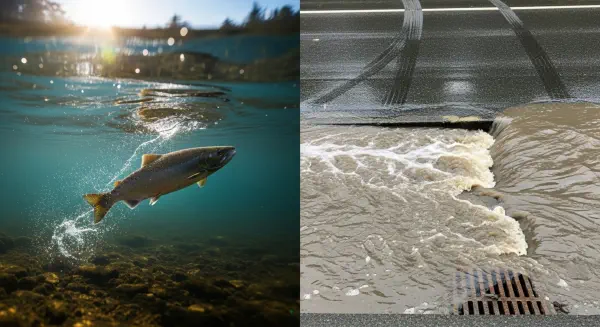
Urban cooling strategies — cool pavements with higher-albedo surfaces, green infrastructure, urban forestry, and permeable paving — offer documented effectiveness in reducing urban heat island intensity. The EPA’s Heat Island Effect programme documents cool pavement temperature reductions of 5–20°C at the surface relative to conventional asphalt, and ambient temperature reductions of 0.5–2.5°C in urban areas with comprehensive cool pavement deployment. Permeable paving enables evapotranspiration even in fully developed urban areas, reducing both the thermal storage effect and stormwater runoff — directly addressing both the heat budget and the TRWP stormwater toxin pathway identified in Post 1.
The funding constraint on cool pavement and green infrastructure deployment is the road maintenance budget — the same budget whose structural shortfall The Asphalt Ledger series documented. Deferred maintenance produces degraded surfaces with lower albedo and higher thermal storage. The road infrastructure spending gap compounds the urban heat island effect: cities that cannot afford to maintain their existing roads cannot afford to upgrade them to higher-albedo resurfacing. The thermal penalty is paid by the public health system, not debited from the road maintenance budget.
The Complete NEPF Account#
The Non-Exhaust Particulate Fraction framework, developed across four posts, reaches a conclusion that none of its individual components states alone. The NEPF for a modern BEV is 100%. This means:
Every milligram of particulate matter that vehicle generates comes from the tire-road interface, the brake system, and road surface abrasion — sources with no regulatory emission limit, no mandatory manufacturer disclosure, and no test cycle measurement in any certification framework currently in force. The vehicle was sold as a zero-emission vehicle. It is a zero-exhaust-emission vehicle. The category name has been applied to a vehicle characteristic while the vehicle continues to generate health-relevant particulate at rates comparable to — and for heavy models, higher than — the diesel vehicle it replaced.
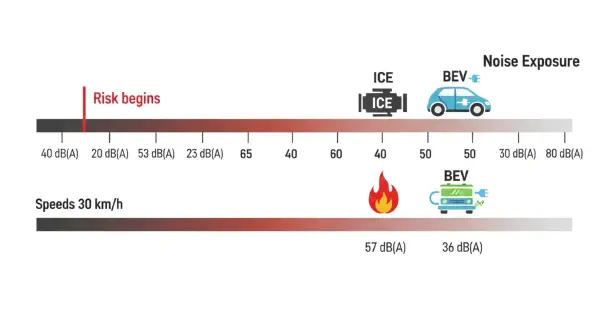
The noise burden of that vehicle above 40 km/h is equivalent to an ICE vehicle of the same class, driven by the same tire-road interaction that generates the particulate. The vehicle is also 10–30% heavier than its ICE counterpart, imposing greater road surface loading, accelerating non-exhaust PM₂.₅ generation, and marginally increasing tire-road noise. The road infrastructure the vehicle uses stores solar energy in sealed impervious asphalt and re-emits it as urban heat, a process for which the EV drivetrain’s lower waste heat output provides minimal offset.
The policy frameworks that designed the EV transition measured exhaust emissions because exhaust emissions were, through most of the 20th century, the dominant source of automotive environmental harm. They imposed ever-tighter limits on a target category that progressive engineering rendered residual, while the non-exhaust, noise, and thermal categories continued to accumulate against uncleaned accounts. The NEPF is the measure that exposes what was left off the balance sheet. Completing the account does not argue against electrification. It argues against the accounting framework that declared partial progress to be total success.