The Study That Priced 45,000 Heart Attacks#
In June 2018, the World Health Organization Regional Office for Europe published its Environmental Noise Guidelines for the European Region — the most comprehensive evidence synthesis on transportation noise and population health to date. Its conclusions, rendered in the clinical language of epidemiological relative risks, described a public health burden of comparable magnitude to fine particulate matter exposure: road traffic noise above 53 dB(A) Lnight causes 22 million people in Europe to suffer chronic high annoyance; 6.5 million suffer chronic sleep disturbance. WHO estimated that noise-attributable ischemic heart disease events in Europe numbered approximately 48,000 cases per year, with a cardiovascular disease pathway confirmed by multiple meta-analyses showing relative risk increases of 1.03–1.07 per 10 dB(A) for long-term exposure.
The physiological mechanism is well-characterised: road traffic noise activates the sympathetic nervous system during sleep, elevating cortisol and adrenaline, sustaining elevated blood pressure even when the individual does not consciously awaken. The body responds to the sound of an articulated lorry on the road outside as it responds to any threat signal — and the cardiovascular infrastructure bearing the cost of that response is not aware that this threat is a truck.
Transport policy in Europe and North America treats noise as an amenity problem. The policy instruments are acoustic barriers — concrete walls along highway corridors, berm earthworks, and glass barriers in urban viaducts — that are deployed to manage noise exposure in newly developed areas and required by environmental impact assessment for major new road projects. They do not address noise exposure in the existing urban fabric where the majority of the population lives. They are not evaluated against the dose-response relationships in the WHO Guidelines. They are not costed against the health burden they are designed to mitigate. The gap between the infrastructure of noise management and the magnitude of the health burden represents what this post terms the Noise Ledger: the uncounted liability that transport policy carries off-balance-sheet, at the expense of the cardiovascular health of urban populations.
The Economics of Sound#
Noise as Dose: How the dB(A) Scale Compresses a Linear Risk#
Road traffic noise is measured in decibels, on a logarithmic scale. A 3 dB(A) increase represents a doubling of sound energy; a 10 dB(A) increase represents a tenfold increase in sound energy; a 30 dB(A) increase represents a thousandfold increase. The practical implication for noise policy is that linear reductions in vehicle count, speed, or tire-road contact noise translate into smaller decibel reductions than intuition suggests. Halving the number of vehicles on a road — a dramatic traffic reduction — produces a 3 dB(A) reduction. Doubling traffic produces a 3 dB(A) increase. The health-relevant exposure window under WHO guidelines — the levels above which cardiovascular effects become measurable — spans approximately 50–70+ dB(A) Lnight, a range that the logarithmic scale compresses into a deceptively small numerical interval.
The economic valuation of noise-attributable health effects is developed through disability-adjusted life years (DALYs) and value-of-statistical-life approaches that have been applied to air pollution policy. The European Environment Agency’s TERM (Transport and Environment Reporting Mechanism) framework includes noise as a health externality but does not routinely produce a single externality cost per vehicle-kilometre comparable to the external cost estimates for CO₂ or PM₂.₅. The most widely cited estimate, from the Handbook on External Costs of Transport (Ricardo-AEA, 2019, updated for the European Commission), places urban road traffic noise costs at approximately $3.8–8.2 per vehicle-kilometre in major European cities, depending on population density and time of day, based on WHO dose-response relationships and European price levels. Applied to total EU urban vehicle-kilometres — approximately 2.6 trillion km/year — the aggregate annual external cost of urban road traffic noise exceeds $9.9 trillion at the high end of the range, a figure that exceeds the total market capitalisation of the entire global automotive sector.
The EV Noise Problem at Speed#
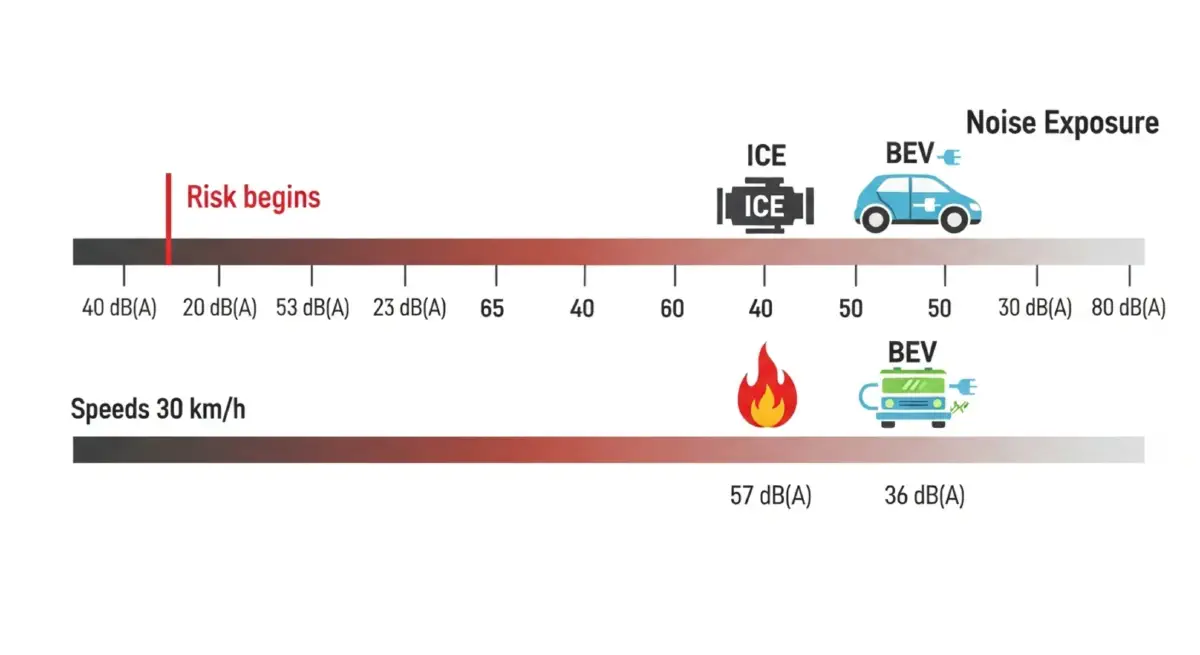
The transition to battery-electric vehicles substantially reduces the powertrain noise contribution to total vehicle noise — the mechanical and engine idle noise, the exhaust sound, and the low-speed combustion frequency spectrum that urban residents most directly associate with traffic noise. Electric vehicles at speeds below approximately 30 km/h are meaningfully quieter than their ICE counterparts for pedestrians in immediate proximity, and EU Regulation 540/2014 (Acoustic Vehicle Alerting System) mandates minimum external sound emission systems for EVs below 20 km/h precisely because the quiet electric drivetrain created a pedestrian safety concern.
Above 40–50 km/h, the situation inverts. Tire-road noise — the sound generated by the interaction between tire tread and road surface — dominates total vehicle exterior noise at highway speeds and becomes the primary noise source for EV and ICE vehicles alike above those threshold speeds. A Tesla Model S travelling at 80 km/h generates approximately 68–70 dB(A) at 7.5 metres — essentially identical to a BMW 5 Series diesel at the same speed, because both vehicles’ noise is dominated by the same tire-road contact mechanism. The EV’s noise advantage disappears precisely where road network exposure is most population-relevant: the urban arterial at 50–70 km/h, the ring road at 80–100 km/h, the residential street at 40 km/h as evening traffic runs.
The additional mass of battery-electric vehicles compounds the tire-road noise contribution: heavier vehicles press more firmly into the road surface, increasing both the deformation of the contact patch and the vibration energy transferred into both the tire structure and the road surface, raising noise emission by approximately 1.5–2 dB(A) per doubling of vehicle mass — a physically small increment that nonetheless translates, under the WHO dose-response relationships, into a measurable increase in population-level cardiovascular risk exposure.
The Urban Pavement Dimension#
Road surface material and condition is the second variable in tire-road noise generation. A worn, coarse-aggregate concrete road surface generates 5–8 dB(A) more tire-road noise than a low-noise porous asphalt surface under comparable conditions — an acoustic difference greater than the EV powertrain advantage at any speed. European research programmes, including the European Commission’s SILENCE and FOREVER-OPEN-ROAD projects, have demonstrated that optimised low-noise road surfaces can achieve the kind of noise reduction that would require tripling the cost of EV penetration targets to achieve through vehicle electrification alone.
The financing gap for road surface maintenance and low-noise resurfacing is directly related to the Road Subsidy Multiplier dynamic documented in The Asphalt Ledger series: deferred maintenance produces degraded, high-noise surfaces, which produce elevated population noise exposure, which generates health costs that are never attributed to the road maintenance budget that failed to prevent them. The noise health cost is paid by the National Health Service, by the cardiovascular care system, and by the individuals experiencing sleep disruption and elevated heart disease risk — not by the road authority whose maintenance deferral created the acoustic environment.
The Silent Variable in the EV Transition’s Health Claims#
The health benefits claimed for the EV transition — reduced air pollution-related premature mortality, reduced respiratory disease burden, reduced cardiovascular mortality — are calculated against the exhaust emission reductions that electrification achieves. Those calculations are valid within their defined scope. What they systematically exclude is:
a) The non-exhaust PM₂.₅ burden that the NEPF analysis in Posts 1 and 2 established will remain at current levels or increase as heavier BEVs replace lighter ICE vehicles; and
b) The tire-road noise burden that will remain essentially constant above 40 km/h as electrification eliminates powertrain noise but leaves the tire-road interaction mechanism unchanged.
The health benefit narrative of transport electrification is accurate for exhaust-source PM₂.₅ and for low-speed urban noise. It substantially overstates the total public health benefit if the non-exhaust and noise contributions are excluded from the accounting. A rigorous health impact assessment of urban fleet electrification — applying the WHO dose-response functions to the full particulate and noise exposure profile of both fleets, not only the exhaust component — would produce a reduced but real health benefit estimate. The reduced estimate is the honest one. The overstated estimate is the one currently in policy circulation. The Noise Ledger is the gap between them.
The next post closes the series by examining the urban heat budget — the third unaccounted output of road infrastructure — and synthesises the NEPF framework across its four dimensions: what a complete accounting of automotive externalities reveals when the exhaust pipe is no longer the dominant source of any of the regulation-relevant outputs it was designed to control.