The Fish That Found the Formula#
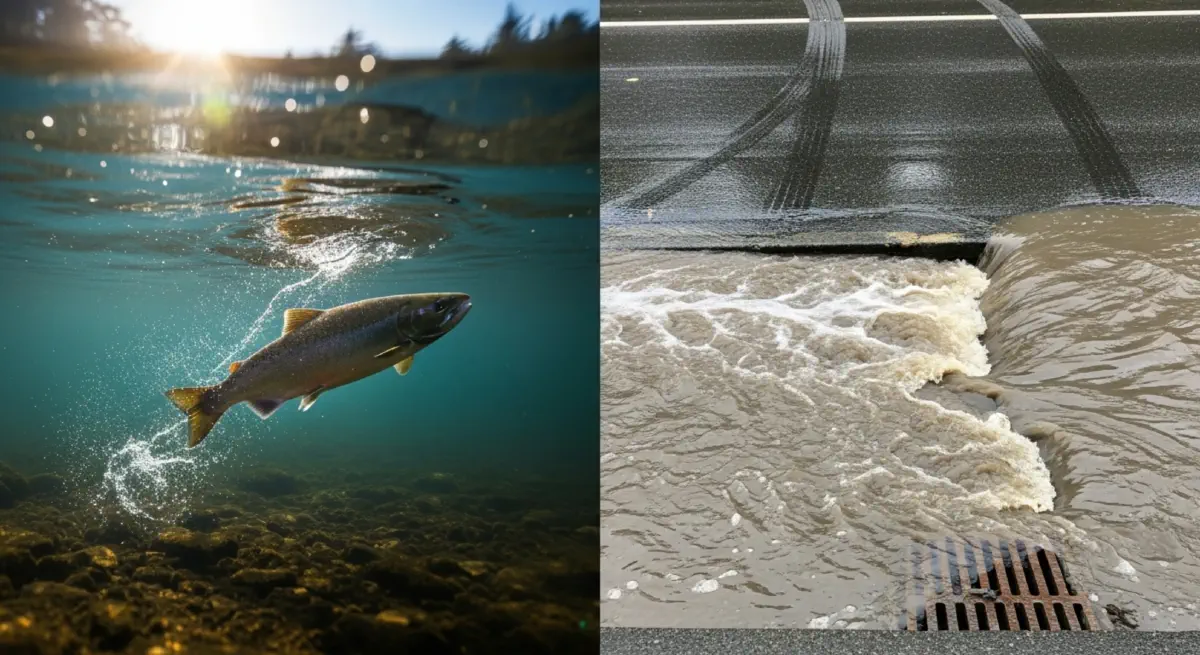
In November 2020, a team of environmental engineers at the University of Washington published a paper in Science that solved a 25-year mystery. Coho salmon returning to spawn in Pacific Northwest urban streams had been dying in large numbers — not occasionally, but reliably, within hours of entering stormwater-fed creeks after rainfall events. The die-offs were correlated with road runoff and had been observed since the 1990s, but the specific toxin responsible had resisted identification because it was not one of the compounds that stormwater monitoring programmes were designed to detect.
The compound identified was 6PPD-quinone. It is a transformation product of 6PPD — N-(1,3-dimethylbutyl)-N’-phenyl-p-phenylenediamine — a chemical added to virtually every passenger car and truck tire manufactured in the last 50 years. 6PPD is an antidegradant: it prevents the rubber compound from cracking under ozone exposure, extending tire life. When 6PPD particles wear from tires onto road surfaces, they react with atmospheric ozone to produce 6PPD-quinone, which washes into stormwater with the first rain and reaches aquatic environments at concentrations that the University of Washington team found to be acutely lethal to coho salmon at 0.095 micrograms per litre. Stormwater samples from Seattle and San Francisco contained 6PPD-quinone at concentrations up to 100 times the lethal threshold.
No tire manufacturer had been required to test for 6PPD-quinone toxicity. No tire regulation required it. The compound that was killing Pacific salmon at scale had been continuously applied to every tire made since the 1970s and was not monitored by any environmental quality standard in any jurisdiction. The regulatory framework for automotive emissions had been looking at the exhaust pipe for fifty years. The toxin was coming from the tire.
The Emission Category That No Clean Car Standard Addresses#
The Euro emissions standards that have progressively tightened exhaust particulate regulations — from Euro 1’s 0.18 g/km particle mass limit for diesel vehicles in 1992 to Euro 6d’s 0.0045 g/km limit currently applicable — operate exclusively on exhaust emissions. The particle number standards introduced in Euro 5 and tightened in Euro 6 regulate particles generated by the combustion process and exiting the tailpipe. The Euro 6d-TEMP diesel vehicle of 2024, equipped with a diesel particulate filter achieving filtration efficiencies above 99%, emits fewer exhaust particles than the air it inhales through the engine’s intake.
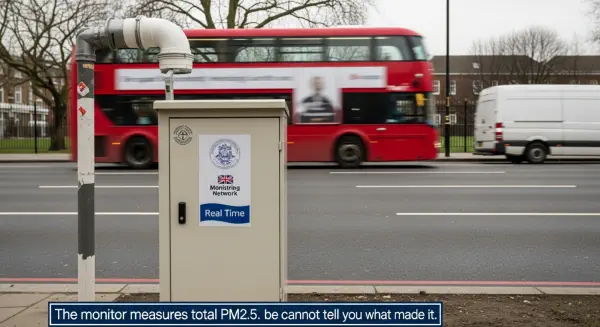
The tire, the brake pad, and the road surface together produce a different category of particle — one that certification standards classify as “non-exhaust emissions” and systematically exclude from regulatory scope. The Non-Exhaust Particulate Fraction (NEPF) measures the proportion of total automotive PM₂.₅ generated by non-exhaust sources:
$$NEPF = \frac{\text{Tire wear} + \text{brake dust} + \text{road abrasion PM}_{2.5} \text{ (g/km)}}{\text{Total automotive PM}_{2.5}\text{/km}} \times 100$$For a Euro 6d diesel vehicle generating 0.0045 g/km of exhaust PM₂.₅ and approximately 0.048 g/km of non-exhaust PM₂.₅ from tire and brake sources combined, NEPF = 0.048 ÷ (0.048 + 0.0045) × 100 = 91.4%. For a battery-electric vehicle generating zero exhaust PM₂.₅ and approximately 0.048–0.055 g/km of non-exhaust PM₂.₅ from the same tire and brake sources, NEPF = 100%. The vehicle class that achieved zero-emission certification generates every microgram of its particulate matter from sources that no emission standard measures, labels, or limits.
The Anatomy of a Tire Wear Particle#
What Comes Off the Tire and Where It Goes#
A passenger car tire loses approximately 0.1–0.3 mm of tread per 10,000 km under normal driving conditions, with higher wear rates in urban conditions with frequent acceleration, braking, and cornering. The mass of material worn from a tire annually — approximately 4–7 kg per vehicle across four tires — becomes tire and road wear particles (TRWP), a composite that includes rubber polymer, carbon black, oils, antidegradants, zinc compounds, and road surface material incorporated during wear. TRWP spans a size range from coarse particles visible to the naked eye to ultrafine particles below 100 nanometres.
The PM₂.₅ fraction — particles below 2.5 micrometres in diameter, which penetrate to the pulmonary alveoli — is generated both by the wear process and by the subsequent fragmentation of larger wear particles. Approximately 20–25% of total TRWP mass falls in the PM₂.₅ size fraction, with the remainder distributed across larger particle sizes that settle near the road surface, enter drainage systems, and accumulate in roadside soil.
The fate of these particles follows three pathways that create distinct environmental and health concerns. The airborne fraction — TRWP becoming suspended airborne PM₂.₅ — is inhaled by roadside populations and contributes to the urban air pollution burden that ambient monitoring programmes attribute to “traffic” without source-speciation. The drainage pathway — TRWP washed into storm drains by rainfall — enters aquatic environments directly, where 6PPD-quinone and zinc compounds (the latter at concentrations 50–200× background in urban stormwater) create the aquatic toxicity pathway that the coho salmon study crystallised. The roadside soil accumulation pathway — TRWP incorporating into the soil matrix along road verges — creates a persistent contamination reservoir that persists decades after road use intensity changes, and which is mobilised by construction, flooding, and soil disturbance.
The Brake Dust Contribution and Its Phase Transition#
Brake dust is a chemically distinct contributor to the non-exhaust PM₂.₅ budget. Conventional friction braking generates particles from both the brake pad compound and the rotor material. Brake pad compounds are complex formulations containing metal fibres, ceramic particles, binders, and lubricants, with the specific composition varying between organic, metalloorganic, and non-asbestos organic formulations. The rotor material is typically grey cast iron, generating iron oxide particles whose magnetic properties allow them to be distinguished in source apportionment studies.
The PM₂.₅ fraction from brake sources is estimated at approximately 0.005–0.015 g/km for conventionally braked ICE vehicles under urban drive cycles. The widely anticipated implication of regenerative braking in hybrid and battery-electric vehicles is that brake pad wear should be substantially reduced, since the electric motor provides braking force for the majority of moderate deceleration events. This is correct for pad-to-rotor friction: BEV brake pad wear rates are approximately 10–15% of those in comparable ICE vehicles under mixed urban and highway driving.
The rotor, however, continues to generate corrosion particulate whether or not it generates friction particulate. Cast iron rotors in low-friction-use situations — as in regenerative-braking BEVs — experience accelerated surface oxidation precisely because the heat from frequent friction use no longer clears the rust layer. Brake dust from BEV rotors, per kilometre of urban driving, is not trivially lower than from ICE vehicles; it is differently composed, with higher iron oxide fractions and lower organic compound fractions. The health effects of iron oxide PM₂.₅ are distinct from but not clearly lower than those of organic brake compound PM₂.₅.
The Mass Penalty That Electric Weight Imposes#
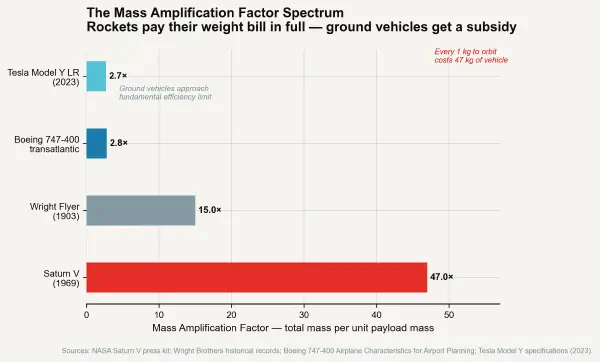
The single most consequential variable for tire wear PM₂.₅ generation is vehicle mass. Tire wear increases non-linearly with vehicle weight — the empirically supported relationship approximates a power law with an exponent of approximately 1.5–2.0, meaning that doubling vehicle weight more than doubles tire wear. The battery packs of current long-range electric vehicles impose a mass penalty relative to comparable ICE vehicles that is directly translated into higher non-exhaust particulate generation.
A Tesla Model Y Long Range weighs approximately 2,003 kg. A BMW 3 Series 320d diesel — a comparable executive vehicle in terms of interior space and performance — weighs approximately 1,690 kg. The mass differential of 313 kg produces a tire wear PM₂.₅ differential estimated at approximately 13–18% higher for the Model Y under comparable urban drive cycles, based on the NORTRIP model relationships published by the Norwegian Institute for Air Research. A Hyundai IONIQ 6 (1,985 kg) generates approximately 11–15% more tire wear PM₂.₅ per kilometre than a Hyundai Elantra 1.6 CRDi diesel (1,421 kg), which shares no component architecture but serves the same market category.
The implication for the NEPF metric is compounding: BEVs have a NEPF of 100% — every particle they generate comes from unregulated sources — and the mass penalty means the absolute quantity of non-exhaust PM₂.₅ per kilometre is higher for many BEV models than for the diesel successors they are replacing. The next post constructs the urban air quality arithmetic that this NEPF distribution produces, and examines why the ambient monitoring frameworks designed to protect public health cannot correctly attribute the non-exhaust contribution they are receiving.