The Particulate Account

Key Insights Across the Series
#

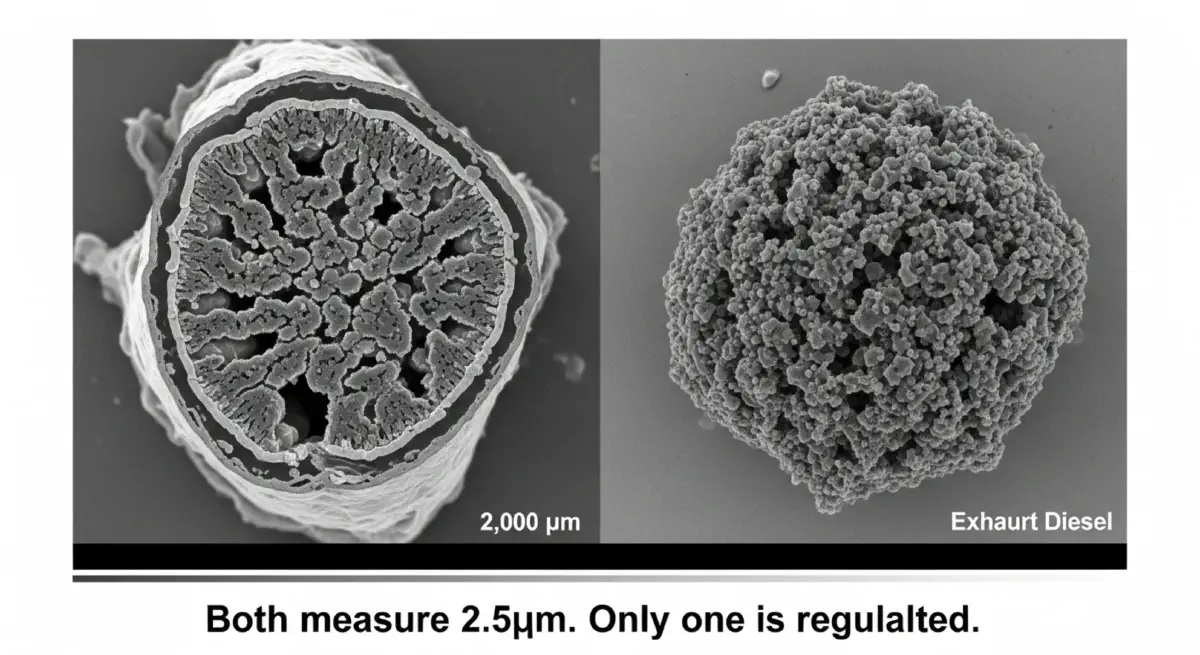
  • The Non-Exhaust Particulate Fraction (NEPF = non-exhaust PM₂.₅/km ÷ total automotive PM₂.₅/km × 100) reveals that 92% of the particulate matter generated by a Euro 6d diesel vehicle and 100% of the PM₂.₅ generated by a battery-electric vehicle comes from tire wear, brake dust, and road abrasion — sources entirely outside the regulatory frameworks that defined the transition to “clean” vehicles.
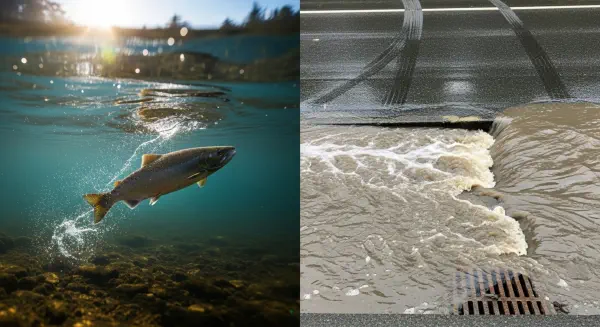
  • Tire wear particles contain 6PPD-quinone, a transformation product of a standard tire antidegradant (6PPD) that has been identified as directly toxic to coho salmon at concentrations as low as 0.095 μg/L; it has been detected in roadside stormwater at concentrations up to 100× the lethal threshold, and its presence in human blood and urine is now documented in published biomonitoring studies.
  • Heavy BEVs generate substantially more non-exhaust PM₂.₅ per kilometre than comparable ICE vehicles of equivalent utility class: a Tesla Model Y (2,003 kg) generates approximately 13% more tire wear PM₂.₅/km than a comparable BMW 3 Series diesel (1,690 kg), entirely due to the mass differential. The battery pack that eliminates exhaust particulate simultaneously increases the category of particulate it cannot control.
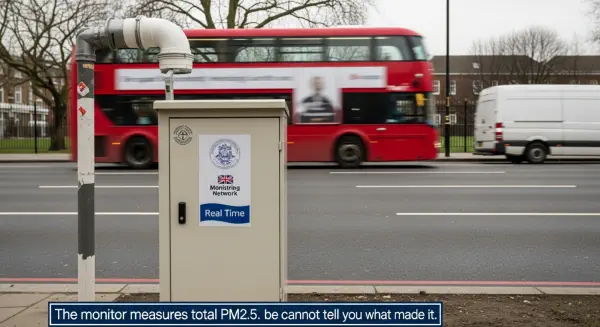
  • The European air quality standard (EU Ambient Air Quality Directive) sets annual mean PM₂.₅ limits of 10 μg/m³ (2021 guideline) but has no mechanism to specifically attribute concentrations to non-exhaust sources, preventing enforcement actions targeted at the sources generating the majority of roadway PM₂.₅ in post-Euro 6 urban environments.
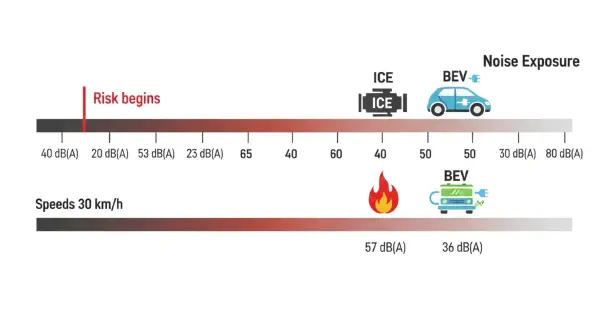
  • Urban road noise generates dose-response health outcomes equivalent to chronic air pollution exposure in epidemiological studies: WHO Europe’s Environmental Noise Guidelines (2018) estimate that 22 million Europeans suffer chronic annoyance and 6.5 million suffer chronic sleep disturbance from road traffic noise — conditions associated with increased cardiovascular mortality at relative risks of 1.03–1.07 per 10 dB(A) for long-term exposure. Neither figure appears in any automotive certification standard.

  1. Harrison, R. M., Jones, A. M., Gietl, J., Yin, J., & Green, D. C. (2012). Estimation of the contributions of brake dust, tire wear, and resuspension to non-exhaust traffic particulate matter concentrations in London. Atmospheric Environment, 55, 492–501. https://doi.org/10.1016/j.atmosenv.2012.03.020
  2. Baensch-Baltruschat, B., Kocher, B., Stock, F., & Reifferscheid, G. (2020). Tire and road wear particles (TRWP) — A review of generation, properties, emissions, human health risk, ecotoxicology, and fate in the environment. Science of the Total Environment, 733, 137823. https://doi.org/10.1016/j.scitotenv.2020.137823
  3. Tian, Z., Zhao, H., Peter, K. T., Gonzalez, M., Wetzel, J., Wu, C., Hu, X., Prat, J., Mudrock, E., Hettinger, R., Cortina, A. E., Biswas, R. G., Kock, F. V. C., Soong, R., Jenne, A., Du, B., Hou, F., He, H., Lundeen, R., … Kolodziej, E. P. (2021). A ubiquitous tire rubber–derived chemical induces acute mortality in coho salmon. Science, 371(6525), 185–189. https://doi.org/10.1126/science.abd6951
  4. Panko, J. M., Chu, J., Ortega, K. L., & Unice, K. M. (2013). Measurement of airborne concentrations of tire and road wear particles in urban and rural areas of France, Japan, and the United States. Atmospheric Environment, 72, 192–199. https://doi.org/10.1016/j.atmosenv.2013.01.040
  5. European Environment Agency. (2022). Air quality in Europe 2022. EEA Report No 05/2022. Publications Office of the European Union. https://doi.org/10.2800/488115
  6. Grigoratos, T., & Martini, G. (2015). Brake wear particle emissions: A review. Environmental Science and Pollution Research, 22(4), 2491–2504. https://doi.org/10.1007/s11356-014-3696-8
  7. Piscitello, A., Bianco, C., Casasso, A., & Sethi, R. (2021). Non-exhaust traffic emissions: Sources, characterization, and mitigation measures. Science of the Total Environment, 766, 144440. https://doi.org/10.1016/j.scitotenv.2020.144440
  8. Pierson, W. R., Brachaczek, W. W., Gorse, R. A., Japar, S. M., Norbeck, J. M., & Keeler, G. J. (1990). Acid rain and atmospheric chemistry at Allegheny Mountain. Environmental Science & Technology, 24(10), 1711–1723.
  9. World Health Organization. (2021). WHO global air quality guidelines: Particulate matter (PM2.5 and PM10), ozone, nitrogen dioxide, sulfur dioxide and carbon monoxide. WHO. https://apps.who.int/iris/handle/10665/345329
  10. World Health Organization Regional Office for Europe. (2018). Environmental noise guidelines for the European region. WHO Europe. https://www.euro.who.int/en/publications/abstracts/environmental-noise-guidelines-for-the-european-region-2018
  11. Karagulian, F., Belis, C. A., Dora, C. F. C., Prüss-Ustün, A. M., Bonjour, S., Adair-Rohani, H., & Amann, M. (2015). Contributions to cities’ ambient particulate matter (PM): A systematic review of local source contributions at global level. Atmospheric Environment, 120, 475–483. https://doi.org/10.1016/j.atmosenv.2015.08.087
  12. Amato, F., Cassee, F. R., Denier van der Gon, H. A. C., Gehrig, R., Gustafsson, M., Hafner, W., Harrison, R. M., Jozwicka, M., Kelly, F. J., Moreno, T., Prevot, A. S. H., Schins, R., Weingartner, E., & Querol, X. (2014). Urban air quality: The challenge of traffic non-exhaust emissions. Journal of Hazardous Materials, 275, 31–36. https://doi.org/10.1016/j.jhazmat.2014.04.053
  13. International Agency for Research on Cancer. (2013). Outdoor air pollution: IARC monographs on the evaluation of carcinogenic risks to humans, volume 109. IARC Press. https://publications.iarc.fr/Book-And-Report-Series/Iarc-Monographs-On-The-Evaluation-Of-Carcinogenic-Risks-To-Humans/Outdoor-Air-Pollution-2016
  14. Cançado, J. E. D., Saldiva, P. H. N., Pereira, L. A. A., Lara, L. B. L. S., Artaxo, P., Martinelli, L. A., Arbex, M. A., Zanobetti, A., & Braga, A. L. F. (2006). The impact of sugar cane–burning emissions on the respiratory system of children and the elderly. Environmental Health Perspectives, 114(5), 725–729. https://doi.org/10.1289/ehp.8485
  15. Denby, B. R., Sundvor, I., Johansson, C., Pirjola, L., Ketzel, M., Norman, M., Kupiainen, K., Gustafsson, M., Blomqvist, G., & Omstedt, G. (2013). A coupled road dust and surface moisture model to predict non-exhaust road traffic induced particle emissions (NORTRIP). Part 1: Road dust loading and suspension modelling. Atmospheric Environment, 77, 283–300. https://doi.org/10.1016/j.atmosenv.2013.04.069