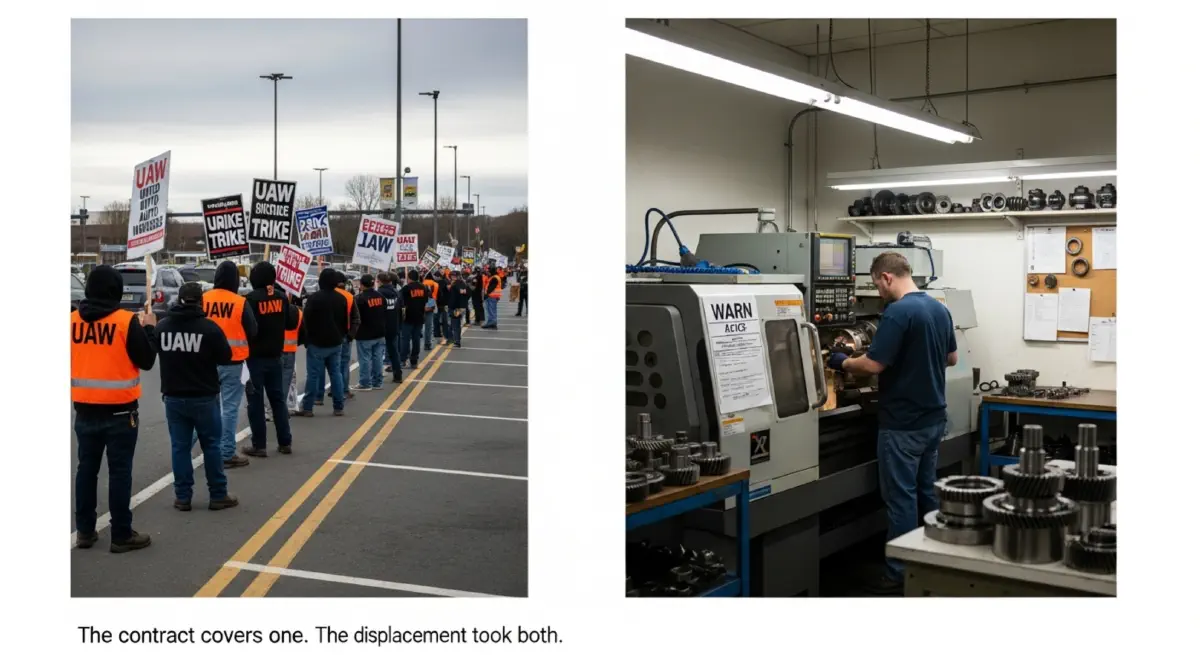
The Strike That Changed One Number#
In September 2023, the United Auto Workers launched the most strategically sophisticated industrial action in the union’s post-war history: a simultaneous targeted strike against all three Detroit OEMs — Ford, General Motors, and Stellantis — with selective escalation designed to maximise economic pressure while preserving UAW’s financial resources. The Stand Up Strike lasted 46 days. The tentative agreements reached in October and November 2023 delivered historic wage gains: approximately 25% increases over four years, improved cost-of-living adjustments, and the restoration of defined-benefit pensions for new hires at certain facilities. UAW President Shawn Fain’s description of the outcome: “We have won things that people said were impossible.”
The agreements also included a commitment from all three OEMs to maintain UAW representation at jointly operated battery manufacturing joint ventures — a specific structural win that addressed the most visible DAJC concern that the EV transition posed at the OEM level. Ford’s BlueOval SK facility in Kentucky, formed as a joint venture with SK On, would be UAW-represented under the new agreement. GM’s Ultium Cells joint ventures — with LG Energy Solution — were subject to UAW representation elections. Stellantis committed to bringing Tier 1 battery plants into UAW scope.
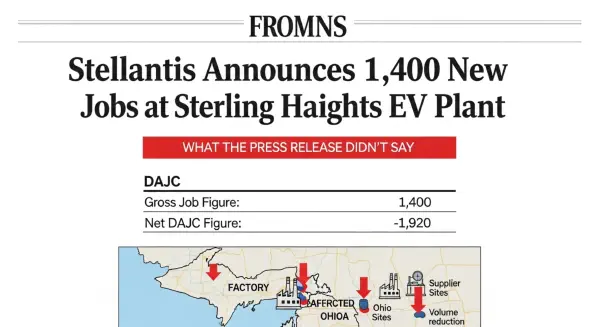
These were genuine and important wins. They were also wins at the OEM and large Tier 1 level — the fraction of the automotive employment ecosystem that is already unionised and whose workers were already covered by NLRA protections. The DAJC displacement identified in Post 2 — the 1,850–1,988 net positions at Sterling Heights, the 7,300–10,800 at the GM transition portfolio — falls heavily at Tier 2 and Tier 3, where unionisation rates are approximately 6–12%, where no UAW contract applies, and where the order-volume decline that drives displacement is invisible to the OEM-level bargaining table that was the 2023 focus.
The Architecture of the Coverage Gap#
What the UAW Contract Covers and What It Does Not#
The UAW’s collective bargaining agreements are plant-specific and employer-specific. The Ford contract covers workers at Ford Motor Company facilities — assembly plants, stamping plants, engine plants, and transmission plants whose ownership is Ford. It does not cover workers at Visteon, Denso, Martinrea, Shiloh Industries, or the hundreds of other independent Tier 1 and Tier 2 suppliers who manufacture the components that Ford’s assembly plants install. Those workers are covered, if at all, by separate collective bargaining agreements with their own employers — or they are not covered by collective agreements.
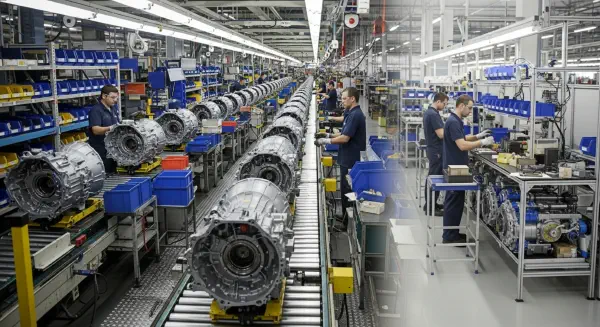
The manufacturing labour intensity differential that generates the DAJC displacement — the 85–110 ICE drivetrain hours versus 55–85 EV drivetrain hours — is distributed across this multi-tier supply chain. The engine block that Ford installs was machined at a precision casting facility. The crankshaft was forged and balanced at a forging shop. The transmission was assembled at a Tier 1 transmission manufacturer. None of these facilities are party to the Ford UAW contract. When Ford’s EV transition reduces their order volume, the workers at those facilities have no contractual protection that the Ford-UAW negotiation can extend or modify.
This is not a gap created by the EV transition — it is a structural feature of the automotive industry’s supply chain organisation that predates electrification by decades. The transition has made it catastrophically relevant: in the ICE era, a supplier’s order volume from a given OEM fluctuated with model cycles and production volumes but did not face permanent structural elimination. The EV transition eliminates the component category entirely — there is no electric version of a catalytic converter, no electric version of a cylinder head. The supplier’s product category does not transition; it disappears.
The German Co-Determination Parallel and Its Limits#
Germany’s industrial relations system operates differently. The Mitbestimmungsgesetz (Codetermination Act) of 1976 requires large German enterprises to have worker representatives on the supervisory board, creating institutional access to strategic corporate decision-making that the U.S. system’s OEM-level collective bargaining does not provide. IG Metall’s engagement with Volkswagen’s transformation planning — including the joint competence centres for EV-related retraining and the negotiated timeline for facility conversion — reflects a richer institutional architecture for managing transitions than the U.S. framework can deploy.
Even within co-determination, the DAJC displacement at the supplier tier creates the same structural challenge as in the U.S.: VW’s supervisory board can negotiate the timeline and conditions for VW facility conversions. It cannot negotiate the order volume that ZF Friedrichshafen, Bosch’s powertrain division, Eaton’s automotive business, or the hundreds of independent precision component manufacturers will lose as the Passat, Tiguan, and ID platform consolidate around EV drivetrain architectures. The supplier workers covered by separate enterprise-level agreements — or by no agreement at all, if the supplier is below the 2,000-employee threshold for board-level co-determination — face the same invisible displacement that DAJC quantifies but collective bargaining cannot address within its current institutional scope.
The DAJC-Negative Outcome as a Political Economy Problem#
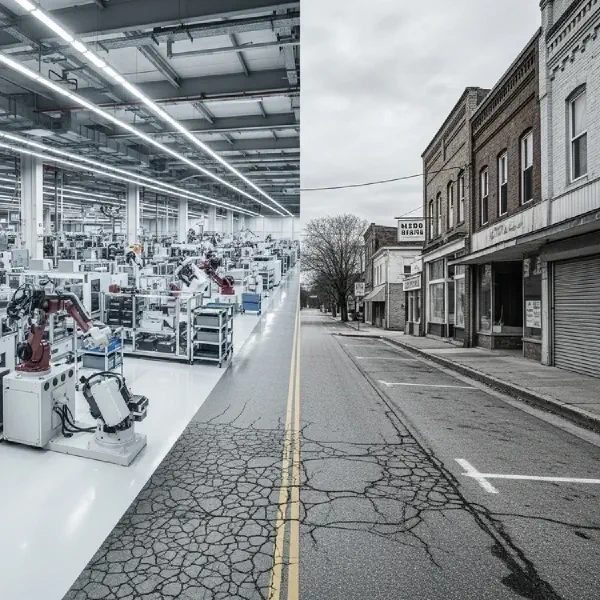
The pattern that DAJC mapping reveals is a political economy problem with a structural shape. The workers who gain in DAJC-positive terms — new assembly jobs at battery facilities, EV assembly plants, and motor manufacturing facilities — are concentrated in greenfield facilities in states with active economic development incentive programmes, predominantly in the southeastern U.S. and targeted midwestern locations. These workers vote in states where the job creation narrative is the political headline. The workers who lose in DAJC-negative terms — precision manufacturing workers at ICE drivetrain suppliers — are concentrated in the legacy industrial communities of Michigan, Ohio, Indiana, Illinois, and the German Automotive Belt. Their displacement is processed through the economic adjustment mechanisms of trade adjustment assistance, unemployment insurance, and community college retraining programmes, none of which were designed for the speed or scale of a technology-driven production category elimination.
The political economy of this distribution creates a specific perverse incentive: the workers and communities who benefit from the transition are in jurisdictions that are likely to support it; the workers and communities who bear the DAJC-negative displacement cost are in jurisdictions already predisposed to challenge the transition’s political legitimacy. The failure to calculate and acknowledge the DAJC cost of the transition is not merely a measurement error — it is a political miscalculation that fuels the binary debate between “the EV transition destroys jobs” and “the EV transition creates jobs.” Both claims are simultaneously and partially true. DAJC is the framework that makes both claims precise: the transition creates jobs at the OEM and large Tier 1 level, where negotiated visibility exists; it destroys jobs at the Tier 2 and Tier 3 supplier level, where no negotiated visibility exists; and the destroyer exceeds the creator in net terms under any DLIR assumption in the empirically supported range of 3.1–3.6.
Just transition policy that does not include DAJC calculation as a precondition for investment approval is not just transition policy. It is investment promotion with a rebranding. The industrial policy credibility of the EV transition depends on whether its architects are willing to measure what it costs, rather than announcing only what it creates.