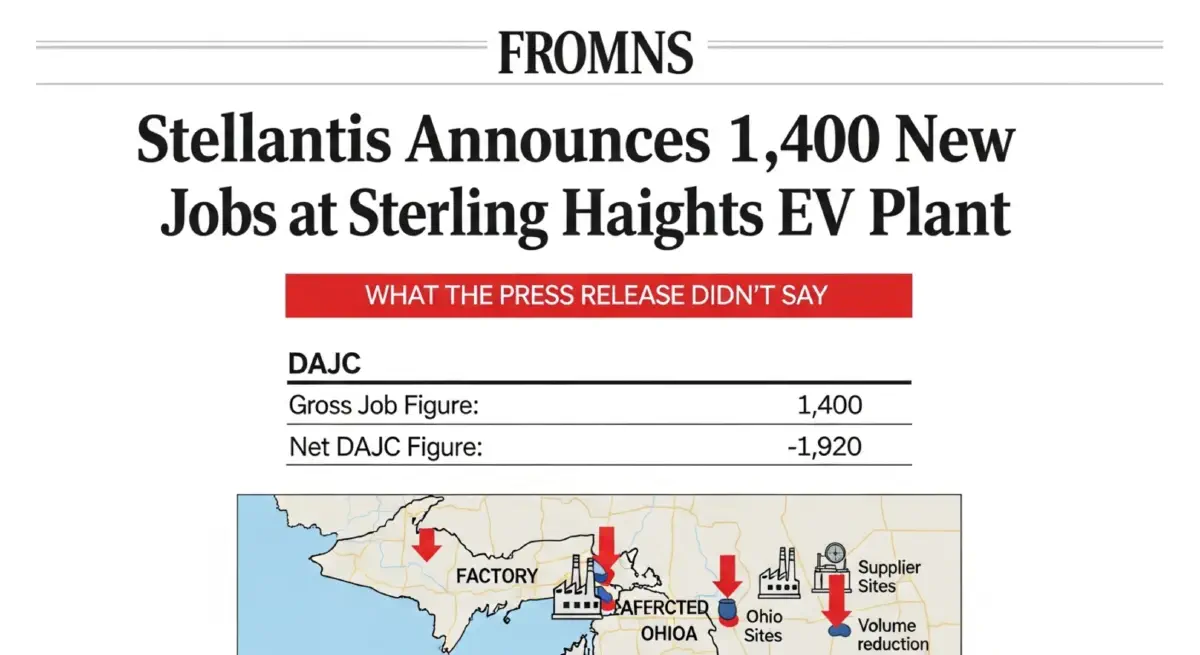
The Press Release and Its Arithmetic#
On February 28, 2022, Stellantis announced a $3.2 billion investment to transform its Sterling Heights Assembly Plant in Michigan into an EV manufacturing facility, with production of an electric Ram 1500 pickup beginning in 2024. The announcement included a job creation claim: approximately 1,400 new positions would be created or retained as a result of the investment. Michigan Governor Gretchen Whitmer called it a “huge win for Michigan workers.” The UAW issued a statement describing the agreement as an important step in the EV transition. The press coverage was uniformly positive.
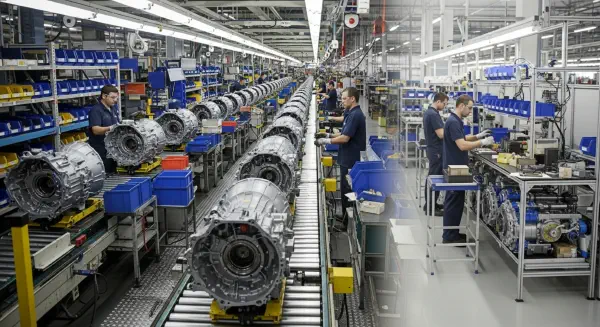
The Sterling Heights Assembly Plant had previously produced the Ram 1500 Classic pickup with a 5.7L Hemi V8 or a 3.6L Pentastar V6 — powertrains assembled from components made at Stellantis engine plants in Trenton, Michigan and Saltillo, Mexico, with transmissions from Stellantis’s Kokomo, Indiana facility. The Sterling Heights plant’s production volume of approximately 250,000 vehicles per year was supported by an estimated 4,800 drivetrain-specific supplier positions across the Tier 1 and Tier 2 supply chain, based on the Center for Automotive Research’s supplier employment methodology for V8-platform pickup trucks.
Applying the DAJC formula to the Sterling Heights announcement:
$$DAJC = 1,400 - \left(4,800 \times \frac{3.4 - 1}{3.4}\right) = 1,400 - (4,800 \times 0.706) = 1,400 - 3,388 = -1,988$$The investment that created 1,400 jobs, on DAJC accounting, destroyed approximately 3,388 supplier positions — yielding a net employment effect of approximately −1,988. Under the low-end DLIR estimate of 3.1 (assuming higher EV drivetrain labour intensity from battery assembly integration):
$$DAJC_{low} = 1,400 - \left(4,800 \times \frac{3.1 - 1}{3.1}\right) = 1,400 - (4,800 \times 0.677) = 1,400 - 3,250 = -1,850$$The range: −1,850 to −1,988 net positions destroyed, with the central estimate approximately −1,920. The range of outcomes reported in public communications: +1,400. The range of outcomes that policy instruments responding to the press release can address: +1,400, because no DAJC calculation accompanied the investment announcement and no regulatory framework required one.
The Table Investment Announcements Did Not Publish#
The Stellantis, Ford, and GM DAJC Calculations#
The DAJC framework applied consistently to the major U.S. OEM EV investment announcements of 2021–2023 — the period in which the Inflation Reduction Act’s advanced manufacturing credits restructured the investment landscape — produces a set of results that the cumulative announcement narrative substantially misrepresents.
Ford Blue Oval City, Stanton, Tennessee (announced 2021, operational from 2025): 6,000 gross jobs at the complex. The Ford F-Series ICE powertrain supported an estimated 18,000–22,000 Tier 1 and Tier 2 supplier positions across the F-Series V8 and V6 production volume of approximately 750,000 units per year. The EV powertrain’s lower labour intensity, applied to the portion of that production volume transitioning to Blue Oval City’s capacity: approximately 8,000–11,000 displaced supplier positions from the ICE drivetrain volume reduction. DAJC range: approximately −2,400 to −5,700 depending on how the partial production transition to EVs is modelled against continued ICE production of the remaining F-Series volume. The partial transition dynamic complicates the calculation but does not resolve it to positive territory at any DLIR assumption in the 3.1–3.6 range for the displaced component.
GM EV Transition Programme, 2021–2025 (multiple facilities): GM announced investment of approximately $35 billion in EV and AV development through 2025, with conversion of multiple assembly plants — Spring Hill, Tennessee; Orion Township, Michigan; Hamtramck, Michigan — to EV production. The aggregate announced “new job” count cited in various statements: approximately 4,000 net new positions across the conversion facilities. The ICE supplier employment supported by the production volumes being converted: estimated 16,000–21,000 positions across the drivetrain supply chain, based on CAR’s supplier intensity methodology. DAJC for the conversion portfolio: approximately −7,300 to −10,800 net positions, depending on the fraction of ICE production fully versus partially discontinued at each converted facility.
Volkswagen Group, European Transition 2025–2030: The European automotive sector’s DAJC calculation has been partially performed by the German IG Metall union and the Bertelsmann Foundation’s Future of Work programme. Their 2021 analysis estimated that the European EV transition would result in a net loss of approximately 75,000 automotive sector jobs in Germany by 2030 under base-case adoption scenarios, with losses concentrated in the Baden-Württemberg and Bavaria supplier clusters where systematic ICE drivetrain manufacturing is most concentrated. The ACEA, using a different methodology that attributes higher labour intensity to battery manufacturing than the IG Metall supply-chain analysis, projected net EV-related job growth of approximately 25,000 by 2030. The methodological difference between IG Metall’s −75,000 and ACEA’s +25,000: treatment of the DLIR. IG Metall applies a DLIR of approximately 3.2 based on production floor data from IG Metall member plants. ACEA applies a lower effective DLIR by attributing all battery investment labour to the automotive sector — including the cell manufacturing jobs in South Korean and Chinese facilities that supply the European BEV fleet and are not European automotive jobs.
The Policy Instrument That Cannot See the Displacement#
The Inflation Reduction Act’s Advanced Manufacturing Production Credit (Section 45X) provides production tax credits of $35 per kWh of battery cell capacity manufactured in the United States, plus additional credits for battery module assembly, electrode active materials manufacturing, and qualifying components. The credit is structured to incentivise domestic battery manufacturing by reducing the cost disadvantage of U.S. production versus lower-cost Asian manufacturing. It makes no provision for the ICE drivetrain supplier workforce that is simultaneously displaced as the battery it incentivises replaces their production volume.
The EU’s Just Transition Fund, created under the European Green Deal with a capitalisation of €17.5 billion, was designed to support communities in heavy-carbon industries — coal mining, cement, steel, and oil refining — transitioning away from carbon-intensive production. Its geographic targeting is based on a Just Transition Plan submitted by each member state, identifying the communities most dependent on carbon-intensive activity. Automotive manufacturing communities whose employment intensity of ICE drivetrain production is a DAJC-negative transition risk are not systematically identified in the Just Transition Plans, because DAJC-negative outcomes are not calculated by the transition planning methodology. Zwickau in Saxony and Rüsselsheim in Hesse — both historically intensive ICE drivetrain manufacturing communities — did not appear in the German Just Transition Plan because automotive electrification was categorised as a decarbonisation solution rather than a transition risk.
A Metric Without a Policy Home#
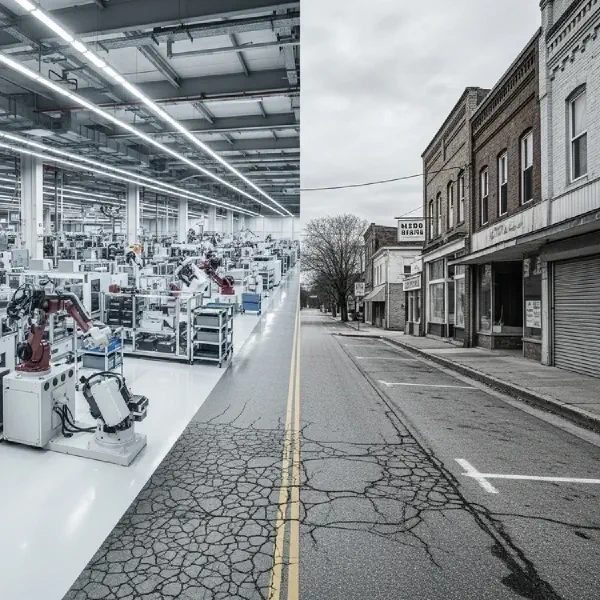
The DAJC table demonstrates a pattern that individual announcements conceal: every major EV investment announcement in the 2021–2023 period that applied DAJC accounting instead of gross job counting produced a negative net employment result. Not marginally negative — substantially negativein every case where the full supply-chain supplier employment supported by the ICE drivetrain volume was included in the calculation. The announcements were not dishonest about the jobs they were creating. They were incomplete about the jobs they were eliminating — and the incompleteness was systematic, because no regulatory requirement, no standard investment disclosure protocol, and no publicly funded analytical framework required the DAJC denominator to accompany the gross job numerator.
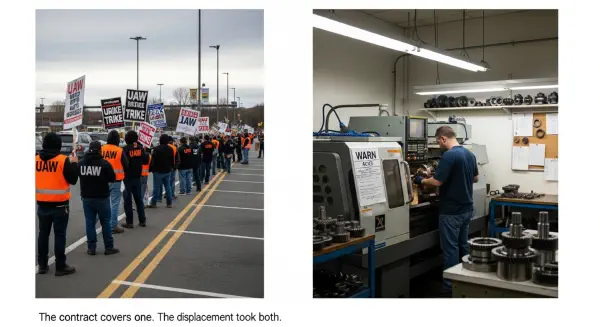
The next post examines whether collective bargaining — the institutional mechanism historically designed to protect workers in industrial transitions — is structurally capable of addressing DAJC-negative outcomes, and what the 2023 UAW contract cycle reveals about the limits of plant-level agreements in a supply-chain displacement event.