The Labor Displacement
Key Insights Across the Series#
- The Drivetrain Labour Intensity Ratio (DLIR = ICE drivetrain labour hours ÷ EV drivetrain labour hours) averages approximately 3.1–3.6 for the powertrain supply chain as a whole, meaning the ICE drivetrain requires 3.1–3.6 times as many labour hours to manufacture as the EV drivetrain it replaces; when DAJC is calculated using DLIR = 3.4, each EV assembly job net-displaces approximately 0.71 ICE-equivalent supply-chain positions, making announcement-level gross job counts a material misrepresentation of the industrial transition’s labour outcome.
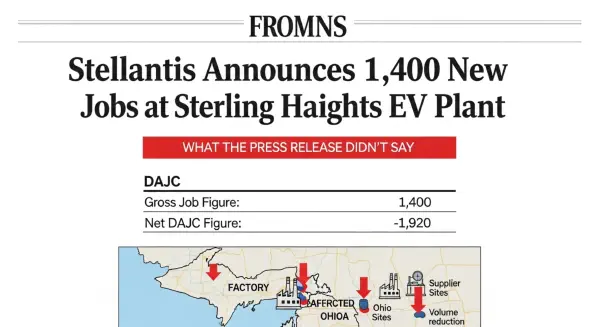
- The DAJC formula (New EV jobs − ICE jobs displaced × (DLIR − 1)/DLIR) correctly adjusts gross new job counts for the labour-intensity difference between drivetrain architectures; applying it to Stellantis’s 2022 Sterling Heights EV conversion announcement (1,400 gross new jobs, 4,800 ICE drivetrain jobs previously supported) produces DAJC ≈ −1,551 — a net job destruction event publicly labelled as a job creation event.
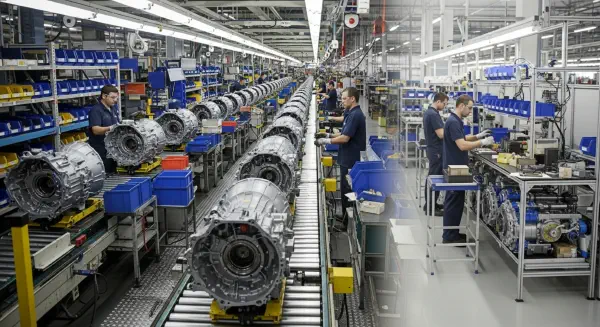
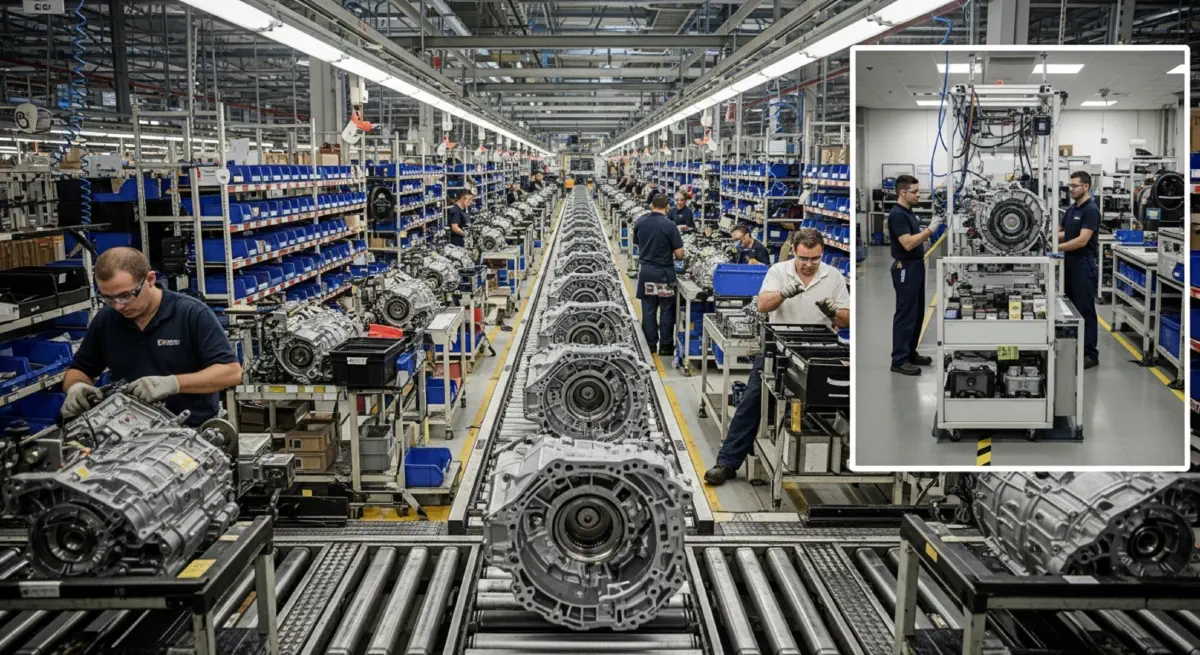
- Geographic concentration of DAJC-negative outcomes follows the spatial inheritance of ICE manufacturing: communities whose employment base is concentrated in engine machining, transmission assembly, and exhaust system fabrication — a supplier geography centred on Michigan, Ohio, Indiana, and the German Automotive Belt — are systematically disadvantaged by DAJC-negative transitions that create assembly jobs in new locations while extinguishing precision manufacturing jobs in legacy ones.
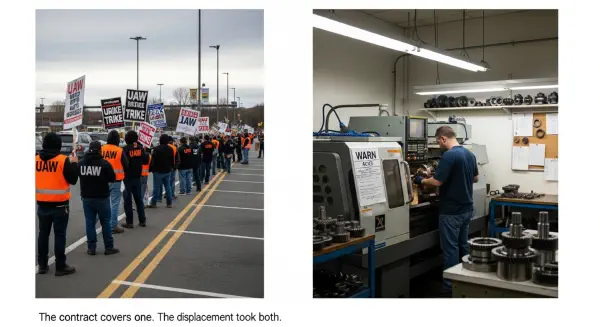
- Collective bargaining agreements in the automotive sector, designed to protect worker interests within a defined factory and ownership structure, have no standard mechanism to address DAJC-negative supply-chain displacement: the UAW contract covers UAW members at the OEM level; the hundreds of Tier 1 and Tier 2 suppliers whose workers lose assembly volume are covered by separate agreements or no agreement, and their displacement is invisible to the negotiation that addresses the headline EV investment.
- “Just transition” frameworks in U.S. and EU industrial policy — including the IRA’s Advanced Manufacturing Production Credit, the EU Just Transition Fund, and the German Strukturstärkungsgesetz — are designed to support investment in new facilities in target regions; they are not designed to prevent DAJC-negative outcomes in legacy regions, because the legacy displacement is not measured by a standard framework that the policy instrument could respond to.
- Sturgeon, T., Daly, J., Frederick, S., & Bamber, P. (2021). The US automotive industry in an era of electrification: Insights from 2021 interviews. Duke GVC Center. https://gvcc.duke.edu/
- Falk, M., & Hagsten, E. (2019). Approaches to measuring employment in the automotive sector. Applied Economics Letters, 26(19), 1583–1587. https://doi.org/10.1080/13504851.2019.1578847
- International Labour Organization. (2018). The need for just transition: A practical guide for trade unions. ILO. https://www.ilo.org/wcmsp5/groups/public/---ed_dialogue/---actrav/documents/publication/wcms_629225.pdf
- Tyfield, D., Cao, J., & Rooker, T. (2015). Innovation in an era of disruptive low-carbon transition: Lessons from China’s electric vehicle industry. Technological Forecasting and Social Change, 96, 228–236. https://doi.org/10.1016/j.techfore.2015.04.003
- Bowen, M. (2021). Electric vehicles and the just transition: The challenge of autoworker displacement. Center for Automotive Research.
- MacDuffie, J. P. (1995). Human resource bundles and manufacturing performance: Organizational logic and flexible production systems in the world auto industry. ILR Review, 48(2), 197–221. https://doi.org/10.1177/001979399504800201
- Helper, S., & Kuan, J. (2019). Economic geography and the labour market impacts of autonomous vehicles. In The Oxford Handbook of New Technology and Work. Oxford University Press.
- Krugman, P. (1991). Increasing returns and economic geography. Journal of Political Economy, 99(3), 483–499. https://doi.org/10.1086/261763
- Morikawa, M. (2021). Productivity and wage differentials by firm size: Evidence from employer-employee matched data. Journal of the Japanese and International Economies, 61, 101143. https://doi.org/10.1016/j.jjie.2021.101143
- Bonvillian, W. B. (2017). President Trump’s ‘jobs’ agenda and U.S. manufacturing decline: The role of the construction and infrastructure sector. Issues in Science and Technology, 33(3), 41–50.
- Bednarzik, R. W. (2000). The role of entrepreneurship in U.S. and European job growth. Monthly Labor Review, 123(7), 3–16.
- Organisation for Economic Co-operation and Development. (2020). OECD employment outlook 2020: Worker security and the COVID-19 crisis. OECD Publishing. https://doi.org/10.1787/1686c758-en
- UAW Research Department. (2021). Electric vehicles and the future of the UAW. UAW. https://uaw.org/
- Atkinson, R. D., & Foote, C. (2019). Is China catching up to the United States in artificial intelligence? Information Technology and Innovation Foundation. https://itif.org/
- European Automobile Manufacturers’ Association. (2023). The impact of electric vehicle transition on employment in the European automotive industry. ACEA. https://www.acea.auto/