The Battery Balance Sheet – Part 2: The BBM Table — Where EVs Break Even and Where They Never Do#
The Grid Map That Subsidy Policy Pretends Does Not Exist#
In January 2024, the German government abruptly terminated its EV purchase subsidy programme — the Umweltbonus — six weeks ahead of schedule, citing a €1.8 billion budget shortfall discovered when a Federal Constitutional Court ruling redirected climate fund allocations. The termination announcement triggered a 14% single-month collapse in German EV registrations and a cascade of factory production adjustments from Volkswagen, BMW, and Stellantis. What the policy debate that followed did not produce — in Germany or in any of the twelve other EU member states that operate EV purchase incentive schemes — was a question about whether the subsidy had been deploying equal climate value per euro spent across the German geography.
Germany's electricity grid averaged 434 gCO₂/kWh in 2022 and approximately 380 gCO₂/kWh by late 2024, reflecting the accelerating build-out of offshore wind capacity. At 380 gCO₂/kWh, a medium-format EV consuming 18 kWh per 100 km emits approximately 68 gCO₂/km in operation — a meaningful saving against a 150 gCO₂/km petrol comparator, but a saving of only 82 gCO₂/km. Against a manufacturing debt of 9,200 kg CO₂, the Battery Break-Even Mileage at current German grid intensity is approximately 112,000 km. A French consumer making the same purchase decision, drawing on a grid 90% nuclear at approximately 58 gCO₂/kWh, achieves break-even in approximately 57,000 km. Both receive the same subsidy amount. They are not making the same environmental investment.
The Matrix the Certification System Does Not Produce#
The BBM formula's value is not in producing a single number. It is in producing a table — a matrix of break-even distances that maps the environmental case for EV adoption against the actual energy geography of each market. That table is the deliverable that current certification refuses to construct. This post constructs it.
Applying the Formula Across the Grid and Chemistry Matrix#
The Five-Grid Calculation#
The Battery Break-Even Mileage formula is:
$$BBM = \frac{\text{Battery manufacturing CO}_2 \text{ (kg)}}{\text{ICE operational CO}_2\text{/km} - \text{EV operational CO}_2\text{/km}}$$Applying this formula requires three inputs for each market: the battery manufacturing carbon (the numerator, which varies by chemistry and production location), the ICE operational carbon per km (a function of the vehicle class and fuel type being replaced), and the EV operational carbon per km (a function of the grid intensity at the point of use and the vehicle's energy consumption rate). The ICE comparator used throughout this analysis is a C-segment petrol at 150 gCO₂/km — consistent with the EU-average new-car fleet CO₂ value before EV adoption effects and representative of the vehicle class where EV substitution is concentrated.
Norway (grid: 26 gCO₂/kWh, EV operational: 4.7 gCO₂/km, saving: 145.3 gCO₂/km). For a standard 75 kWh NMC pack at 9,200 kg manufacturing CO₂: BBM = 63,300 km. For a 60 kWh LFP pack at 7,200 kg manufacturing CO₂: BBM = 49,600 km. At Norway's grid intensity, all current battery chemistries achieve manufacturing break-even well within the first ownership cycle. Norway is the paradigm case where the EV environmental claim is unambiguously and immediately valid.
France (grid: 58 gCO₂/kWh, EV operational: 10.4 gCO₂/km, saving: 139.6 gCO₂/km). NMC 75 kWh BBM: 65,900 km. LFP 60 kWh BBM: 51,600 km. France's near-nuclear grid produces break-even distances comparable to Norway's. French EV policy, which includes one of the most generous per-vehicle incentive schemes in the EU at $6,000–7,500 for lower-income buyers, is deploying precisely where its climate arithmetic supports it.
Germany (grid: 380 gCO₂/kWh late 2024, EV operational: 68.4 gCO₂/km, saving: 81.6 gCO₂/km). NMC 75 kWh BBM: 112,700 km. LFP 60 kWh BBM: 88,200 km. Both chemistries achieve break-even within vehicle lifetime at current grid intensity, though at its outer bounds. The German case is grid-positive but sensitive: a battery produced in a more carbon-intensive manufacturing environment (Chinese cell manufacture at 560 gCO₂/kWh rather than European) increases manufacturing debt to approximately 11,800 kg and extends NMC break-even to approximately 144,600 km — beyond the average German vehicle lifetime. German EV certification does not require disclosure of where the cells were manufactured when calculating the environmental claim.
Poland (grid: 713 gCO₂/kWh, EV operational: 128.3 gCO₂/km, saving: 21.7 gCO₂/km). NMC 75 kWh BBM: 424,000 km. LFP 60 kWh BBM: 332,000 km. Neither chemistry achieves break-even within a realistic vehicle lifetime. Poland's per-vehicle EV subsidy programme, funded partly through EU cohesion funds, deployed at identical per-vehicle rates to the French and German programmes until 2023 revisions. The Polish EV buyer receives the same subsidy as the French buyer for a vehicle whose manufacturing debt cannot be repaid on the grid where it will operate. The subsidy is not environmentally neutral; it is funding a deferred environmental promise contingent on grid decarbonisation that has not yet been scheduled.
China (grid: 565 gCO₂/kWh, EV operational: 101.7 gCO₂/km, saving: 48.3 gCO₂/km). NMC 75 kWh BBM: 190,400 km. LFP 60 kWh BBM: 149,100 km. China's LFP chemistry — dominant in the domestic market at approximately 60% of new EV sales — achieves break-even closer to the upper bound of vehicle lifetime. The NMC case does not. China's grid decarbonisation trajectory — adding renewable capacity at approximately 300 GW annually — will shorten these break-even distances substantially over the next decade, but the vehicles being deployed in 2024–2026 are making their break-even calculation against current grid conditions, not projected future ones.
The Three-Chemistry Adjustment#
Battery chemistry is the second variable in the BBM numerator, and its effect on the table is substantial enough to alter the conclusion for specific markets.
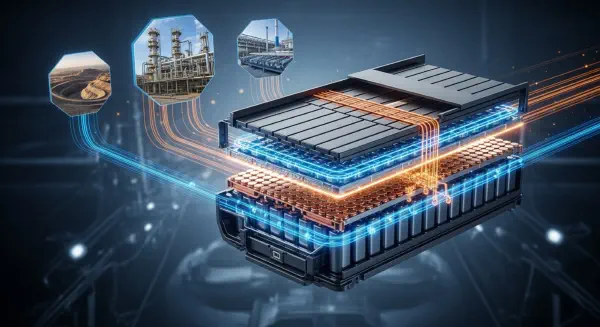
Nickel-Manganese-Cobalt (NMC) chemistry, dominant in premium and long-range Western EVs, carries the highest manufacturing carbon of current commercial chemistries due to cobalt and nickel content. At 9,200 kg CO₂e for a 75 kWh pack under European manufacture, NMC is the most manufacturing-intensive option per unit capacity.
Lithium-Iron-Phosphate (LFP) chemistry, which uses neither cobalt nor nickel, carries approximately 20–25% lower manufacturing carbon per kWh of capacity — approximately 6,100–7,500 kg CO₂e for a 75 kWh equivalent pack, or 4,900–6,000 kg for a 60 kWh pack that achieves comparable real-world range. LFP's lower energy density requires a larger pack for equivalent range, partially offsetting the per-kWh carbon advantage, but the net manufacturing debt per vehicle remains meaningfully lower. In Germany, LFP BBM is 88,200 km vs. NMC's 112,700 km — a difference that, at current German grid intensity, distinguishes a vehicle that will likely break even from one that may not.
Solid-state batteries — entering limited production from 2025–2027 at Toyota, QuantumScape, and Solid Power — project manufacturing carbon savings of 15–30% per kWh relative to NMC at volume production, primarily from the elimination of liquid electrolyte and separator manufacturing steps. For a solid-state 75 kWh equivalent pack, projected manufacturing debt falls to approximately 6,400–7,800 kg CO₂e. At Polish grid intensity, this produces a BBM of approximately 295,000–360,000 km — still more than double vehicle lifetime, but representing meaningful directional improvement. The BBM framework makes these chemistry trade-offs legible at the market level, which no current certification system does.
The Production-Location Multiplier#
BBM is a function not only of where the vehicle is operated but of where the battery was manufactured. A cell produced in a Norwegian or Icelandic facility with near-zero-carbon industrial electricity carries a manufacturing debt of approximately 4,200–5,500 kg CO₂e for a 75 kWh NMC pack — less than 60% of the European average. A cell produced in a Chinese facility at 560 gCO₂/kWh industrial electricity carries approximately 11,400–13,200 kg — approximately 40% higher than the European average.
The IRA's domestic content requirements and the EU Battery Regulation's supply-chain disclosure framework are both designed to shift production toward lower-carbon manufacturing environments. Neither instrument produces a BBM figure at the point of sale. An American EV qualifying for the full $7,500 IRA tax credit under domestic assembly rules may have had its cells manufactured in a facility whose production-location multiplier produces a BBM 30–40% longer than a European-produced alternative. The credit is calibrated to supply-chain geography, not to the climate outcome that BBM measures.
The Table That Policy Cannot See and Consumers Are Not Shown#
The BBM matrix produced by this analysis divides the major EV markets into three categories that current regulatory architecture refuses to distinguish.
The first category — Norway, France, Iceland, Sweden — comprises markets where current grid intensity makes EV adoption an immediate, unambiguous environmental investment at manufacturing debt levels achievable with current battery technology. BBM falls below 70,000 km for all commercial chemistries. These markets are where EV subsidies generate genuine and prompt carbon reduction per euro spent.
The second category — Germany, United Kingdom, Austria, Netherlands — comprises markets where current grid intensity places most EV configurations within vehicle lifetime break-even under favourable manufacturing conditions, but within a range where manufacturing location and chemistry choice become policy-relevant variables. BBM falls between 85,000 and 145,000 km depending on chemistry and production source. These markets are where the BBM disclosure would meaningfully change consumer and policy decisions.
The third category — Poland, Czech Republic, India, China (current grid), South Africa — comprises markets where current grid intensity produces BBM values outside realistic vehicle lifetimes for standard NMC chemistry. These are not markets where EVs are permanently non-beneficial; they are markets where the environmental case depends on grid decarbonisation commitments that have not yet been translated into deployed capacity. They are receiving the same per-vehicle subsidies, the same zero-emission designations, and the same regulatory incentives as Category 1 markets — and they will not produce the same climate outcomes. The BBM table makes that distinction explicit. Its absence from policy design makes the distinction invisible. The next post will show how that table changes over time, because the break-even calculation is not static: as the battery ages, the denominator shrinks and the break-even distance moves further away.