The Battery Balance Sheet – Part 1: The Manufacturing Debt — What a Battery Actually Costs in Carbon#
The Definition That Was Designed Not to Look Upstream#
In February 2021, Volvo Cars published a lifecycle assessment that its communications department had clearly debated releasing. The document confirmed what independent researchers had been publishing for years: the Polestar 2 long-range sedan entered the world carrying approximately 26 tonnes of CO₂ equivalent embedded in its manufacturing process — against 17.2 tonnes for a comparable Volvo XC40 petrol. The gap was 8.8 tonnes, attributed almost entirely to the traction battery. Volvo framed the disclosure as corporate transparency. What it revealed, more precisely, was the existence of a systematic accounting gap in European automotive regulation.
The "zero emission vehicle" designation in EU Regulation 2019/631 — Europe's binding fleet CO₂ standard — is a point-of-use definition. It measures exhaust emissions during vehicle operation. A vehicle generating zero grams at the tailpipe receives zero-emission classification regardless of the carbon content of the lithium it required, the coal firing the refinery that processed it, or the grid powering the Gigafactory that assembled its cells. Every EV subsidy, fleet credit, and green financing instrument in the European architecture is built on a definition that treats the manufacturing phase as legally invisible. The battery's carbon debt is a real, calculable quantity — and the opening balance in a ledger that European vehicle certification was specifically designed not to open.
The Debt That Accumulates Before the First Charge#
The central claim supporting EV environmental benefit is that replacing a petrol car with an electric one reduces lifetime carbon emissions. That claim is conditional on premises that point-of-sale regulation does not verify: a grid sufficiently clean to overcome the battery's manufacturing carbon within the vehicle's operational lifetime, and an accounting framework that includes manufacturing in the comparison at all. Neither condition is presently confirmed when a purchasing decision is made. Measuring the debt precisely is the necessary foundation for any honest claim about when — and whether — an EV delivers its environmental promise.
Tracing the Carbon Through the Supply Chain#
From Ore Body to Gigafactory Floor#
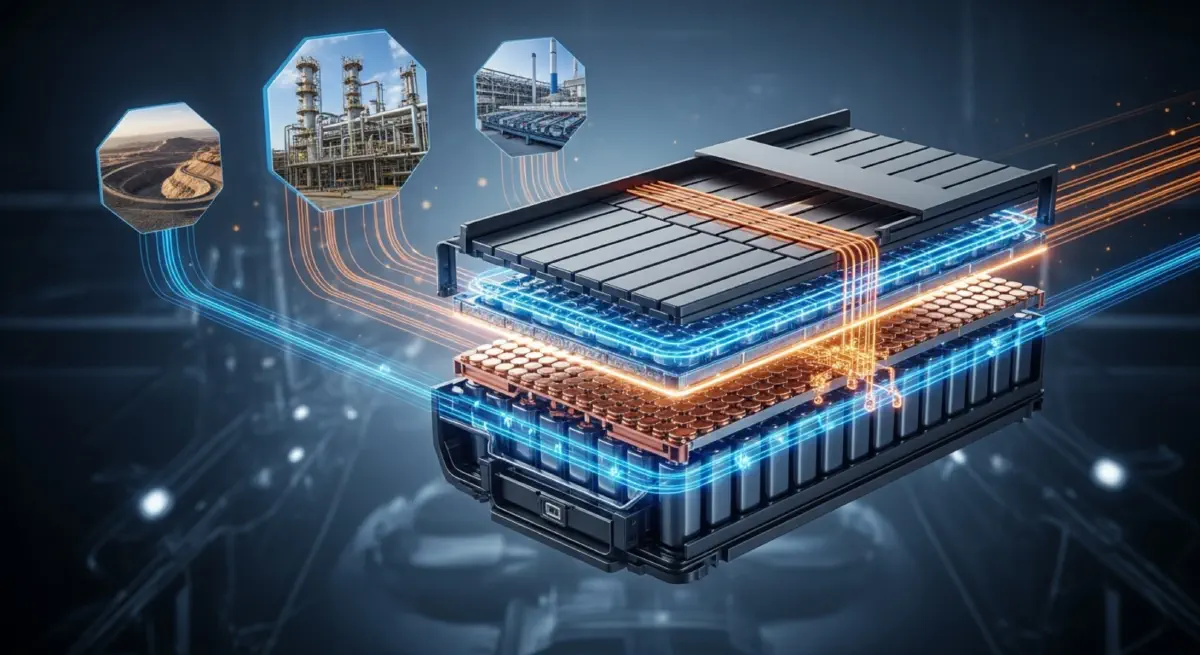
The lithium-ion battery pack is not manufactured in a single location. It is assembled from materials whose extraction, chemical transformation, and cell synthesis span three continents before a single cell reaches an assembly plant, and each stage carries a carbon cost determined by the energy sources available at that stage.
Lithium extraction generates carbon primarily through processing rather than mining. Hard-rock spodumene mining, concentrated in Western Australia and accounting for approximately 45% of global supply, requires crushing, flotation, and high-temperature roasting to produce lithium concentrate. This roasting step — typically coal or natural gas-fired — generates approximately 1.5–2.5 kg CO₂ per kilogram of lithium carbonate equivalent at the mine site. Brine extraction in the Atacama Desert involves lower direct energy consumption at the mining stage but multi-year evaporation cycles and substantial embedded water infrastructure. Neither method is energy-free; neither is accounted for in any vehicle emissions certification.
The refining stage is where the carbon arithmetic becomes most consequential. Converting spodumene concentrate into battery-grade lithium hydroxide — the specific compound required for modern NMC and NCA cathodes — demands acid roasting, solvent extraction, and controlled crystallisation. As of 2024, China controls approximately 68% of global lithium hydroxide processing capacity. Chinese industrial electricity averaged 550–580 gCO₂/kWh in 2023, powered predominantly by coal baseload with slowly expanding renewable capacity. Processing the approximately 8.5 kg of lithium metal content in a single 75 kWh NMC battery pack through a Chinese refinery generates between 90 and 160 kg CO₂ — for lithium alone.
Cobalt and nickel each carry comparable upstream footprints. Cobalt, sourced primarily in the Democratic Republic of Congo and refined predominantly in China, involves hydrometallurgical processing that contributes approximately 150–200 kg CO₂ per EV battery. Nickel's conversion to battery-grade nickel sulphate is among the most energy-intensive per-unit-mass steps in the entire supply chain; Indonesia's expanding laterite nickel processing, built around coal-fired industrial parks, generates approximately 40–55 tonnes CO₂ per tonne of finished nickel sulphate. Cell manufacturing at modern Gigafactory facilities consumes energy at a rate Argonne National Laboratory's BatPaC model estimates at 400–600 kWh per kWh of battery capacity produced. At a German facility drawing on a grid averaging 430 gCO₂/kWh, manufacturing the cells for a 75 kWh pack generates 12.9–19.4 tonnes CO₂ from cell manufacturing alone.
Pack assembly, thermal management hardware, battery management electronics, and structural integration add a further 0.5–1.5 tCO₂e. The aggregate manufacturing carbon for a 75 kWh NMC battery pack — totalling mining, refining, cell manufacturing, and pack assembly — falls in the range of 7–13 tCO₂e under European or East Asian industrial conditions. Argonne's GREET model central estimate for this configuration is approximately 9.2 tCO₂e, representing the weighted average of manufacturing locations and grid intensities characterising actual production in 2023–2024. This is the battery's carbon backpack at the moment of first charge: the manufacturing debt that operational savings must repay before any net environmental benefit accumulates.
The Two Regulatory Frameworks That Cannot See Each Other#
European vehicle emissions regulation has always been structured around point-of-use performance. The Euro emissions standards, the CO₂ fleet average regulation, and the ZEV certification framework all measure what exits the exhaust pipe during operation. This was a defensible design choice in 1993, when the dominant environmental question was urban air quality from combustion products. By 2025, the largest source of environmental differentiation between competing powertrain technologies is the carbon intensity of manufacture, not operation — yet the regulatory architecture has not rotated.
EU Regulation 2023/1542 — the Battery Regulation — is the first instrument to require lifecycle carbon accounting for traction batteries, mandating Carbon Footprint Declarations from 2024 and maximum lifecycle thresholds from 2027. This represents methodological progress. It also reveals its own limits: a Carbon Footprint Declaration is a supply-chain compliance document filed with regulatory authorities, not a consumer-facing purchase disclosure. It does not appear on a window sticker. It is not recalculated annually as the Polish or German grid decarbonises. It does not produce the single, comparable figure — distance to manufacturing break-even — that could allow a consumer in Warsaw to understand that their EV decision involves different environmental arithmetic than an identical decision made in Bergen.
The gap has an exact parallel in national accounting conventions. GDP treats defensive expenditures — pollution cleanup, preventable disease treatment — as economic growth, a structural error that Simon Kuznets himself warned against in 1944. European vehicle certification makes an analogous choice: it counts the operational benefit of the EV while excluding the manufacturing cost, mistaking a partial account for the whole. The methodology is not an oversight. It was inherited from a regulatory tradition built before the manufacturing phase became the critical variable.
The Grid Differential That Makes the Debt Either Recoverable or Permanent#
Manufacturing carbon is a fixed cost. The rate at which operational savings repay it is determined entirely by where the vehicle is charged. This geographic variability is not a correction factor around a central truth — it is the central analytical fact, and it generates outcomes that span from a manageable debt to one that exceeds the vehicle's entire service life.
Norway's electricity grid is 90–95% hydroelectric, producing approximately 26 gCO₂/kWh in annual average terms. An EV consuming 18 kWh per 100 km in Norwegian conditions emits approximately 4.7 gCO₂/km in operation, against a petrol comparator generating 150 gCO₂/km. The operational saving is 145.3 gCO₂/km. Against a manufacturing debt of 9,200 kg CO₂, the break-even distance is approximately 63,300 km — achievable within the first ownership cycle. Poland, where coal supplies 70–75% of electricity at approximately 713 gCO₂/kWh, yields an EV operational footprint of approximately 128 gCO₂/km — only 22 gCO₂/km below the petrol comparator. At that saving rate, repaying the same 9,200 kg manufacturing debt requires approximately 418,000 km. The average Polish vehicle lifetime is 160,000–180,000 km. The Polish EV does not break even on battery carbon within a realistic service life.
China is the most consequential case globally: 9.4 million passenger EVs sold in 2023, operating on a grid averaging 550–580 gCO₂/kWh. A Chinese EV requires approximately 250,000 km to achieve manufacturing carbon break-even — outside a typical vehicle lifetime. Knobloch et al., writing in Nature Sustainability in 2020, estimated that 95% of EVs globally already deliver lower lifecycle emissions than petrol equivalents. That figure reflects grid conditions at a specific baseline. Extended to current deployment in grid-intensive markets — Poland, India (730 gCO₂/kWh), South Africa (820 gCO₂/kWh) — the 95% figure contracts under the arithmetic of deploying the same vehicle in fundamentally different energy environments. The universal claim is not wrong everywhere. It is wrong in specific geographies that receive identical policy instruments as though they were Norway.
The Formula the Window Sticker Does Not Show#
The three components assembled in this post — the battery's manufacturing carbon at 9.2 tCO₂e as a central estimate, the regulatory frameworks that do not disclose it, and the grid-dependent arithmetic of when it can be repaid — define the components of a single calculable metric.
The Battery Break-Even Mileage formula is:
$$BBM = \frac{\text{Battery manufacturing CO}_2 \text{ (kg)}}{\text{ICE operational CO}_2\text{/km} - \text{EV operational CO}_2\text{/km}}$$The numerator is the manufacturing carbon established here. The denominator is the operational saving per kilometre at the relevant grid intensity — the difference between what the petrol vehicle would emit and what the EV actually emits at the point of use. The result is the distance that must be driven before the EV has cancelled its manufacturing debt.
This calculation appears in academic lifecycle assessments. It appears in the Argonne GREET model for researchers who know to look. What it does not appear on is any window sticker, any subsidy application form, any insurance document, or any consumer comparison tool in any EU member state. The EU Battery Regulation will produce Carbon Footprint Declarations — supply-chain documents for regulators. It will not produce a BBM per vehicle, calculated at the grid intensity of the country of sale, updated as grids change, visible to the person deciding between a petrol and electric car in a Polish dealership in March 2026.
The next post applies this formula systematically: five national grids, three battery chemistries, a matrix of break-even distances that divides the European market into categories that its certification framework cannot currently distinguish. The numbers do not argue against electric vehicles. They argue against the fiction that identical subsidies in Norway and Poland are responding to the same environmental arithmetic — and against the policy architecture that has chosen to maintain that fiction.