
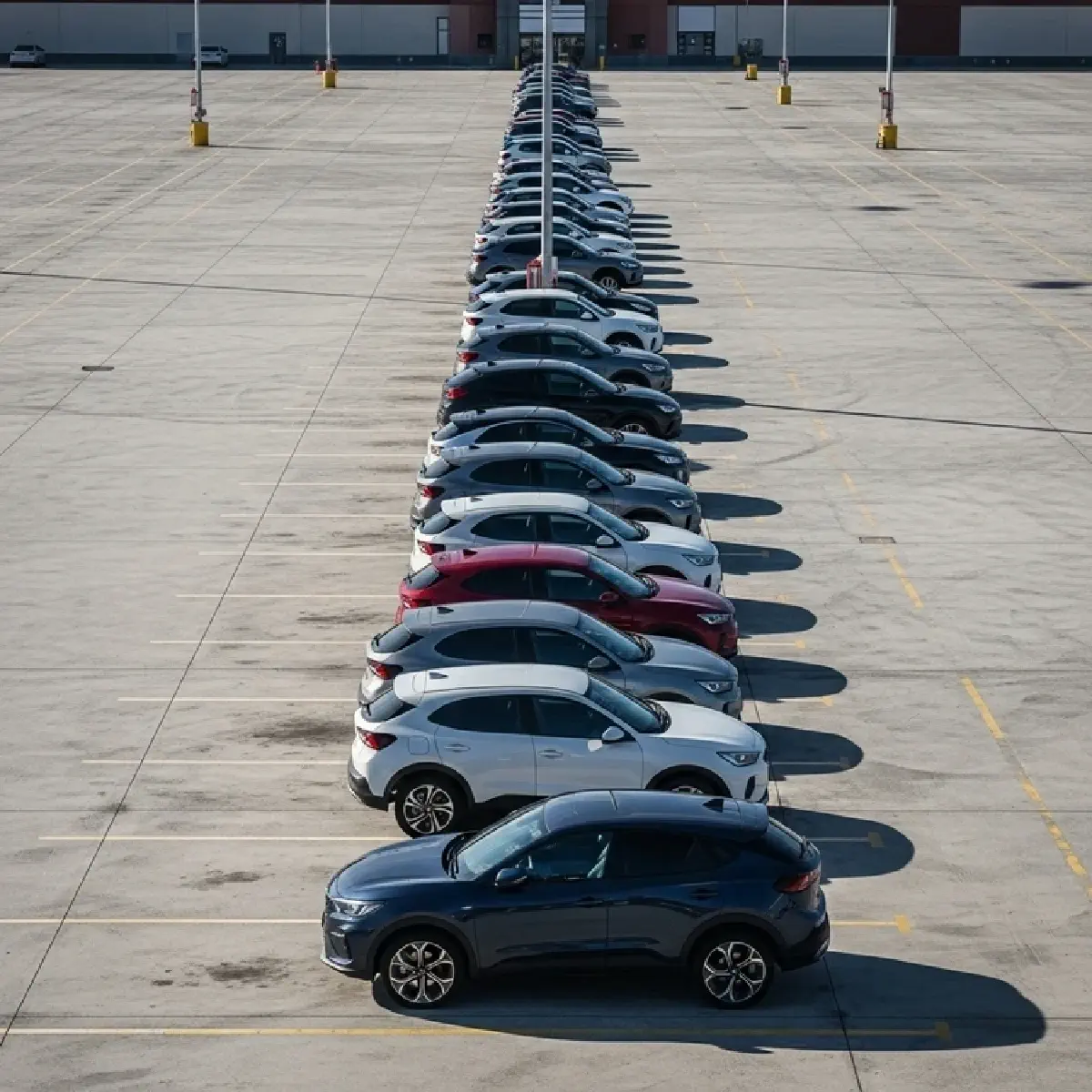
The SUV’s conquest seemed complete by the early 2000s. It had defeated the sedan, marginalized the minivan, and redefined the American automotive landscape. But its very success bred new vulnerabilities. The 2008 financial crisis and another spike in oil prices exposed its economic fragility. Critics hammered its environmental impact. The “SUV backlash” was in full swing.
The industry’s response was not to retreat, but to evolve. The loophole that birthed the SUV now threatened to constrain it. The next strategic shift involved abandoning the very truck platform that defined it. Enter the crossover SUV.
Built on car platforms, crossovers offered better fuel economy, handling, and ride comfort. They looked like SUVs—tall, upright, and muscular—but were legally and mechanically classified as passenger cars. This was the final, perfect synthesis. The crossover shed the truck’s drawbacks while keeping its psychological and aesthetic benefits. It was the ultimate vehicle of compromise, and it accelerated the SUV’s dominance. By 2020, crossovers and SUVs together accounted for over 70% of all new vehicle sales in the United States.
The Luxury Reboot and the Death of the Car#
The most profound transformation occurred at the high end of the market. Luxury brands like Cadillac, Lincoln, and later even Porsche and Lamborghini, once defined by low-slung sedans, pivoted almost entirely to SUVs. The luxury sedan, a symbol of elegance and engineering, became a niche product. The luxury SUV became the primary profit engine.
This shift was driven by pure economics. Profit margins on large SUVs were—and remain—exceptionally high, often exceeding $10,000 per vehicle. A luxury SUV could command $20,000 or more above its production cost. For automakers, these were not just vehicles; they were financial instruments. They funded investments in electric and autonomous technology that their own gasoline-heavy product lines were making obsolete.
The SUV thus completed its journey from regulatory accident to centerpiece of corporate strategy. It morphed from a functional tool into a token of value extraction. The high-profit SUV subsidized everything else, creating a perverse incentive to sell ever-larger, more expensive models. The humble, truck-based wagon had become the financial bedrock of the global auto industry.
Cascading Externalities: The SUV’s True Legacy#
The societal footprint of this triumph is vast and measurable. The shift from cars to SUVs was the second-largest contributor to the global increase in CO2 emissions between 2010 and 2018, behind the power sector but ahead of heavy industry, trucks, and aviation. If SUVs were a nation, they would be the world’s sixth-largest emitter.
Their impact extends beyond emissions. Their weight accelerates road wear—damage to pavement scales to the fourth power of axle weight. A single 6,000-pound SUV causes exponentially more road damage than a 3,000-pound sedan. Their size demands more space, widening streets, enlarging parking stalls, and contributing to urban sprawl. Their taller hoods create larger front blind zones, contributing to a tragic increase in pedestrian fatalities, which hit a 40-year high in the US in 2022.
Perhaps the ultimate paradox is that the SUV solved few of the practical problems it claimed to address. Studies show the average SUV or crossover carries only 1.5 passengers per trip—no better than a car. Their cargo space, while large, is often less usable than a minivan’s due to the height of the load floor. They are, for most daily uses, a highly inefficient packaging of mass, energy, and space.
The Drag Act Never Ends#
The story of the SUV is a masterclass in unintended consequences. A regulatory footnote (Policy and Critique) designed to protect a dying breed of work trucks spawned a vehicle that reshaped the world’s cities, energy systems, and climate. It is a tale of industrial adaptation (Historical Case Studies), where legacy automakers used their institutional knowledge of trucks to fend off foreign competition in cars.
It is driven by deep-seated consumer psychology—the desire for safety, status, and a narrative of autonomy. And its entire lifecycle, from the mining of its materials to the wear on our infrastructure, is a story of displaced costs and global supply chains (Trade and Supply Chains).
The station wagon never died. It simply put on a costume, first of a truck, then of an adventure gear icon, and finally of a luxury good. Each rebranding answered a market need, real or perceived, while expertly navigating the rules of the game. The SUV is the ultimate chameleon, a vehicle whose identity is forever flexible because its original purpose was never about function. It was about finding a way to survive, and then dominate, within a system of rules it was never meant to play by. The drag act continues, now on an electrified stage, proving that the most powerful force in automotive history is not horsepower, but context.