
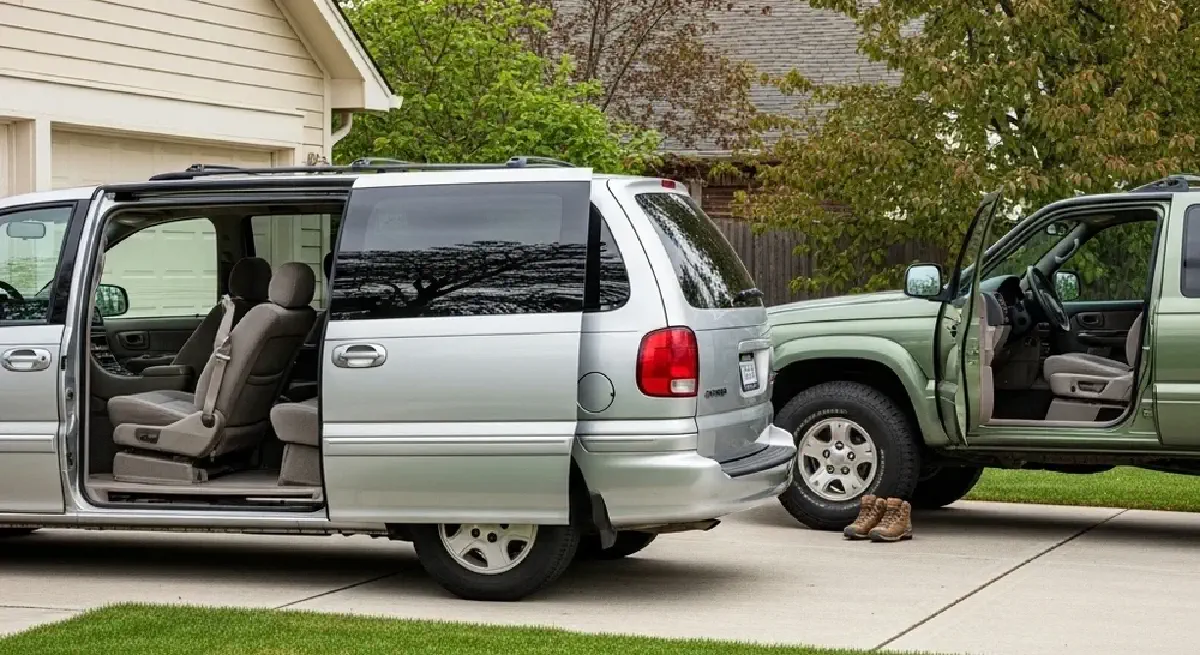
By the early 1990s, the SUV had established its legal and commercial beachhead. But it did not conquer the family garage unchallenged. Its most significant rival emerged not from the truck world, but from a more pragmatic place: the minivan.
Introduced by Chrysler in 1984, the minivan was a revelation. It was based on a passenger car platform, offering car-like fuel economy and handling. Its unibody construction, sliding door, and low floor made it phenomenally functional. It was the true spiritual successor to the station wagon, optimized for the modern errand. For a decade, it reigned supreme as the sensible family vehicle.
The SUV’s path to victory required defeating this rational favorite. It did so not on the basis of utility or cost, but by tapping into a powerful undercurrent of social psychology and perceived risk. Automakers began a deliberate campaign to frame minivans as symbols of surrender—to parenthood, to practicality, to dullness. SUVs, in contrast, were marketed as vehicles of autonomy and retained identity.
Advertising shifted decisively. Minivan ads showed happy families loading up for a trip. SUV ads showed a single vehicle, often filmed in majestic, empty landscapes like Moab or the Rockies. The driver was portrayed as an adventurer, an individual. Even if the vehicle was destined for suburban streets, it sold a dream of escape and capability. This marketing framed the SUV not as a tool for a task, but as a badge of self-reliance.
Engineering the Illusion of Safety#
The most potent weapon in this campaign was safety—or, more accurately, the perception of safety. SUVs sat higher. They were heavier. They felt more substantial. This created an undeniable psychological advantage: the command seating position. Surveys consistently showed buyers felt “safer” and “more in control” in an SUV.
The physics, however, told a more complex story. Their high center of gravity made them prone to rollover accidents, a rare but often deadly crash mode for passenger cars. Their stiff, truck-based frames did not absorb crash energy as well as car frames, leading to greater risk for occupants in certain impacts. Most consequentially, their height and rigidity posed a lethal incompatibility with passenger cars. In a collision, an SUV’s bumper would override a car’s crumple zones and crash directly into the passenger compartment.
Automakers knew this. Internal memos from the 1990s discussed the “aggressivity” of their light trucks towards cars. Yet, publicly, the narrative of ultimate safety was pushed relentlessly. It created a vicious arms race mentality on the road. If your neighbor drove a larger vehicle, you became less safe in your sedan. The rational response was to also buy an SUV. This negative externality, where one person’s purchase degraded the safety of others, fueled a mass migration out of passenger cars.
The Cowboy Cargo Cult#
The SUV’s aesthetic solidified this ethos. Designers embraced what critics called “muscular utilitarianism.” Fenders became flared. Hoods rose, both for styling and to accommodate larger V8 engines. Grilles grew prominent and chrome-accented. The original Jeep’s functional design cues—the squared-off shoulders, the vertical grille—were copied and exaggerated into a visual language of toughness.
This was a cargo cult of capability. Most SUVs would never see a dirt road, let alone a rocky trail. The plastic “cladding” on lower doors, originally meant to protect against brush scratches, became a ubiquitous styling feature on pavement-bound models. Roof racks were standard, often carrying nothing but air resistance. The vehicles were performances of utility, their design signaling an adventurous spirit that most owners would never exercise.
This transformation reached its peak with the launch of vehicles like the 1994 Ford Explorer “Eddie Bauer” edition. It came with two-tone paint matching the famous outdoor brand’s jackets and interior trim sourced from the same supplier. The SUV was no longer just a vehicle. It was a lifestyle product. It sold a curated identity of rugged outdoor expertise, even if its primary mission was navigating the asphalt wilderness of strip-mall parking lots. The station wagon’s drag act was now a full-blown cultural phenomenon, and its next act would be its most audacious yet.