
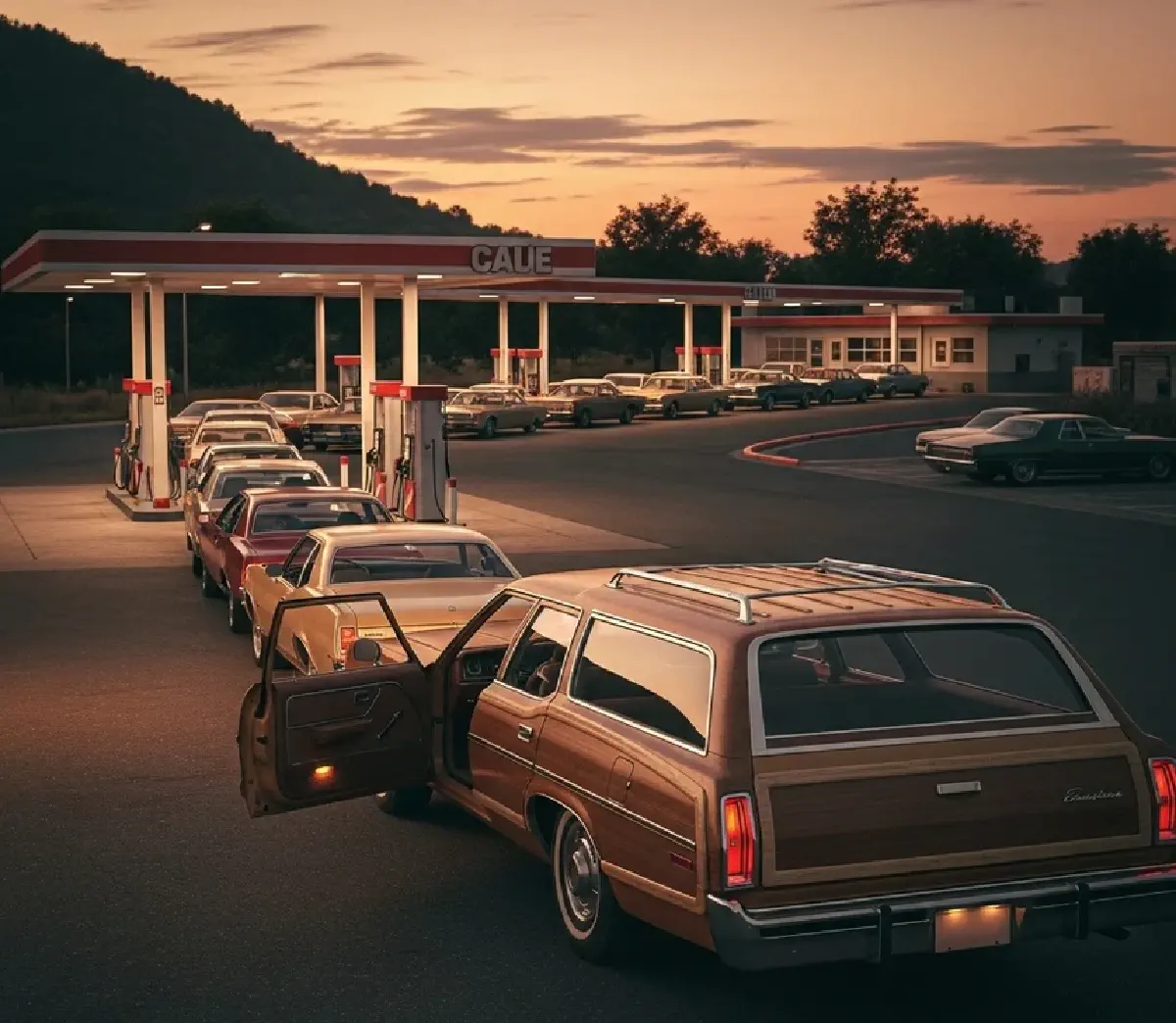
In 1973, the first global oil crisis struck. Lines snaked around gas stations as prices quadrupled. American drivers, long accustomed to cheap fuel, faced a new reality of scarcity. The automotive industry panicked. The large, body-on-frame station wagon—the quintessential family hauler—suddenly seemed like a dinosaur, a gas-guzzling relic.
Congress responded with the Corporate Average Fuel Economy (CAFE) standards in 1975. For passenger cars, the rules were strict and the timeline aggressive. For “light trucks”—a category created for work vehicles like pickups and vans—the standards were far more lenient. This regulatory fork in the road was not an accident. It was a political compromise to protect farmers, tradesmen, and the domestic auto industry.
No one in Washington envisioned a family of five commuting in a “light truck.” Yet, within this obscure regulatory carve-out, the seed for the modern Sport Utility Vehicle was planted. The SUV, America’s eventual vehicle of choice, was born not from consumer desire or engineering brilliance, but from a legislative loophole. It was, in its earliest legal definition, a station wagon wearing the regulatory disguise of a truck.
The Regulatory Vacuum That Built an Empire#
The CAFE standards created two parallel automotive universes. By 1990, a passenger car fleet had to average 27.5 miles per gallon. The light truck fleet needed only 20.5 mpg. This 7-mpg regulatory gap was an economic siren song for automakers. It represented billions in potential savings on engineering, materials, and penalties.
More critically, it allowed for a different kind of vehicle. Building on a light-truck chassis exempted a model from costly emissions controls, safety features like airbag mandates, and the most stringent crash-test standards applied to cars. The financial logic was irresistible. Automakers could produce a vehicle with the passenger space of a station wagon but governed by the forgiving rules of the commercial world.
The stage was set. All that was needed was a vehicle to walk through this open door.
From Army Jeep to Suburban Status Symbol#
The concept of a passenger vehicle on a truck platform was not new. The original Jeep Wagoneer, introduced in 1963, pioneered the idea. But it was a niche, rugged vehicle. The true catalyst was the Chevrolet Suburban, a cavernous vehicle that had evolved since 1935. For decades, it was a utilitarian workhorse for churches, camps, and contractors.
In the late 1980s, a pivotal shift occurred. General Motors and other automakers began marketing these truck-based wagons not to tradesmen, but to suburban families. Advertising stopped highlighting towing capacity and started showcasing leather interiors, premium sound systems, and the ability to carry seven passengers in comfort. The value proposition was cleverly dualistic: it offered the utility of a truck with the luxury of a car, all while sidestepping the costly regulations attached to the latter.
This rebranding required a new name. “Station wagon” was tainted by association with the gas crises. The term “Sport Utility Vehicle” was minted. It conjured images of active, adventurous lifestyles, not grocery runs and soccer practice. The “sport” was vague, the “utility” implied capability, and “vehicle” sounded more robust than “car.” It was a masterstroke of consumer psychology, transforming a regulatory workaround into an aspirational identity.
The Incumbent’s Dilemma and the Rise of the Explorer#
The beneficiaries of this shift were not the struggling American car companies of the 1970s, but the very same giants a decade later. They owned the patents, factories, and expertise for body-on-frame truck platforms. Japanese and European rivals were excelling at building efficient, unibody passenger cars. The SUV loophole neutralized that advantage.
The moment of crystallization came in 1990 with the launch of the Ford Explorer. It was not a revolutionary design. It was a brilliantly executed adaptation of the Ford Ranger pickup chassis. But Ford marketed it perfectly. It was sized right, priced right, and presented as the safe, commanding choice for the family. When it was paired with the new “Country Squire” trim package—a direct, ironic callback to the wood-paneled station wagons of old—the circle was complete. The station wagon had not died. It had put on a truck’s clothes, adopted a more rugged name, and begun its conquest of the American driveway.
Sales exploded. The Explorer soon became the best-selling vehicle in America. Other manufacturers raced to copy the formula. The SUV was no longer an alternative; it was becoming the mainstream. A machine born from a regulatory anomaly was now dictating the future of automotive design, urban planning, and fossil fuel consumption. The consequences of this accidental creation were only beginning to unfold.