In 1956, President Dwight D. Eisenhower signed the Federal-Aid Highway Act, authorizing $25 billion (over $250 billion today) for the construction of 41,000 miles of interstate highway. It was the largest public works project in history, a triumph of national vision. Seven decades later, that triumph has hardened into a trap. The concrete ribbons that enabled unprecedented mobility also dictated an unshakeable dependence on the private automobile, forging a path dependency of asphalt and steel that now resists any alternative. The highways shaped the suburbs, which demanded more highways, which demanded more cars—a self-reinforcing loop of spatial and economic lock-in.
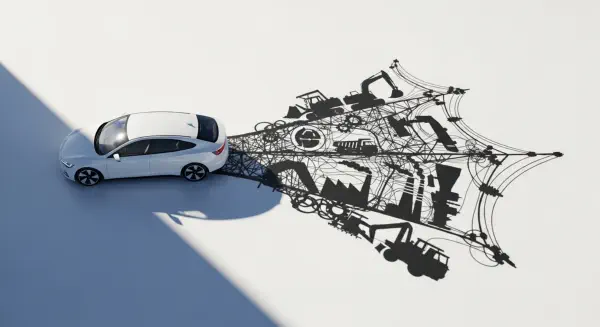
This is the infrastructure trap: the phenomenon where massive, sunk investments in a specific technological system create overwhelming inertia, making shift to a superior alternative economically and politically prohibitive, even when the original system’s flaws become severe. For automobility, the trap is tripartite: physical (roads, parking, fuel stations), economic (tax bases, business models), and digital (proprietary charging networks, software platforms). This infrastructure isn’t just a support system for cars; it is a cage that actively shapes behavior, stifles innovation, and amplifies the societal impact of any failure within the automotive system itself. We are not merely addicted to cars; we have built a world where no other rational choice exists.
The trap’s power lies in its positive feedback loops and the distribution of its costs and benefits. The benefits of road investment (personal mobility, economic development along corridors) are concentrated, visible, and immediate for powerful constituencies. The costs—congestion, pollution, sprawl, exclusion of non-drivers—are diffuse, delayed, and borne by the less powerful or by future generations. This creates a political and economic engine that perpetuates the system, even as its negative externalities accumulate to crisis levels. To escape requires not just new technology, but the dismantling of a deeply entrenched material and financial empire.
The Concrete Vise#
The Sunk-Cost Sprawl Engine#
The interstate system was not neutral infrastructure; it was a spatial sorting mechanism. It made cheap, distant land accessible, fueling suburbanization. Suburbs, with their low-density, single-use zoning (separating homes, shops, and offices), are fundamentally uneconomical to serve with public transit. The average cost per trip for public transit in a low-density area can be 5-10 times higher than in a dense city.
Thus, each new subdivision and strip mall locks in demand for private vehicle travel for decades. The property tax base of these communities is often insufficient to maintain their own sprawling road networks, leading to deferred maintenance crises. Yet, the perceived solution is never to increase density to make transit viable; it is to widen roads to ease congestion—a temporary fix that induces more demand, leading to more sprawl, in a vicious cycle known as induced demand. The infrastructure creates the problem it is then called upon to solve, at ever greater cost.
The Parking Prison#
An estimated 30% of land in U.S. city centers is dedicated to parking—a staggering misallocation of valuable urban space, mandated by law. Parking minimums in zoning codes force developers to build expensive parking structures, the cost of which is baked into every apartment rent and grocery bill, subsidizing drivers at the expense of all residents. This spatial commitment physically enforces car dependency. It makes walking unpleasant (past parking lots) and makes redeveloping areas for density prohibitively expensive, as the cost of tearing out parking must be overcome. The infrastructure isn’t just for cars; it is a barrier to any other form of mobility.
The Fueling and Charging Lock-in#
The Gas Station Ecosystem#
The global network of gasoline stations represents a multi-trillion-dollar investment in refining, distribution, and retail. This ecosystem possesses immense political power and creates a switching cost for alternative fuels. Biofuels or synthetic fuels must be backwards-compatible with this infrastructure or face an insurmountable barrier to entry. The infrastructure defends the incumbent technology.
The New Digital Trap: Proprietary Charging#
The EV transition is repeating the same pattern, potentially creating new digital-age traps. Unlike the standardized gasoline nozzle, charging networks are fragmented, with competing plug standards (though consolidating), payment systems, and reliability levels. Tesla’s superior, vertically integrated Supercharger network is a competitive moat but also a walled garden.
More insidiously, the software that manages charging, billing, and vehicle-grid communication is becoming a new layer of proprietary infrastructure. If automakers or charging operators lock drivers into their own closed ecosystems (e.g., your car only gets fast charging on Brand X’s network with a monthly subscription), they recreate the very dependency and lack of choice that defines the current fossil fuel trap. The infrastructure of the future could be even more controlling than the pipes of the past.
The Economic Engine of Perpetuation#
The automotive-industrial complex is not just manufacturers; it is a vast economy of dealerships, repair shops, insurance companies, advertising firms, and municipal finance departments reliant on gas taxes and parking fees. This economy employs millions and wields commensurate political influence.
Any systemic shift—prioritizing transit, implementing congestion pricing, removing parking minimums—is framed as a threat to jobs and the economy. The infrastructure trap is thus defended by a powerful coalition with a direct financial stake in the status quo. This makes reform politically treacherous, even when it is economically and environmentally rational for society as a whole.
Furthermore, municipal budgets are structurally dependent on car-centric development. Property taxes from sprawling commercial strips and gas taxes for road funds create a perverse incentive: cities must encourage more driving to fund the services strained by more driving. It is a fiscal doomsday machine.
The Path to Nowhere#
The infrastructure trap explains why technological solutions like the electric vehicle, while necessary, are insufficient. An EV in a traffic jam is still a symptom of sprawl. An EV parked on a vast concrete lot still contributes to urban heat islands and inefficient land use. The trap ensures that innovations are channeled to sustain the existing system, not to transcend it.
Escaping the trap requires recognizing it as a system of political economy and spatial design, not just transportation engineering. It requires policies that deliberately rebalance the scales: replacing gas taxes with road-user pricing, converting parking mandates into maximums, funding transit-oriented development, and allowing density. These are not just transportation policies; they are surgeries on the entrenched anatomy of the infrastructure trap.
The hardest realization is that the trap was built choice by choice, subsidy by subsidy, over generations. Unbuilding it will be the work of generations more. The first step is to see the concrete not as freedom, but as the walls of a very comfortable, very expensive, and increasingly unsustainable cage.