
The Collision of Reform and Intervention#
By 1968, the Tatra 603 had been in production for thirteen years, evolving from a clandestine prototype into the definitive carriage of the Czechoslovakian state. As the car was receiving its final aesthetic face-lift—moving its four headlights to the outer edges of the fascia—the country was undergoing a far more radical transformation. Under the leadership of Alexander Dubček, who replaced Antonín Novotný as First Secretary, the Communist Party of Czechoslovakia (KPCz) sought to implement “socialism with a human face”. This period, known as the Prague Spring, aimed to democratize the socialist system by abolishing censorship and adapting to new social realities.
The reform movement was driven largely by the “inteligencja” and students, who used the newly won freedom of the press to criticize the Stalinist policies of the past. The abolition of censorship allowed for public discussions on previously taboo subjects, garnering massive support for Dubček’s leadership. However, this “springtime” of political openness was viewed with existential dread in Moscow. The Soviet Union feared that if the Czechoslovakian experiment succeeded, it would trigger a systemic failure across the entire Eastern Bloc.
The Night the Spring Ended#
The systemic risk of political contagion led to one of the most significant military interventions of the Cold War. On the night of August 20-21, 1968, the Warsaw Pact launched Operation “Danube”.
The Scale of Operation “Danube”#
Approximately 250,000 soldiers from the Soviet Union, Poland, Hungary, and Bulgaria crossed the borders to suppress the reformist movement. Poland alone contributed 30,000 troops from the 2nd Army, commanded by General Florian Siwicki. The intervention was massive, intended to provide a total show of force that would prevent any armed resistance. While the Czechoslovakian army was ordered not to fight, the civilian population refused to remain passive. Nearly 50 people died in Prague on the first day of the occupation as citizens clashed with tanks.
Resistance and Civil Disobedience#
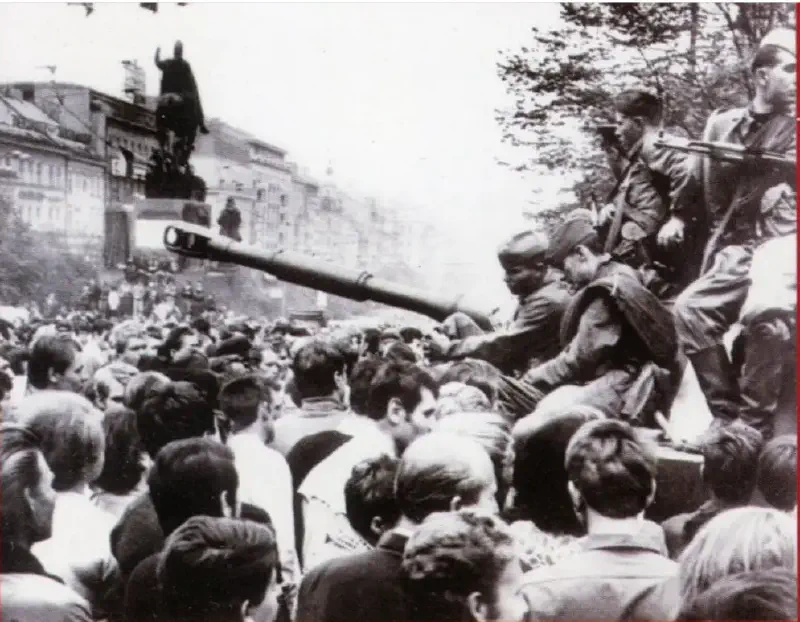
The civilian response was characterized by a mixture of defiance and tragedy. Citizens engaged in a campaign of disorientation, removing town name signs to confuse the invading troops, some of whom were reportedly so lost they believed they had accidentally entered West Germany (RFN). On Wenceslas Square, crowds surrounded Soviet tanks, not with weapons, but with arguments, attempting to “educate” the soldiers by explaining that there was no “counter-revolution” to suppress. The sense of national despair culminated in the self-immolation of student Jan Palach in January 1969, a sacrifice echoed in Poland by Ryszard Siwiec, who performed a similar act at the Tenth Anniversary Stadium in Warsaw in protest of the invasion.
The Era of “Normalization”#
The immediate consequence of the invasion was the “normalization” of the country under the Moscow Protocol, signed on August 26, 1968. This agreement forced the reintroduction of censorship, the removal of reformist leaders, and the permanent stationing of Soviet troops on Czechoslovakian soil. Dubček was eventually replaced by Gustav Husak, and the KPCz officially condemned the reform attempts of 1968 as a deviation from the “only correct line”. The “human face” of socialism was replaced by the rigid, grey reality of a state under occupation.
The Legacy of the Black Whale#
The Tatra 603 survived the Prague Spring, continuing production until 1975, but its symbolic meaning was irrevocably altered. After 1968, the car was no longer a symbol of a modernizing, reforming state; it became a relic of the “normalization” era, associated with the officials who oversaw the stagnation of the following two decades. The car’s final version, produced during the height of the occupation, saw the chrome “T” emblem added to the hood—a small aesthetic flourish in an era of political contraction.
Today, the Tatra 603 is viewed as a “cult” object, a rare artifact of a complicated history. In 2008, during the 40th anniversary of the invasion, 603s were included in street exhibitions in Prague to remind citizens of the era. The car serves as a reminder that technology and design do not exist in a vacuum; they are shaped by the political systems that fund them and the social upheavals that define their time. The “Black Whale” remains a testament to the ingenuity of engineers who worked in the shadows, and a silent witness to a spring that was crushed under the treads of a 250,000-man army.