
The Anarchist Architects of Koprzywnica#
In the early 1950s, the design offices of the Tatra factory in Koprzywnica were officially occupied with the mundane task of drafting three-axle trolleybuses, specifically the Tatra T400. Beneath these sanctioned blueprints, however, lay a subversive reality. A team of engineers, led by architect František Kardaus and the pragmatic Vladimír Popelář, were secretly sketching the future of the Czechoslovakian automotive industry. They called their clandestine project the “Valuta,” a name that hinted at the high-value potential of a vehicle that ignored the drab mandates of central planning. This act of professional “anarchy” was born from a refusal to let the art of the luxury aerodynamic limousine die under the weight of post-war austerity.
The tension between creative ambition and political directive serves as a microcosm for the systemic risks inherent in the Eastern Bloc’s industrial model. By 1953, the political winds shifted, and a “decision from above” finally mandated the creation of a representative limousine to compete with the Soviet ZIM. The engineers were given a nearly impossible deadline: less than twelve months to produce full documentation. Because they had already performed their secret labor, they simply pulled the Valuta drawings from beneath the trolleybus plans. The resulting Tatra 603 was not just a car; it was a manifestation of individual expertise surviving within a system designed to prioritize collective mediocrity.
The Engineering Paradox of a Socialist VIP Limousine#
The Tatra 603 represented a radical departure from the boxy, utilitarian vehicles that characterized the era’s “people’s cars.” It was a vehicle designed for speed, comfort, and, most importantly, the projection of state power.
Aerodynamics as a Primary Technical Constraint#
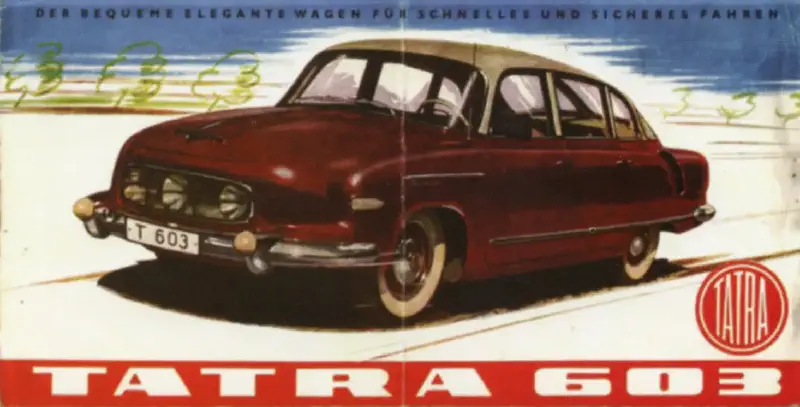
The vehicle’s silhouette was dictated by 1930s-era aerodynamic principles, heavily influenced by the earlier Tatra T77. The design minimized protruding elements, integrating headlights into the front fenders to reduce drag. The 603 featured a panoramic front windshield and a distinct, split rear window that flowed seamlessly into the engine cover. These features contributed to a low coefficient of drag, which was essential given the engine’s power limitations compared to Western luxury counterparts. This streamlined form, often referred to as the “Black Whale,” allowed the 1,470 kg vehicle to reach speeds of 160 km/h with a relatively modest engine.
The V8 Heart and the Steering “Third Eye”#
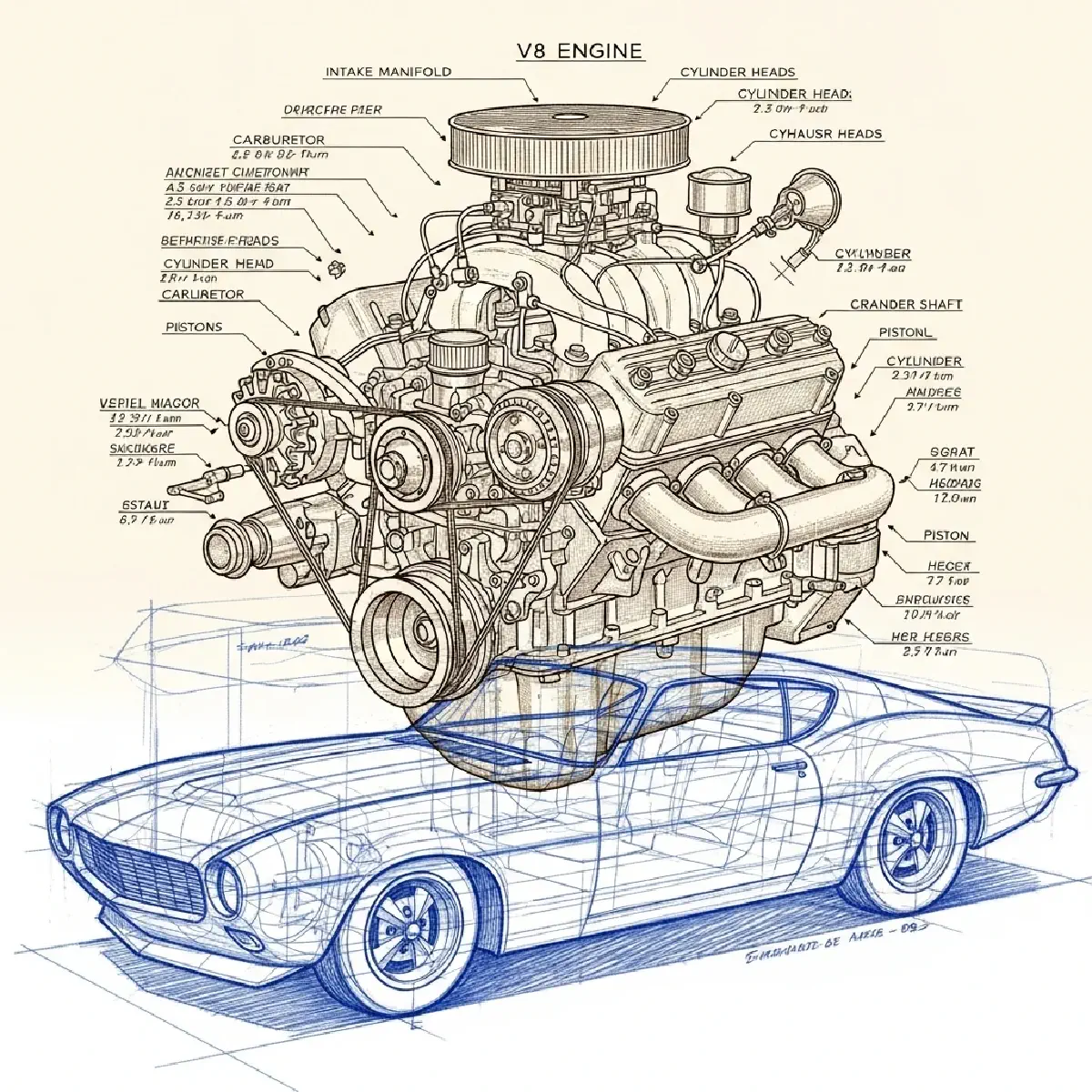
Mechanically, the 603 was centered around a rear-mounted, air-cooled V8 engine. Originally developed for racing monoposts like the Tatra 607, the 2,545 ccm unit produced 95 HP. To manage the weight distribution of a rear-engine layout, engineers placed the 55-liter fuel tank in the front. The most striking aesthetic and technical feature of the early models was the triple-headlight arrangement. The central headlight was not static; it was geared to the steering mechanism, physically turning with the wheels to illuminate the driver’s intended path through dark mountain passes. This “third eye” became a hallmark of the car’s specialized engineering.
Evolutionary Refinement and Racing Pedigree#
As the model matured, it underwent significant technical face-lifts. The T2-603, introduced in 1962, replaced the triple-light setup with four headlights and a wider hood. While the engine displacement was slightly reduced to 2,472 ccm, performance actually increased through a higher compression ratio, moving from 6.5:1 to 8.2:1 to produce 105 HP. The platform’s durability was proven on the racing circuit; in 1966, a modified version designated the 603-B6 competed in the “De la Route” marathon at the Nürburgring. It featured disc brakes and spoilers, maintaining an average speed of over 110 km/h for nearly 10,000 kilometers, eventually finishing in 4th and 5th place.
The Failure of Consumer Accessibility#
While the Tatra 603 was a triumph of engineering, its lifecycle highlights the systemic failure of the socialist economy to distribute technological progress to the masses. The car was a “socialist limousine” in name only; in practice, it was a tool of the hierarchy. The production process remained remarkably primitive, with only 9 cars built by hand in 1956 despite a target of 70. Over its twenty-year production run from 1955 to 1975, only 20,442 units were produced—a number that underscores its exclusivity.
This limited production run was a deliberate choice that solidified a path of dependency where high-end automotive technology was reserved for the state apparatus. The “average Novak” or “Kowalski” could never hope to own one. Even the color of the car was a signal of systemic exclusion: black paint was strictly reserved for state recipients, while the vanishingly few private owners were forced to accept grey models. This engineering marvel thus became a visual marker of the widening gap between the ruling elite and the citizens they claimed to represent.