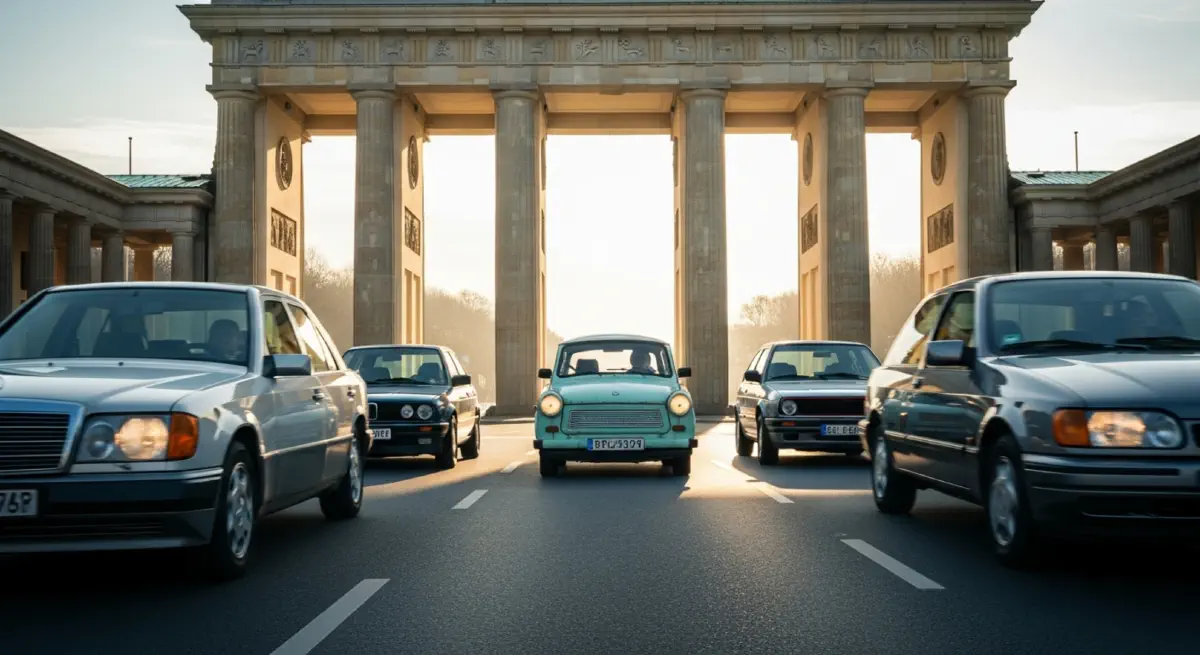
On the morning of November 10, 1989, the border crossings between East and West Berlin opened. Within hours, tens of thousands of Trabants streamed through Checkpoint Charlie, the Invalidenstrasse crossing, and the Bornholmer Strasse bridge. They were filmed by news crews, photographed by journalists, and marveled at by West Berliners who had spent forty years mocking the plastic-bodied cars. The images were incongruous: the pastel-colored Trabants, with their putt-putt engines and clouds of blue smoke, surrounded by the sleek Mercedes, BMWs, and Volkswagens of the West. The ridicule was immediate and intense. Der Spiegel ran a cover story titled “The Trabi’s Last Trip,” featuring a cartoon of a Trabant being crushed by a Mercedes. The joke was that the car was worthless—which was true, in the strictest sense. A Trabant that had cost 7,450 East German marks and required a thirteen-year wait was now worth scrap value. Some owners simply abandoned them at the border.
What happened next was stranger. Within months of the Wall’s fall, the Trabant began its transformation from object of ridicule to object of nostalgia. The shift was not gradual. It was, as Ina Merkel has written, “at an unbelievable pace and all at once.” By 1990, Trabants were being painted with advertisements, fitted with subwoofers, and converted into mobile DJ setups. By the mid-1990s, they were appearing in museums, in art installations, and on postcards. By the 2000s, they were collectors’ items, with restored models selling for more than their original price. The Lada underwent a similar transformation, though its trajectory was different. In Russia, the Lada 2101—the original Zhiguli—was voted the country’s best car of the twentieth century in a 2000 poll conducted by Za rulem magazine. It received more than 25 percent of the vote, beating every other car. In Finland, where Ladas had been imported in large numbers during the 1970s, they became cult objects. In Britain, the Lada was remembered primarily as a joke—the punchline of a thousand comedy routines—but even there, a dedicated following emerged.
The phenomenon has a name: Ostalgie, a portmanteau of Ost (East) and Nostalgie (nostalgia). It is usually dismissed as sentimentality, a longing for the lost world of the GDR that conveniently forgets the Stasi, the travel restrictions, and the chronic shortages. But Ostalgie is more complex than mere nostalgia. It is a way of making meaning out of a past that has been declared worthless. The Trabant, which was once proof of socialism’s failure, became proof that socialism had existed at all. Its plastic body, which was once a joke, became a marker of authenticity. Its waiting list, which was once a symbol of deprivation, became a symbol of a time when desire was structured differently—when people waited for things, rather than clicking and having them delivered.
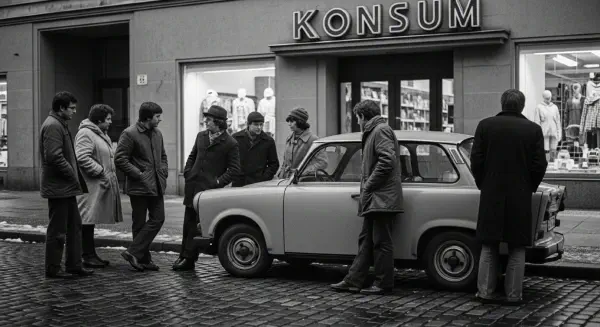
The transformation of the Socialist Car from icon to relic can be understood through what anthropologists call “fetishism.” The term, originally coined by Marx, describes the process by which objects acquire value that has no relation to their material properties. The Trabant was always fetishized—first as a symbol of socialist modernity, then as a symbol of backwardness, then as a symbol of lost innocence. What changed was the context, not the car. The Trabant parked in front of a Konsum store in 1988 looked normal. The same Trabant parked in front of a Benetton in 1990 looked absurd. By 2000, the Benetton was gone and the Trabant was in a museum, placed behind velvet ropes. The context had shifted again, and the car’s meaning shifted with it.
The Lada’s afterlife followed a different logic. In post-Soviet Russia, the Lada was not a relic but a daily reality for millions of drivers. Production continued at Togliatti, though the cars were updated with fuel injection, catalytic converters, and—eventually—modern body panels. The Lada became the car of the new middle class, not because it was aspirational but because it was affordable. A Lada cost one-fifth the price of a comparable Western car, and in a country where average monthly wages were still under $500 in the early 2000s, affordability mattered. The Lada was not nostalgic; it was practical. But it was also, increasingly, a symbol. The car’s Soviet origins, which had been a liability in the 1990s, became a source of pride in the 2000s. The Lada’s reputation for durability—for surviving Russian roads, Russian winters, and Russian indifference—became a point of national identity. The car was not a relic of a failed system; it was proof that Russians had made things that lasted.
The difference between the Trabant’s trajectory and the Lada’s reflects different post-1989 experiences. The GDR was absorbed into the Federal Republic, its institutions dissolved, its currency replaced, its history reclassified as an aberration. The Trabant became a relic because the world that produced it had been declared dead. The Soviet Union collapsed more slowly, and its dissolution was not followed by absorption into a larger state. The Lada persisted because the conditions that produced it—the roads, the climate, the economy—persisted. The car’s design, optimized for Soviet conditions, remained relevant in post-Soviet Russia. Its steel body could survive potholes; its high ground clearance could navigate unpaved roads; its simplicity meant it could be repaired by mechanics who had learned their trade on Soviet cars. The Lada was not a relic of the past; it was a vehicle for the present.
But the Lada’s persistence also revealed the limits of nostalgia. In 2008, when the Russian government raised tariffs on imported cars to protect the domestic industry, drivers took to the streets in protest. The Lada was no longer the people’s car; it was the car people were forced to buy. The nostalgia that had surrounded the Lada in the early 2000s evaporated when the car became a symbol of protectionism, stagnation, and the failure of the Russian auto industry to compete. By 2015, Lada sales had collapsed, and the company was being restructured with state support. The car that had been a symbol of Soviet achievement was now a symbol of Russian dependency.
The Socialist Car’s afterlife, then, is not a single story but a set of stories, each reflecting the different fates of the states that produced them. The Trabant became a museum piece, a symbol of a lost world. The Lada became a workhorse, then a problem. The Skoda, produced in Czechoslovakia, was absorbed by Volkswagen and transformed into a modern European car—its socialist origins acknowledged but downplayed. The Dacia, produced in Romania, was absorbed by Renault and rebranded as a budget car for emerging markets. Each of these trajectories tells us something about how the Cold War ended—and about what was lost, or preserved, in the transition.
The persistence of the Socialist Car in cultural memory suggests that its meaning was never only about transportation. It was about waiting, about relationships, about the material experience of living in a system that promised abundance but delivered scarcity. The Trabant’s thirteen-year waiting list, the Lada’s six-year rust guarantee, the Skoda’s reputation for unreliability—these were not defects but features. They shaped how people understood their relationship to the state, to the economy, to the objects they owned. When the system collapsed, the cars remained, carrying with them the traces of that experience. The nostalgia that surrounds them is not for the system itself but for the material culture that made that system real.
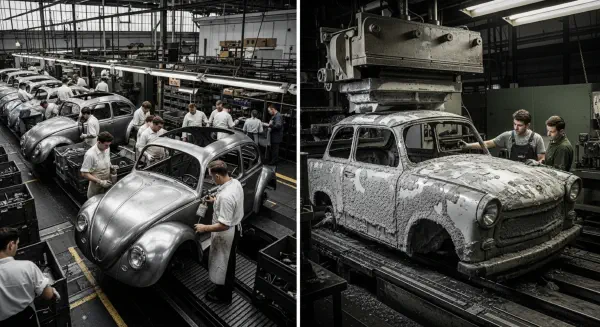
In 1991, the last Trabant rolled off the line in Zwickau. The factory was sold to Volkswagen, which now produces the Golf in the same plant. The Trabant is no longer manufactured, but it is still on the roads—restored by enthusiasts, driven in parades, displayed in museums. Its plastic body, which was once a symbol of socialist ingenuity, is now a symbol of a world that no longer exists. But the car persists, not because it is useful but because it means something. It is a reminder that objects outlive ideologies, that the past is not erased but accumulated, that The Socialist Car is inscribed not only in buildings and borders but also in the cars we drive—and in the cars we remember.