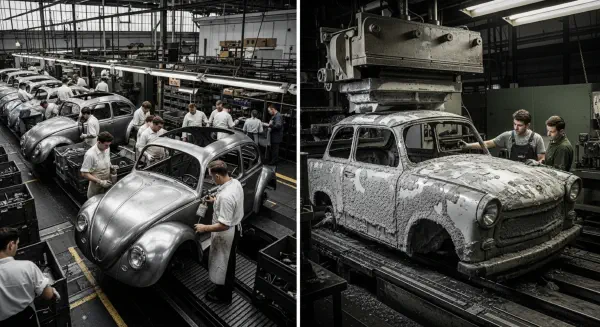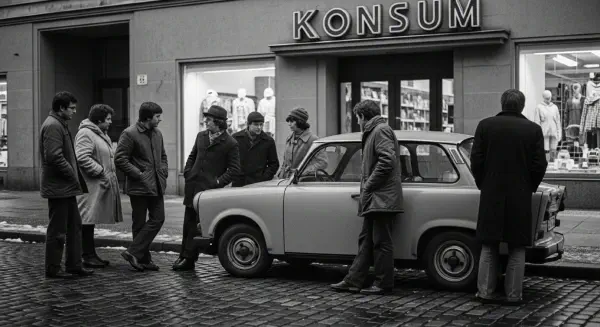
When the Trabant rolled off the assembly line in Zwickau, it did so with a two-stroke engine that produced 23 horsepower, a body made of cotton-reinforced phenolic resin, and a chassis that had, in earlier models, been constructed of wood. To Western observers, these were marks of backwardness. To East German engineers, they were solutions to problems the West never had to face. The steel embargo, the shortage of skilled labor, the absence of foreign currency—these were not external constraints on design but the design’s starting point. The Socialist Car was not a copy of the Western automobile adapted to local conditions. It was a different artifact altogether, shaped by a different set of optimization pressures.
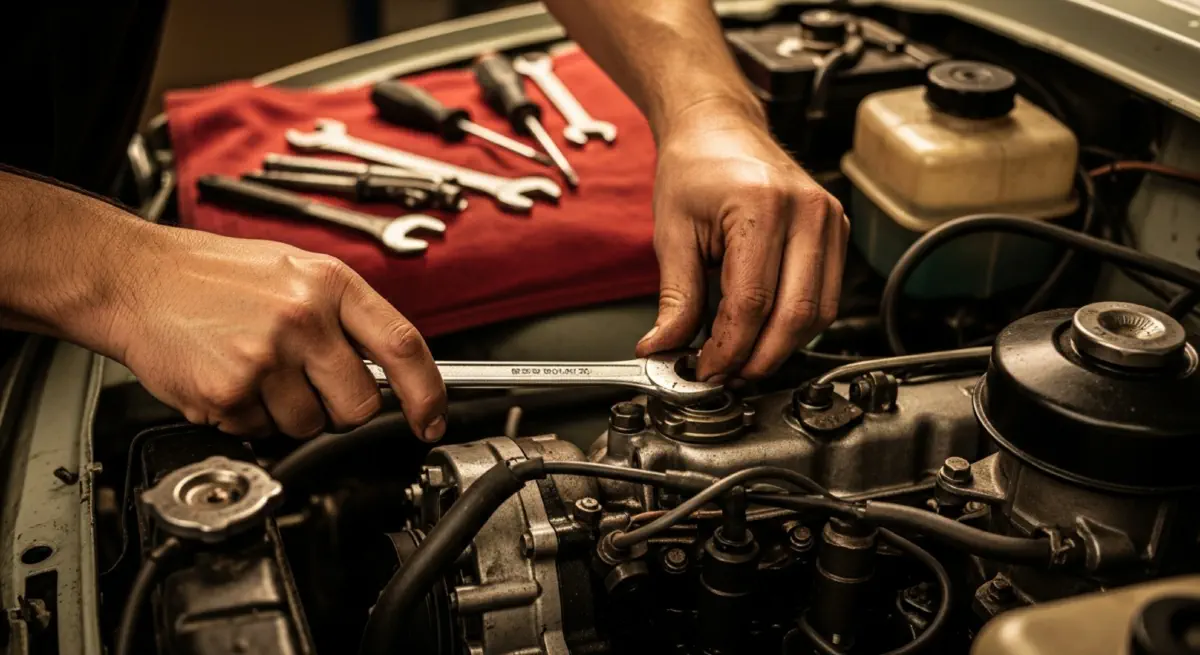
The two-stroke engine was the first of these design choices. It was not a relic of Saxony’s prewar industrial base, though that history mattered. The two-stroke was lighter than the four-stroke Otto engine, required less steel, and could be installed in any orientation—upside-down, sideways—because its oiling system worked regardless of gravity. In a planned economy that lacked flexibility, versatility was a virtue. The two-stroke was also cheaper to manufacture and easier to teach to the new generation of engineers being trained after the mass emigration of technical intelligentsia to the West. Between 1949 and 1961, the GDR lost a significant portion of its professional class. The engineers who remained had to design for a workforce in training. The two-stroke engine’s simplicity—fewer moving parts, a single casting, no valves—meant that a worker with basic mechanical training could understand it, repair it, and, if necessary, improvise parts for it.
The trade-offs were severe. The two-stroke engine burned oil mixed with gasoline, producing the blue smoke that became the Trabant’s signature. It was loud—the “putt-putt” sound that West Germans mocked as the noise of socialism. It was inefficient, consuming more fuel per kilometer than an equivalent four-stroke. But these were externalities that the system could absorb. Noise was not a design priority when cars were scarce. Pollution was not regulated. Fuel efficiency mattered less than fuel availability, and the GDR, supplied by Soviet oil, faced different price signals than Western Europe. The two-stroke was not a bad engine. It was a different engine, optimized for a different set of constraints.
The plastic body was the second major design choice. Duroplast, the cotton-reinforced phenolic resin developed by Rolf Weichert in 1957, was a response to the Battle Act embargo on sheet steel. But it was also a political statement. Plastics were central to the GDR’s “Chemistry Programme,” launched in 1958, which aimed to use synthetic materials to leapfrog the West. The rhetoric was explicit: capitalist societies, dependent on imported steel, would be overtaken by socialist societies that had mastered synthetic chemistry. The Trabant’s body was not a compromise but a demonstration. Its pastel colors—light blue, banana gold, gray, blue-green, cream—were meant to signal modernity, not austerity. The car was designed to be seen, and in the gray streets of East German cities, its colors stood out.
But the Duroplast body also had practical implications. It was not steel, which meant it could not be repaired with conventional bodywork techniques. The Trabant’s manual devoted pages to repairing cracks and tears in the plastic shell—where to acquire extra Duroplast, how to glue patches, how to reinforce the cotton substrate. The car’s body was not something that could be replaced; it was something that had to be maintained. This was not an oversight. It was a design decision that reflected the system’s priorities. With steel scarce and replacement parts unavailable, the car had to be built to last—or at least to be repairable by its owner. The expected lifespan of a Trabant was eight to ten years. In 1989, more than 80 percent of Trabants produced since 1963 were still on the road.
The Wartburg, East Germany’s other car, followed a different engineering philosophy. Produced at the former BMW plant in Eisenach, the Wartburg had a steel body and a more powerful three-cylinder engine—but it was also designed for export. The Wartburg was produced in far lower numbers than the Trabant and cost nearly three times as much. It was meant for Party officials, for export to other socialist countries, and, occasionally, for sale in the West to generate hard currency. The Wartburg’s existence alongside the Trabant reveals a hierarchy within socialist production: one car for the masses, another for the elite. But even the Wartburg, with its steel body and more conventional engineering, shared the Trabant’s maintenance demands. Its owners, like Trabant owners, had to be mechanics.
The Soviet automotive industry followed a similar logic but on a larger scale. The Lada, produced at the VAZ plant in Togliatti from 1970 onward, was the Soviet Union’s first true people’s car. But it was not designed from scratch. The VAZ plant was built with assistance from Fiat, and the Lada was a licensed version of the Fiat 124, adapted for Soviet conditions. The adaptations were telling: the Lada’s suspension was raised to handle unpaved roads; its brakes were upgraded to Soviet standards; its engine was tuned for lower-octane fuel. The car was also fitted with a tool kit that included an air pump, a device for setting breaker points, and even a light to illuminate night repairs. The message was clear: this car would break down, and its owner would fix it.
The Lada’s owner’s manual went further. It advised new owners to completely dismantle the car’s body and flood all cavities with anticorrosion fluid. The expected rust resistance, the manual explained, would otherwise last only six years. This was not a warning; it was an instruction. The car was delivered incomplete, requiring the owner to finish the job. In the West, new cars were handed over in a state of near perfection—spotless, gleaming, ready to drive. In the East, new cars were handed over with a list of tasks: mount the windshield wipers, rustproof the chassis, adjust the carburetor. The owner was not merely a consumer; he was a co-producer, completing the work that the factory had left unfinished.
This delegation of labor was not a failure of quality control. It was a structural feature of the planned economy. Factories were incentivized to meet production targets, not to produce perfect cars. The cars that rolled off the line were counted, not inspected. The work of inspection, adjustment, and repair was pushed onto the consumer. In the GDR, this was called Eigen-Sinn—the creative self-reliance that kept the system functioning. The term, coined by historian Alf Lüdtke, captures something essential about state socialism: it was not a machine that worked according to plan but a system held together by the improvisational skills of its citizens. The Trabant, with its two-stroke engine and plastic body, was the material expression of that system.
The engineering choices that defined the Socialist Car were thus not technical failures but systemic responses. The two-stroke engine was a solution to the problem of scarce steel and untrained engineers. The Duroplast body was a solution to the problem of embargoed sheet metal. The absence of planned obsolescence was a solution to the problem of unavailable replacement parts. Each choice made sense within the constraints of the system—and each produced a car that was, in the West’s terms, backward. The irony is that the West was moving in the opposite direction. By the 1970s, Western cars were becoming more complex, more reliable, less repairable. The shift from mechanical to electronic systems was making the car a black box. The Socialist Car remained a machine that could be opened, understood, and fixed by its owner. In this sense, it was more like the cars of the 1930s than the cars of the 1980s—a machine that demanded a relationship, not just a transaction.
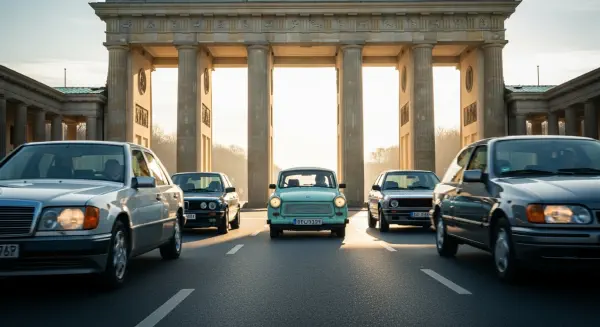
When the Wall fell, these differences became visible in a new way. The Trabant’s two-stroke engine, which had been a solution to socialist constraints, became a problem in a capitalist context. The blue smoke violated emissions standards. The noise violated noise ordinances. The plastic body, which had been a source of pride, became a joke. But the skills that the Trabant had trained—the ability to repair, to improvise, to make do—did not disappear. They migrated to the gray economy, to the used-car market, to the culture of autobasteln that persisted long after the Trabant itself had vanished from the streets. The car’s engineering had produced not just a vehicle but a kind of person: someone who understood machines, who could fix what was broken, who saw scarcity as a problem to be solved rather than a failure to be lamented.