In the summer of 1977, a retired car mechanic named Zhdanov spotted a wrecked Chevrolet Bel Air decaying in the yard of a Soviet repair shop. The car had once belonged to a Belgian citizen, and when it broke down, Soviet mechanics—unable to repair it—simply removed the engine and left the chassis to rust. Zhdanov, a lifelong enthusiast, offered 690 rubles for the salvage. A committee of experts was formed. They determined that the Chevrolet was the equivalent of a Chaika, the limousine reserved for senior Communist Party officials. They subtracted 40 percent for damage and wear, and set the price at 6,868 rubles—ten times what Zhdanov had offered. He refused to pay. Then he began writing letters. Over the next two years, he climbed the Soviet bureaucratic ladder, corresponding with local officials, regional authorities, and eventually Premier Aleksei Kosygin himself. All for a car that had no engine and was weeks away from being scrapped.
Zhdanov’s story, preserved in the Soviet state archives, is not exceptional. Across the Eastern Bloc, the automobile functioned not as a commodity in a market but as a currency in a system of favors, privileges, and informal exchange. The waiting lists, the coupon systems, the preferential allocations to Party officials and factory shock workers—these were not inefficiencies to be corrected. They were structural features of state socialism, mechanisms for distributing scarce goods that also distributed power. The Socialist Car, in this sense, was never just a car. It was a tool for managing the relationship between the state and its citizens.
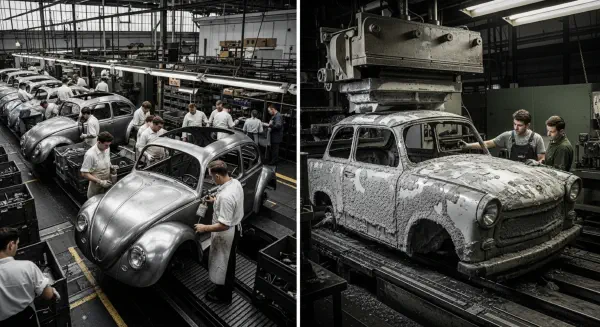
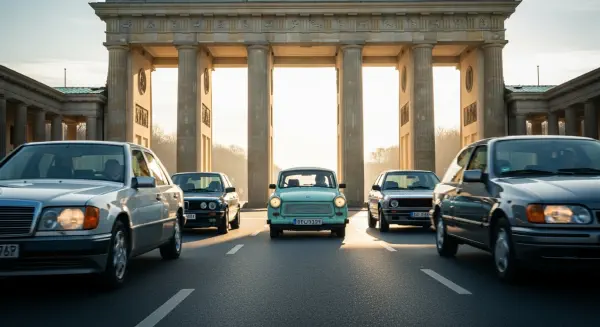
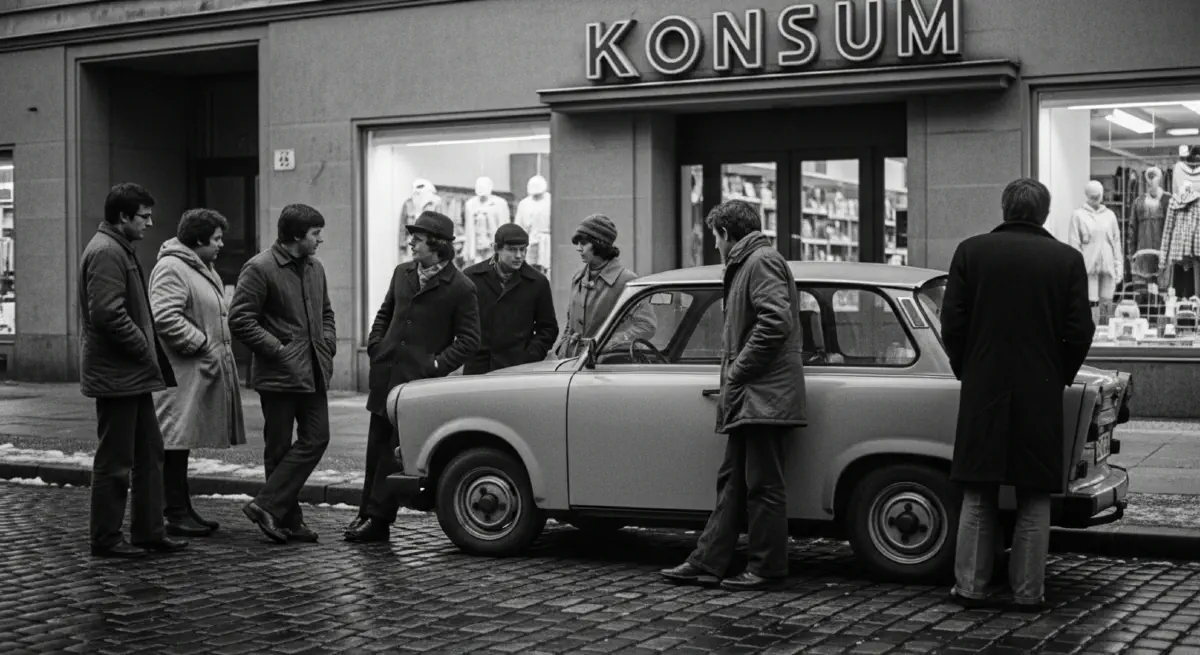
The architecture of scarcity began with production. Between 1964 and 1989, the GDR produced a steadily growing number of Trabants, from 30,000 to nearly 150,000 units annually. But demand grew faster. By 1989, 43 people wanted a Trabant for every one available. The waiting list stretched to thirteen years. Those who placed orders in 1977 watched the Berlin Wall fall just as their cars were finally due—only to find that Western automobiles had suddenly rendered their Trabants worthless. In Poland, the situation was similar but more complex. When the Fiat 126p—the “maluch,” or toddler—went into production in 1973, the state set the price at 69,000 zloty, roughly twenty-five months of average wages. To manage demand, the state savings bank, PKO, began accepting prepayments for cars scheduled for production four to seven years in the future. Within one week, 47,000 people opened accounts. By 1981, nearly 1.6 million Poles had prepaid for cars they would never receive. The system collapsed in 1986, with more than 180,000 undelivered cars and a compensation scheme that lasted into the 1990s.
These waiting lists were not passive. They were instruments of discipline. In both the GDR and Poland, workers who fulfilled their obligations successfully and conscientiously received preferential treatment. Those who violated public order, arrived late for work, or drank excessively were moved down the list or removed entirely. In Naberezhnye Chelny, the Soviet truck-building city where 40,000 workers arrived each year in the early 1970s, the waiting list for cars was administered directly by KamAZ and the construction organization Kamgesenergostroi. Workers who stayed on the job, met their quotas, and avoided the drying-out cells—14,649 people passed through them in 1977 alone—received apartments, vacation vouchers, and eventually, if they were lucky, a car. Those who did not fell off the list.
But the official distribution system was only part of the story. Beneath it ran a parallel economy of coupons, connections, and barter. In Poland, the coupon—the talon—was a piece of paper that allowed its holder to bypass the waiting list entirely. Talony were distributed by ministries, industrial associations, and the Office of the Council of Ministers. Each institution claimed more cars than it was allocated, and each was under pressure from below. A 1978 request to Janusz Wieczorek, chief of the Office of the Council of Ministers and a man who served under five prime ministers over twenty-four years, reveals how the system worked. A film director who had owned a car since 1957 wrote to Wieczorek requesting a new Wartburg. “Due to the fact that I got used to driving a Wartburg,” he explained, “I would prefer to stay with this make.” He received his coupon. A veteran who survived Auschwitz wrote of his “humble request,” describing his escape from the camp and eight months hiding in forests. He, too, received a car.
The language of these petitions—the humility, the appeals to suffering, the listing of orders and decorations—reveals the power dynamics of the distribution system. Petitioners bowed before Wieczorek because they believed they had to. They described themselves as completely powerless, their problems unsolvable without a car. “You are my only hope, Minister,” one wrote. The system was paternalistic, but it was also reciprocal. Those who received coupons were expected to use their cars in ways that served the state—ferrying goods, transporting colleagues, demonstrating loyalty. In Hungary, where György Péteri has documented the internal distribution of cars within the Communist Party apparatus, the rules were explicit: functionaries who used their private cars for official business received reimbursement at preferential rates, plus 15 percent of their work mileage for personal use. The Party subsidized driver’s education, offered favorable credit, and allowed apparatchiks to skip the queue entirely. By 1976, private cars owned by Party members were covering 6.2 million kilometers annually in official service—the equivalent of the work of two hundred professional chauffeurs.
The effect of these systems was to turn the Socialist Car into what scholars have called a “nodal point” of informal exchange. The car’s value extended beyond its use as transportation. It was a store of wealth, a source of social status, and a medium of exchange. In the GDR, where the official waiting list stretched to thirteen years, a used Trabant sold for more than twice the price of a new one. The difference represented not depreciation but appreciation—a function of scarcity, not quality. The black market in waiting-list positions was equally robust. Spots were traded for hard currency, Western goods, or favors that could not be bought at any price. When the Berlin Wall fell, the collapse of this system was immediate and devastating. People who had waited thirteen years for their cars found them suddenly worthless. The coupons, the connections, the careful cultivation of Party officials—all of it evaporated overnight.
Yet the logic of scarcity persisted, transformed. In post-Soviet Russia, the waiting list was replaced by the used-car market, which imported millions of Japanese and European vehicles through Vladivostok and St. Petersburg. The Lada, once the most sought-after car in the Soviet Union, became a symbol of backwardness. But the informal economy that had sustained the old system did not disappear. It migrated to new forms: the marshrutka minibus, the shared taxi, the mechanic who worked for cash. The skill of acquiring scarce goods—of navigating systems of favors, of knowing who to ask—remained a form of capital. The Socialist Car’s afterlife, in this sense, was not its transformation into a collectors’ item but the persistence of the habits it had trained.
Zhdanov, the mechanic who pursued the wrecked Chevrolet through the Soviet bureaucracy, never received his car. The archival record does not reveal the outcome, but the thick correspondence between Zhdanov and the authorities suggests that he was still writing letters in 1970, two years after he began. His story is a parable of the Socialist Car: a man who spent his retirement chasing a broken foreign vehicle, not because it was useful but because it was scarce. He was not irrational. He understood that in a system where value was determined not by the market but by access, a wrecked Chevrolet was worth more than its parts. The system had taught him to see scarcity as opportunity. And when the system collapsed, he was still writing letters, still believing that somewhere, in some office, someone had the power to give him what he wanted.