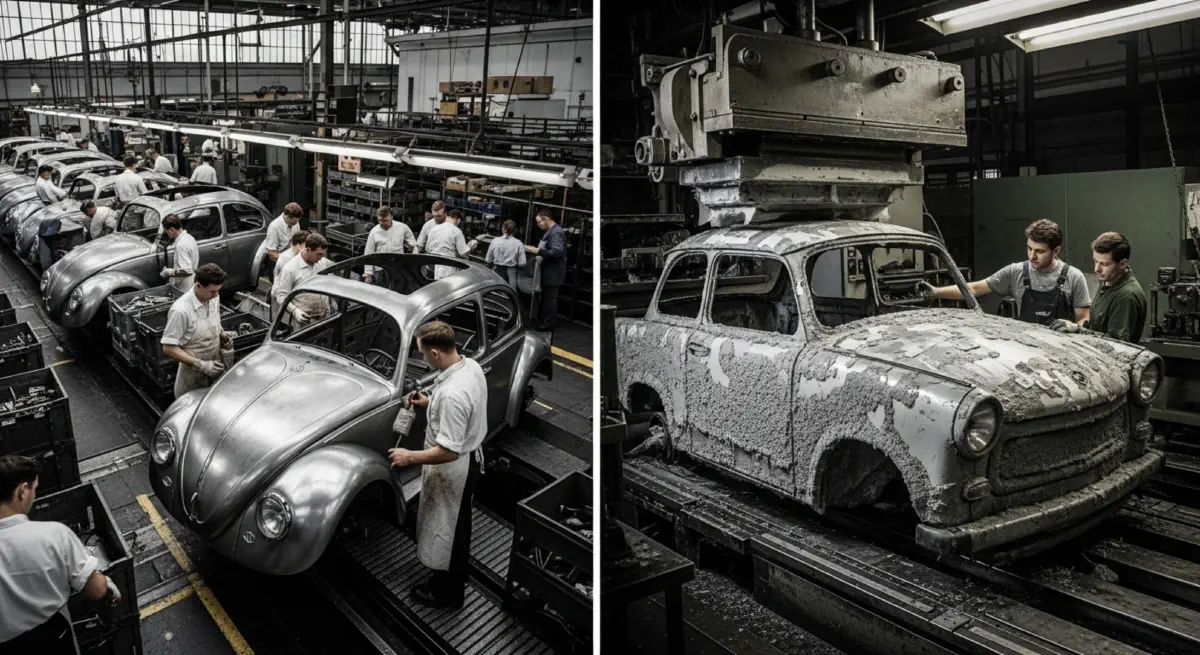
On May 23, 1949, the Federal Republic of Germany was proclaimed in Bonn. Less than five months later, on October 7, the German Democratic Republic followed in East Berlin. Neither state, as historians have noted, planned its arrival. Both emerged from the wreckage of Hitler’s Reich and the fractious diplomacy of the Allied occupation. But what would define these two Germanies over the next forty years was not just their geopolitical alignments, but the material culture they built to sustain them. In West Germany, the steel-bodied Volkswagen Beetle became the engine of an economic miracle. In East Germany, the plastic-bodied Trabant became a daily reminder of systemic scarcity. These two cars, both designed for the masses, came to embody the fundamental differences between capitalism and state socialism in ways that political manifestos never could.
The divergence began with war reparations. The Soviet Union dismantled the Audi factory in Zwickau, carting away 3,800 machines under SMAD order number 44 and leaving only about 10 percent of the plant intact. What remained of German automotive engineering in the East was rebuilt as a state-owned enterprise, VEB Sachsenring Automobilwerke, forced to rely on what it could produce domestically. In the West, by contrast, the Volkswagen factory at Wolfsburg fell under British control and soon benefited from Marshall Plan investment. By 1955, Volkswagen was producing one million Beetles annually, and West German car ownership was exploding. East Germany, meanwhile, faced a crippling embargo. The Battle Act of 1951—sponsored by Alabama Representative Laurie Battle—restricted the export of strategic goods, including sheet steel, to the Eastern Bloc. For East German planners, the steel shortage was not a logistical inconvenience. It was a design constraint that would define their national car.
The solution came from chemistry. In 1957, Rolf Weichert, research director at VEB Plasta in Erkner, combined phenol with aniline and formaldehyde, embedding cotton fibers to create a flexible phenolic plastic later known as Duroplast. It was not the first plastic car—Henry Ford had experimented with soy-based plastics in the 1930s, and the Chevrolet Corvette introduced a fiberglass body in 1953—but it was the first plastic car produced on a mass scale for a planned economy. Weichert’s “Trabiplast” was molded into body panels for the P50 Trabant, the first model to bear the name, which entered production in 1957. By 1960, the Zwickau plant was producing 35,270 Trabants annually. The car cost 7,450 East German marks—roughly twenty-eight months of average wages—and was celebrated in state propaganda as a triumph of socialist ingenuity. Its plastic body was not a compromise, the rhetoric insisted, but a statement: socialist societies were cleverer, using synthetic materials to bypass capitalist resource constraints.
This claim, however, concealed a more complex reality. The two-stroke engine that powered the Trabant was a holdover from Saxony’s prewar industrial base, introduced in 1911 by Hugo Ruppe of Zschopau. Its simplicity offered advantages—it was lighter, cheaper, and could be installed in any orientation—but its drawbacks were severe. The Trabant’s two-cylinder, 500cc engine produced just 23 horsepower. It emitted a choking cloud of blue smoke and a cacophonous buzz that West Germans mocked as “the sound of socialism.” By contrast, the Beetle’s four-stroke engine, designed by Ferdinand Porsche in the 1930s, produced 25 horsepower from its 1,100cc engine and ran far cleaner. The divergence in engineering reflected deeper industrial trajectories: West Germany had access to global supply chains; East Germany was forced to make do with the resources it could produce synthetically.
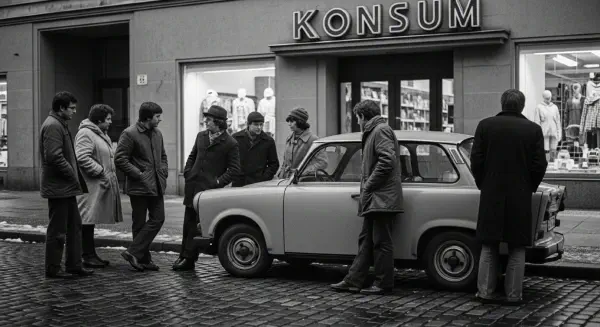
The Trabant’s waiting list became the defining feature of East German car culture. By 1989, the ratio of people who wanted a Trabant to those actually available was 43:1. The waiting period stretched to thirteen years. A used Trabant sold for more than twice the price of a new one, and a brisk black market developed around spots on the waiting list. The car’s scarcity was not a market failure in the capitalist sense but a structural feature of the planned economy. The more consumer goods the state produced, the more demand it stimulated, but production could never catch up because the system’s priorities remained fixed on heavy industry. When Erich Honecker replaced Walter Ulbricht as party leader in 1971, he promised to make housing the priority. The Wohnungsbauprogramm built nearly a million apartments by 1990, but car production remained constrained. The Trabant’s waiting list, in this context, served a political function: it bound citizens to the state, turning car ownership into a deferred promise of future abundance.
The Beetle, by contrast, was a promise kept. West Germany produced 2.9 million cars annually by 1968; the Trabant peaked at 150,000 in 1989. The Beetle became the best-selling car in history, with 21.5 million units produced by 2003. It was exported worldwide, generating hard currency that the GDR, constrained by its currency’s nonconvertibility, could never match. But the comparison that matters is not merely quantitative. The Beetle and the Trabant embodied competing visions of modernity. The Beetle represented Fordist mass production—standardized, scalable, exportable. The Trabant represented what Eli Rubin has called “Eigen-Sinn”: a system held together by individual initiative, creative self-reliance, and the improvisational skills of ordinary people who learned to repair their own cars because there were no mechanics.
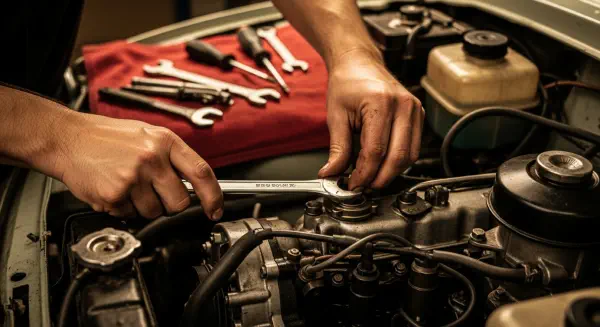
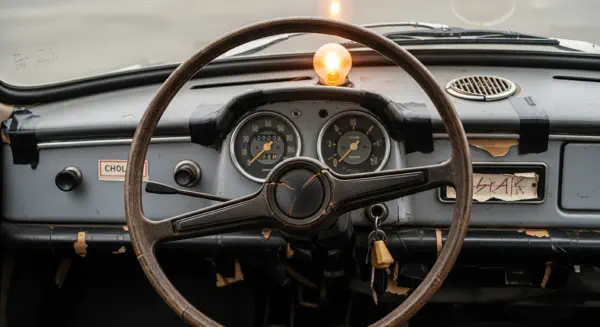
The Trabant’s manual was not a user guide in the Western sense. It did not explain where to find the switches and levers. Instead, it depicted every gasket, valve, and hinge in enough detail that any owner could take the car apart and reassemble it. This was not a marketing gimmick. It was a necessity. In 1989, more than 80 percent of Trabants produced since 1963 were still on the road, even though the two-stroke engine was estimated to have a lifespan of only eight to ten years. Owners jury-rigged replacement parts, glued Duroplast patches over cracks, and swapped knowledge at campgrounds. The car became a node in a vast network of informal exchange—a gray economy of bartered services and improvised solutions that kept the system functioning.
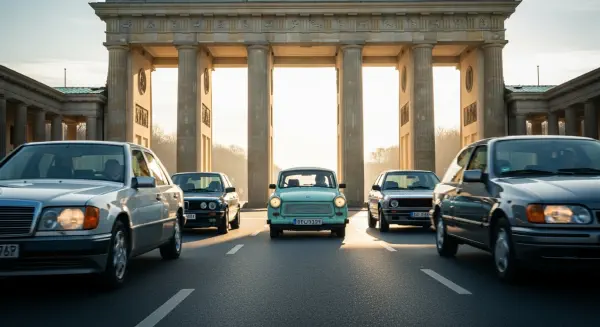
When the Berlin Wall fell in November 1989, tens of thousands of Trabants crossed into West Germany. They were photographed by Western journalists, who marveled at their primitive engines and plastic bodies. The ridicule was immediate and relentless. But the transformation that followed was even stranger. By the mid-1990s, as more Trabants were replaced with Audis and Volkswagens, the few remaining examples began to accrue value. What had been an object of ridicule became a fetish. The phenomenon of Ostalgie—nostalgia for East German life—turned the Trabant into a symbol of a lost world. Its plastic body, once proof of socialist incompetence, now seemed quaint. Its waiting list, once a symbol of deprivation, now evoked a time when desire was structured differently.
The Beetle and the Trabant thus illuminate something fundamental about how material culture shapes political identity. The Beetle was a car of consumption—something you bought, used, and replaced. The Trabant was a car of maintenance—something you cared for, repaired, and preserved. The Beetle represented mobility as commodity; the Trabant represented mobility as relationship. These distinctions were not accidental. They emerged from the industrial base, political constraints, and economic logic of two systems that were, for forty years, trying to prove which could deliver a better life. The answer, by 1989, seemed clear: West Germany’s economic miracle had won. But the persistence of the Trabant in cultural memory suggests that the contest was never only about efficiency. It was about what we owe to objects, and what they owe to us.