Key Insights
#The four posts in this series trace the arc of the Socialist Car from its origins in postwar reconstruction to its afterlife as cultural icon. Several overarching insights emerge:
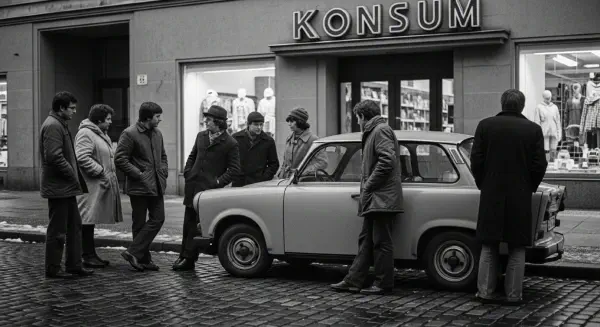
- Material constraints shape political legitimacy. The Trabant’s plastic body was not a design choice but a necessity imposed by the Battle Act embargo. The car became a symbol of socialist ingenuity, but its deficiencies—noise, pollution, unreliability—undermined the regime’s claim to deliver a modern consumer society.
- Scarcity creates its own logic of value. In the Eastern Bloc, cars functioned as currencies, not commodities. The thirteen-year waiting list, the black market for coupons, and the culture of Eigen-Sinn all emerged from the gap between demand and supply. This logic persisted even after 1989, shaping post-socialist car cultures.
- Engineering is political. The two-stroke engine, the Duroplast body, and the absence of planned obsolescence reflected systemic constraints: lack of steel, shortages of skilled labor, and the priority of heavy industry. These technical choices had cultural consequences—from the sound of East German streets to the maintenance habits of drivers.
- Objects outlive ideologies. The afterlife of the Socialist Car—from ridicule to nostalgia to collectors’ value—reveals that material culture resists easy ideological sorting. The Trabant’s transformation from symbol of failure to symbol of identity reflects deeper struggles over how to narrate the socialist past.
References
#- Rieger, B., & Rubin, E. (2009). Trabant and Beetle: The Two Germanies, 1949–89. History Workshop Journal, 68(1), 1–32.
- Rubin, E. (2009). The Trabant: Consumption, Eigen-Sinn, and Movement. History Workshop Journal, 68(1), 27–44.
- Siegelbaum, L. H. (Ed.). (2011). The Socialist Car: Automobility in the Eastern Bloc. Cornell University Press.
- Kirchberg, P. (2000). Plaste, Blech und Planwirtschaft: Die Geschichte des Automobilbaus in der DDR. Nicolai.
- Zatlin, J. (1997). The Vehicle of Desire: The Trabant, the Wartburg, and the End of the GDR. German History, 15(3), 358–380.
- Landsman, M. (2005). Dictatorship and Demand: The Politics of Consumerism in East Germany. Harvard University Press.