The Market Square at the End of the World#
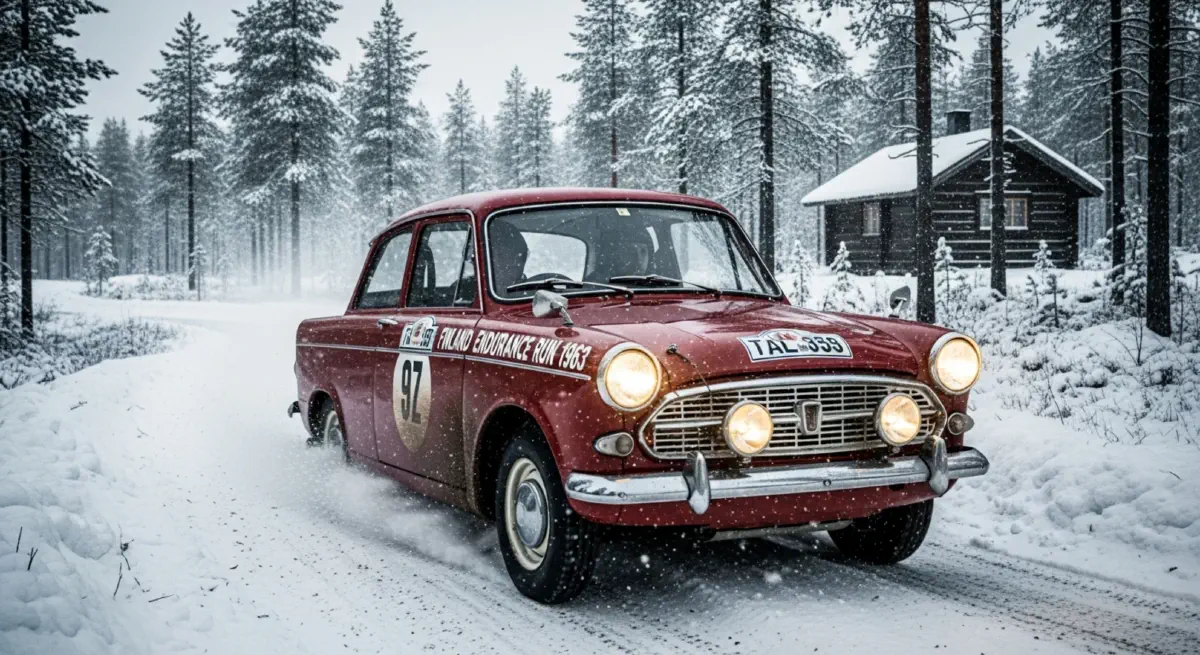
In the bleak light of a January afternoon in 1963, the Helsinki Market Square became the staging ground for a performance of mechanical hubris that few observers believed could succeed. The thermometer had dropped off the bottom of the scale, marking one of the most severe winters of the century—a period where the Adriatic froze and the Arctic Circle seemed to descend into the heart of Europe. Amidst the frozen breath of the onlookers and the skepticism of the locals, a single Hillman Super Minx stood ready for "Operation Hillman Non-Stop," a three-week marathon designed to cover 40,000 kilometers on the treacherous roads of Finland. This was not a specialized racing machine, but a standard family car intended to prove that British engineering could survive a climate that routinely turned lakes into shortcuts for the brave.
The venture was a study in split-second timing and industrial desperation. With only 10 minutes allowed for each service check and oil change, the team of four drivers, led by the seasoned Carlson, prepared to fight a relentless battle against both the clock and a climate that offered no mercy. As the British commercial attaché and local dignitaries wished the crew "godspeed," the mission began under a promise of snow, moving from the placid surface of Finland’s only motorway toward the "dark continent" of the northern tundra. The journey ahead would take them 450 miles north of Helsinki, deep into Lapland, where temperatures of -20 degrees centigrade were not an anomaly but a baseline for survival. It was a test of supreme endurance where every turn of the road held hidden dangers, and every hour of the 525-hour run was a gamble against systemic failure.
The Thesis of Validated Dependability#
The 1963 Hillman Super Minx endurance run in Finland demonstrated that high-performance reliability is not the exclusive domain of specialized racing vehicles but can be successfully engineered into the mass-market family car through rigorous stress-testing. By achieving a 53-mph average speed over 27,000 miles in sub-zero conditions, the Super Minx proved that a design prioritizing "useful reserve of power," advanced suspension, and front disc brakes could navigate the systemic fragility of a primitive, ice-bound infrastructure. This achievement transformed the automobile from a seasonal luxury into a 24-hour tool of industrial mobility, signaling a shift where automotive durability became the primary metric for consumer value in the global market.
The Architecture of Constant Motion#
The Engineering Logic of the Super Minx Foundation#
At its core, the Hillman Super Minx was designed to be the "ideal family car," balancing the draft-free comfort of deep seats and ample legroom with the mechanical grit required for trans-continental travel. However, the transition from a suburban cruiser to an arctic endurance runner required a vehicle architecture with a significant "reserve of power" to maintain high average speeds on twisty country lanes. The engine had to provide enough torque to pitch the car forward like a bobsleigh on the crest run while adhering to the strict traffic regulations of the Finnish interior. This optimization between civilian safety and rally-grade performance was the foundational trade-off that defined the Super Minx’s success.
The car’s physical integrity was further bolstered by an "advanced suspension system" that smoothed out the bumps in snow-packed roads that rose and fell like ocean waves. In the northern territories, where the sun remained below the horizon for 18 hours a day, the car’s electrical and lighting systems were under constant load, illuminating a world of elusive images and strange shadows. The engineering challenge was not merely to keep the engine turning but to ensure that the driver had "absolute confidence" in the smooth and positive action of the front disc brakes, even on ice-studded tires. This systemic reliability allowed the car to maintain its 53-mph average despite the "torturous" territory and the need for constant gear changes.
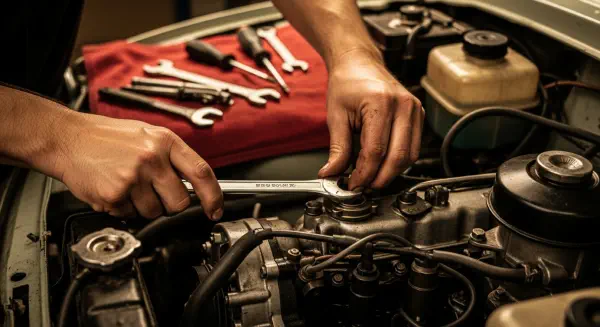
Furthermore, the vehicle’s lifecycle design was tested by the brutal 10-minute service window, which demanded a high level of "design-for-maintenance". Mechanics had to perform oil changes and service checks with surgical speed to ensure that every second spent refueling was "won back on the road". This logistical constraint highlighted the car’s mechanical accessibility; if the Super Minx had been overly complex or fragile, the three-week non-stop run would have collapsed under the weight of its own maintenance requirements. The car was not just a machine but a participant in a high-speed assembly line that stretched across the frozen landscape of Finland.
The Crucible of Context: Risks and Environmental Attrition#
The endurance run took place in an environment where "sub-zero temperatures are the rule rather than the exception," pushing the Super Minx into a "crucible of context" that few machines of the era could withstand. The risk was not merely mechanical but biological and ecological. Drivers faced 8-hour spells at the wheel, often in 18 hours of darkness, where the only signs of life were stunted trees in a "dazzling sea of snow". A single "brush with a reindeer" demonstrated the fragility of the human-machine interface in the wild; while the animal sped off into the forest, the Hillman remained slightly bruised, a physical testament to the proximity of disaster.
The run was also a test of interdisciplinary logistics, involving the cooperation of the Finnish Traffic Police, the British Embassy, and every Rootes dealer in the country. This network formed a fragile "barometer of the car's progress," where split-second timing was the essence of the operation. The social dynamics of the run were equally critical, as the "good people of Rovaniemi" and young villagers along the route provided the human fuel of hospitality that kept the drivers motivated in the "bitingly cold weather". The success of the car was dependent on a world where "science triumphs" through the simple answer—a reliable machine supported by a dedicated community.
This environmental attrition extended to the car’s interaction with the infrastructure. Much of the 40,000-km route consisted of "snow-covered or heavily iced" roads that sent the car leaping like a deer, testing the structural welds and the grip of the special ice studs. In the northern territories, the car probed "still deeper into the country," crossing bridges that were barely more than wooden slats in a tundra landscape. This was a journey of "constant hail and farewell," where the Super Minx had to transition from the sophistication of Helsinki to the isolation of latitude 68 degrees north without a single system failure.
The Cascade of Effects: From Helsinki to the World Market#
The ripple effects of "Operation Hillman Non-Stop" were immediate and quantifiable. The final tally of 43,935 kilometers (27,340 miles) in 525 consecutive hours served as a "scroll of modern achievement" that was publicized in real-time by the Finnish press. This was not a success that was hidden until the "bag was safely in" but a transparent, three-week drama that captured the imagination of the entire country. The achievement of a 53-mph average speed over such a distance proved that the "modern African" or "modern Finn" could rely on a family car as a high-speed tool of development.
The run confirmed the Super Minx’s status as a car that had "proved its paces" not just in the Arctic, but across the world’s most arduous courses. The Hillman had already withstood 15,000 miles of "Belgian pave" and had been first in its class in the East African Safari, one of the most grueling rallies ever devised. These achievements created a cumulative data set that marketed the Super Minx as a vehicle of "validated dependability" under the most exacting conditions that weather could offer. The result was a boost to the British export market, as the car became a "colorful tribute" to the tireless men and the reliable machines that bridged the gap between nations.
Ultimately, the cascade of effects led back to the consumer. The endurance run demonstrated that features like "draft-free and comfortable" cabins and "smooth and positive" brakes were not just luxuries but survival tools in a world of extreme climate. The Super Minx became a symbol of a new era where "business as usual" could continue even when the mercury dropped off the scale. It democratized the record-breaking endurance of the early 20th-century explorers, bringing that same reliability to the driveway of the average suburban family.
The Synthesis of Cold and Calculation#
The 1963 Arctic run of the Hillman Super Minx stands as a historical pivot point where the "endurance trial" evolved from a niche adventure into a rigorous industrial standard. It reminds us that mechanical reliability is not a static property but a dynamic response to the "ruthless roads and the relentless clock". The success of the Super Minx was not merely a result of its engine or its 53-mph average speed, but of an engineering philosophy that accepted the "worst conditions" as the primary design constraint.
The 10-minute service window at the heart of the Finnish winter remains the ultimate metaphor for this era of transition. It represents the realization that for a machine to truly serve society, it must be as resilient as the people who drive it and as accessible as the tools used to fix it. In an age where we now grapple with "motonormativity" and the systemic costs of car dependency, the Hillman Super Minx’s 21-day dash reminds us of the original promise of the automobile: the freedom to navigate a "dazzling sea of snow" and reach the end of a "testing run" with nothing more than a few bruises.
As we look toward the future of the electric and autonomous vehicle, we must ask if our modern designs can match the "tireless" nature of the 1963 Super Minx. Can a software-defined vehicle survive 525 consecutive hours of sub-zero attrition without a satellite link or a heated garage? The names of Carlson and his team are etched into the history of the Rootes Group not just for their speed, but for their willingness to trust their lives to the "trusted Hillman". Their journey was a "fine achievement" that continues to resonate as a testament to the power of a machine that has truly "proved itself on the roads of the world".