The Mirage of Personal Liberty#
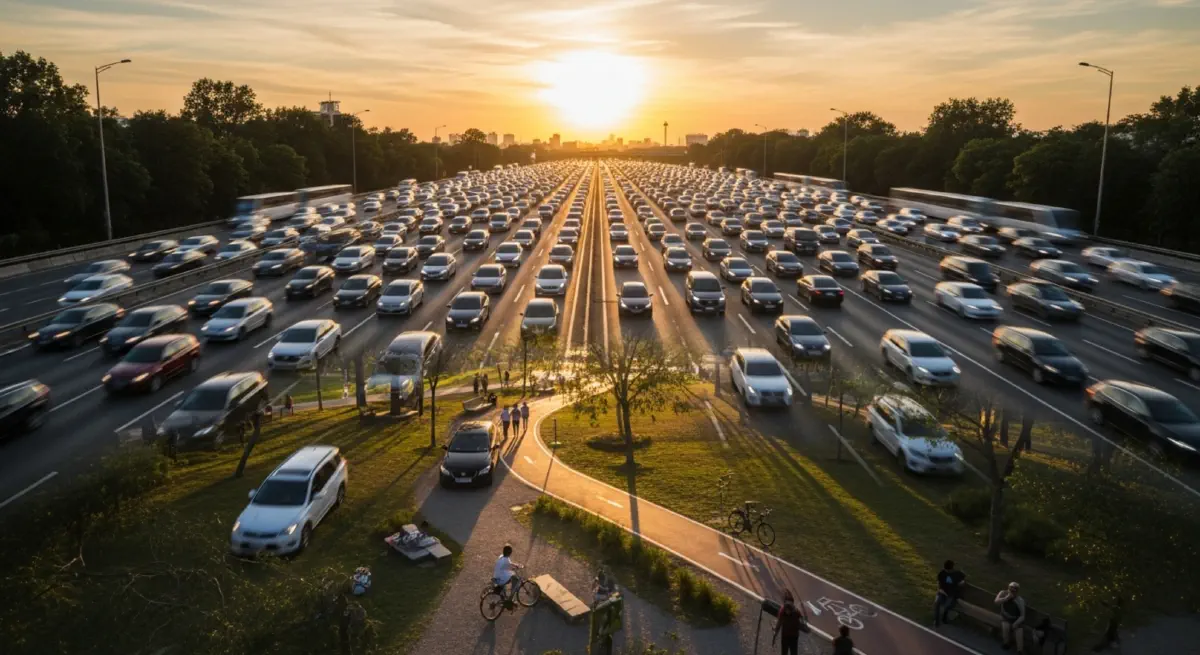
The modern automobile is often marketed as the ultimate vessel of individual freedom, a high-torque chariot capable of whisking its occupants away from the drudgery of the urban grid toward a horizon of infinite possibility. This narrative of "independence, success, and adventure" is not a spontaneous cultural artifact but a meticulously crafted image supported by an industry that spends more on advertising than almost any other sector in the global economy. From a young age, we are conditioned by movies, music, and television to see the car as a prerequisite for adulthood, with car chase scenes and product placements embedding the machine into our collective subconscious. We are shown images of cars gliding through empty, scenic landscapes, yet the daily reality for the average driver is far more prosaic: a sedentary, high-stress crawl through gridlocked traffic. This disconnect between the promise and the reality is the foundation of what researchers now call "motonormativity," a cognitive bias that renders the staggering violence and toxicity of cars invisible through sheer ubiquity.
As we navigate our cities, we are largely blind to the fact that we have completely ripped up the urban fabric—which functioned for thousands of years on a human scale—to accommodate a technology that is fundamentally incompatible with dense living. We have accepted a world where 9,000 miles of a cross-continental journey might be a "record run," yet a walk to buy a bag of milk in a modern suburb is a logistical impossibility. This transition to car dependency was not an inevitable or natural outcome of technological progress; it was engineered through decades of aggressive lobbying, political donations, and infrastructure propaganda designed to ensure that the only way to participate in society was to buy a vehicle and the fuel required to move it. Today, we face a central paradox: the tool we adopted to "annihilate distance" has, in fact, pushed everything farther apart, isolating us from our neighbors and locking us into a fragile system of mobility dependence.
The Thesis of Systemic Displacement#
The global regime of automobility represents a catastrophic failure of systemic design, where the ephemeral convenience of individual travel is subsidized by the collective degradation of public health, environmental integrity, and financial solvency. By internalizing the "motonormative" belief that driving is an absolute necessity, modern society has socialized the massive externalities of "car harm"—including 1.3 million annual deaths and the pervasive spread of microplastics—while creating a regressive economic burden that disproportionately affects the most vulnerable. True urban resilience requires more than a superficial transition to electric power; it demands a fundamental re-engineering of the urban form to prioritize human-scale accessibility over the space-inefficient and lethal demands of the private machine.
The Friction of Material Reality#
The Lethal Mechanics of the Modern Street#
The most visceral manifestation of the car’s systemic failure is the sheer scale of human loss it extracts as a price for mobility. Global traffic crashes kill an estimated 1.3 million people every year, establishing them as the leading cause of death for children and young adults between the ages of 4 and 30. Since their inception, motor vehicles have been responsible for between 60 to 80 million deaths—a figure that matches the total human cost of World War II. This violence is increasingly preventable, yet the automobile industry has found it more profitable to market massive SUVs and pickup trucks that are designed with heavy, tall frames that maximize lethality for those outside the vehicle. While European cities have seen a 36% reduction in road deaths since 2010 through safer street design, the United States has seen a 30% increase in the same period, with pedestrian deaths surging by 80%. We have created environments where every time a citizen attempts to cross a street, they are forced into a life-and-death decision process, effectively fortifying public spaces against the very people who live in them.
The Chemical Shadow of the Rolling Wheel#
Beyond the immediate trauma of crashes, cars engage in a "long game" of environmental attrition that kills populations slowly through the release of nitrogen dioxide, sulfur dioxide, and particulate matter. Even if we were to replace every internal combustion engine with an electric motor, we would only address a fraction of the pollution. Cars release hundreds of environmental pollutants from brakes, vehicle corrosion, and—most significantly—tire wear. A 2025 study in Leipzig found that 65% of microplastic and nanoplastic particles in urban air originate from tire wear, a toxic "road dust" that is blown into the air or washed into water supplies. Because electric cars are significantly heavier than their gas-powered counterparts, they actually increase the rate of tire and road erosion, accelerating the spread of chemicals like 6PPD, a rubber stabilizer known to cause massive die-offs in aquatic life. We are, quite literally, drinking and breathing our tires, the formulas for which remain "trade secrets" hidden from public scrutiny.
The Acoustic and Thermal Enclosure#
The systemic harm of the car extends to the fundamental sensory and thermal environment of the city, turning shared public spaces into hostile zones. Motor vehicles are the primary source of noise pollution in urban areas; once a car exceeds 30 km/h, the sound of the engine is eclipsed by the "rolling noise" of tires on the pavement. This constant auditory stress is not merely annoying; it is a clinical hazard linked to cardiovascular disease, high blood pressure, and cognitive impairment. Furthermore, the car-centric urban form creates a thermal trap known as the "urban heat island effect," where vast expanses of paved asphalt absorb and slowly release heat, making cities significantly hotter during weather extremes. While the transportation sector is responsible for 23% of global energy-related CO2 emissions, this figure excludes the massive carbon footprint of building and maintaining concrete infrastructure and the end-of-life disposal of vehicles. Car-centric cities are, by design, less resilient and more energy-intensive than compact, walkable urban forms.
The Restoration of the Human Scale#
The 20th-century obsession with the private automobile has resulted in a world that is louder, more dangerous, and more socially fragmented than at any point in the history of human settlement. We must dismantle the "motonormativity" that blinds us to the daily violence of our streets and recognize that every "accident" is, in fact, a predictable failure of systemic design. The car was a revolutionary invention, but its misapplication as the universal, default solution for all movement has socialized its staggering costs while privatizing its increasingly rare benefits.
True urbanism is not about the absolute elimination of the motor vehicle, but its demotion to a specialized tool of last resort. By reclaiming our streets for people, we can restore the "Gym of Life," reduce the $12,000 annual tax on low-income families, and ensure that our children can navigate their world with the same independence as a previous generation. The transition to a healthier city requires the political will to stop subsidizing car harm and start investing in the infrastructure of human connection.
Ultimately, the most successful urban places are those where the car is unnecessary, and the city itself becomes a platform for social and economic flourishing. As we look toward the future, the choice is clear: we can continue to serve the machine, or we can begin the work of rebuilding cities for the humans who inhabit them. The freedom of the 21st century will be measured not by the miles we drive, but by the distances we no longer need to travel to find a sense of community.