The Paradox of the Hyde Park Start#
At 3:00 p.m. on a bleak January day in 1963, the Helsinki Market Square stood frozen, a testament to a century-defining winter that had turned the Adriatic into an ice sheet. Eleven years earlier, a similar scene unfolded at Hyde Park Corner in London, where three men in a 4-liter Humber Super Snipe set off to cross the "dark continent" of Africa. These moments represented the zenith of the automotive promise: the idea that a machine, through "stubborn purpose" and "north country courage," could conquer 10,500 miles of desert and jungle in a mere 13 days. The car was then viewed as a revolutionary tool of liberation, a "scroll of modern achievement" that bridged the gap between ancient buildings and the far corners of the earth. It was an era of "adventurers only," where the signposts were occasional piles of stones and the risk of death was a calculated trade-off for the "annihilation of distance".
Yet, fast-forward to the 21st century, and the "adventure" has been institutionalized into a mandatory, sedentary, and lethal system of survival. The same "useful reserve of power" that allowed the Hillman Super Minx to maintain a 53-mph average through the Arctic tundra is now utilized to idle in gridlock on the busiest highways in North America. The "independence" once signaled by a record-breaking run to Cape Town has devolved into a state where 1/5th of American car owners hold a "very strong" desire to live car-free, yet find themselves trapped by a built environment that makes buying a bag of milk impossible without a motorized vehicle. We are haunted by the "Ghost of the Highway," a legacy of mid-century engineering that prioritize some people's journeys at the expense of everyone else's safety and solvency. This transition from a tool of exploration to a weapon of systemic harm marks the most significant psychological and economic shift in the history of human settlement.
The Thesis of Entropic Dependency#
The historical trajectory of the automobile—moving from a resilient tool for extreme endurance to a fragile, mandatory system of urban movement—reveals a catastrophic failure to account for the systemic externalities of "motonormativity." By institutionalizing the mid-century myth of infinite mobility through aggressive lobbying and subsidized infrastructure, modern societies have traded the "Gym of Life" for a sedentary existence that socializes 1.3 million annual deaths and trillions in infrastructure debt. Reclaiming the human scale requires a fundamental deconstruction of the "Universal Law of Cities," recognizing that the very machines engineered to provide freedom have become the primary agents of social isolation and economic extraction.
The Evolution of the Systemic Trap#
The Mechanics of Mass Displacement and the Engineering of Obsolescence#
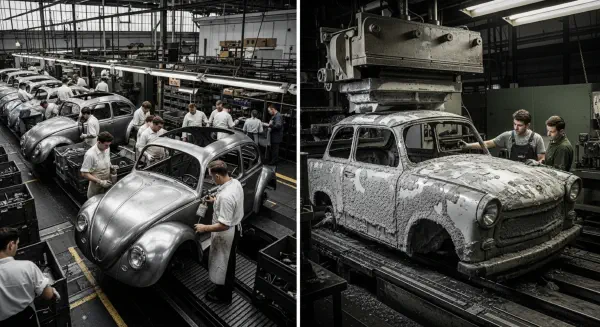
The original engineering philosophy of the Rootes Group emphasized "design-for-maintenance" and "design-for-extreme-utility," where a 10-minute service check could keep a vehicle moving for 525 consecutive hours in sub-zero temperatures. This technical prowess was intended to prove that the "modern African" or "modern Finn" could rely on a car to bypass the failures of local infrastructure, such as 17 primitive ferries in the Congo or the "sea of stones" in the Sahara. However, this "foundation and mechanism" of reliability was eventually co-opted by an industrial logic that prioritized "lifecycle displacement," moving the burden of maintenance and environmental load onto the public. The automobile industry discovered it could maximize profits by selling giant SUVs and pickup trucks that are heavier, taller, and more lethal to those outside the vehicle, effectively "locking-in" higher levels of energy use and systemic risk.
As cars became more "accessible" to the average suburban family, the engineering focus shifted from overcoming nature to consuming space. The "advanced suspension system" that once smoothed out snow-packed roads in Lapland was scaled up to support massive vehicles that now consume more space per hour than 20 bus passengers combined. This spatial inefficiency is not a byproduct of the technology but a core mechanism of the car-centric system. In places like Toronto, the government spent over $5 billion to rehabilitate a crumbling expressway that originally cost only $1 billion to build, demonstrating that the "mechanism" of the car now drains more resources than it provides in mobility. We have built a machine that is no longer a tool for the adventurer but a predator of the municipality, demanding constant "well-placed leverage" in the form of public subsidies and mandatory parking.
The Psychological Crucible and the Economic Extraction of Normalcy#
The "crucible of context" that defines our current era is the phenomenon of "motonormativity," a cognitive bias that renders car harm invisible while moralizing other forms of pollution. In a 2023 UK study, 75% of respondents condemned smoking in public, yet only 17% applied the same logic to driving in highly populated areas, despite the fact that cars release nitrogen dioxide, sulfur dioxide, and toxic "road dust" from tires. This psychological "lock-in" is supported by an industry that spends more on advertising than almost any other, embedding "car ads" inside movies and music to associate the machine with independence. We are conditioned from a young age to see the car as a prerequisite for adulthood, even as children who are driven to school are shown to have lower geographical awareness of their own neighborhoods compared to those who walk.
This psychological bias is mirrored by a regressive economic structure that treats the private machine as a socialized utility. While drivers often complain about "road tax," the reality is that motorists in countries like Australia pay only 1/6th of the total costs of their automobility, with the rest socialized through general taxes and health costs. In the United States, the average cost of car ownership has ballooned to over $12,000 per year, forcing low-income households to spend 32% of their pre-tax income just to participate in society. This "economic extraction" is further hidden in the "high cost of free parking," where every parking spot in a multi-level garage can add $25,000 to $75,000 to the cost of housing. We have created a "Crucible of Context" where the "freedom" of the driver is actively subsidized by the person who walks, the person who breathes, and the child who is denied the "Gym of Life".
The Cascade of Intergenerational Failure and the Urban Heat Island#
The "cascade of effects" from our 70-year experiment with mass automobility is most visible in the hollowing out of our urban cores and the deterioration of public health. To accommodate the "sea of stones" that is the modern parking lot, dozens of historic buildings were bulldozed, destroying the very density that makes small, specialized businesses—like the craftsmen of Tokyo—economically viable. This bad land use is a primary driver of habitat disruption and the reduction in biodiversity, with over 1 billion vertebrates killed by cars annually. Furthermore, the paved surfaces required for cars absorb and release heat, creating the "urban heat island effect" that makes cities significantly more dangerous during weather extremes. The car has quite literally transformed the climate of the city it was designed to serve.
The most tragic cascade, however, is the impact on future generations. Every day, approximately 700 children are killed in car crashes, making traffic violence the leading cause of death for those between the ages of 4 and 30. Even those who survive the streets are "poisoned" by the long game of pollution, with nitrogen dioxide contributing to 4 million cases of childhood asthma per year and tire wear contributing to 65% of microplastics in urban air. The "independence" of the 1952 adventurer has been replaced by the "isolation" of the modern teenager in car-dependent suburbia, who lacks the ability to do any activities without being chauffeured by their parents. We have "redistributed space" in a way that ensures most disabled people, children, and low-income residents are the "losers" in the car economy.
The Synthesis of Human-Scale Restoration#
The history of the Trans-African run and the Finnish Arctic trials reminds us that the motorcar was once a tool of supreme endurance and "scientific triumph". Yet, the "Universal Law of Cities" dictates that the more car-friendly a place is, the more unpleasant it is to be there as a human being. We have reached a point of systemic fragility where the "shimmering heat" and "arid quagmire" of the Sahara have been replaced by the auditory stress of "rolling noise" and the financial trap of "infrastructure debt". The solution is not to "ban all cars" but to demote them from a mandatory existence to a specialized tool of last resort.
The "freedom" of the 21st century will not be found in a faster engine or a 10-minute service check, but in the freedom to live without a car entirely. By reclaiming space from asphalt, we can restore the "Gym of Life," reduce the $12,000 annual tax on families, and ensure that the "signposts" of our cities are once again human connections rather than occasional piles of stones. We must stop treating "car harm" as an inevitable "accident" and start treating it as a choice of systemic design. The city of the future must be a place where a child’s drawing of their journey to school includes more than just two isolated points with "nothing in between".
As we look back at the "scroll of modern achievement" from 1952, we must ask if our current path leads toward progress or towards a "mountain range" that cuts us off from our neighbors. The true "conqueror of Africa" or the "hero of Helsinki" in the 2020s will be the planner who removes the bollards, converts the highway into a park, and returns the city to the people. The "fine achievement" of the past was to conquer distance; the fine achievement of the future will be to restore the human scale and end the "motonormative" crisis.