In a parking lot in Anaheim, California, a 2021 Tesla Model 3 sits plugged into a Supercharger for the third time that day. Its odometer reads 255,000 miles — 410,000 kilometres. Its owner, an Uber driver named Carlos, has been in the car for 11 hours. He will drive another three before he sleeps. He has done this, six or seven days a week, since the car was new. The battery, according to a diagnostic readout performed by a curious mechanic two weeks earlier, has retained 88 to 90 percent of its original capacity. The electric motor is untouched. The brake pads are original, still measuring above the service limit thanks to regenerative braking.
But the suspension clunks over speed bumps. The motor mounts, which had hardened into inelastic blocks of rubber and steel, were replaced at 230,000 miles for $130 in parts. The driver’s door handle failed last year and cost $400 to fix. The large central touchscreen, which controls nearly every vehicle function, restarts itself randomly once a week — a soft crash that Carlos has learned to ignore because the car keeps moving when it happens.
Carlos’s Model 3 is not a hero of durability in the way a 500,000‑kilometre Camry Hybrid is. It is something more ambiguous: a proof of concept, a sketch of what battery electric vehicle longevity might look like, a laboratory for a new set of failure modes that the automotive world is only beginning to understand. It is also a test that the electric vehicle industry — Tesla very much included — has not previously had to pass. Now, after five years of rapid accumulation in rideshare fleets, the data is deep enough to draw preliminary conclusions. They do not align neatly with either the evangelism of EV advocates or the scepticism of their critics.
The Battery: Better Than Feared, Worse Than Some Claim#
When electric vehicles began entering rideshare service in significant numbers around 2019, the dominant fear was battery degradation. The logic seemed unassailable: a lithium‑ion battery, cycled deeply every day and frequently subjected to the thermal stress of DC fast charging, would lose range rapidly. The rideshare duty cycle would accelerate the one component in an EV that was, by far, the most expensive to replace. Early adopters who poured their savings into a Model 3 would be stranded with a car that could no longer complete a shift. Fleet operators who bet on EVs would see their residual values crater.
The reality, as recorded by the growing corpus of high‑mileage Tesla teardowns, the telematics data collected by firms like Recurrent Auto, and the testimonies of drivers themselves, is considerably more nuanced.
The most striking data points come from the rideshare drivers who have pushed their Model 3s furthest. In addition to Carlos’s vehicle at 410,000 kilometres and 88‑90 percent state‑of‑health, a Model 3 operated by an Australian Uber driver reached 409,770 kilometres with 90 percent state‑of‑health after four years — an average of 278 kilometres per day. The battery in that car had been charged predominantly with AC slow charging (71 percent) and only 29 percent DC fast charging. The mechanic who inspected it, an EV specialist who posts teardown videos under the name EV Workz, noted that the battery cell voltage delta was still within the factory specification.
These are not isolated examples. Recurrent Auto, which aggregates battery data from over 15,000 EVs including fleet units, reports that battery replacements in modern EVs (post‑2022) occur at a rate of just 0.3 percent across all vehicles surveyed. Even among older EVs, only 1.5 percent have required a pack replacement. The data, however, contains a critical qualifier: the degradation curve is not one curve. It is a set of curves that diverge dramatically depending on how the vehicle is charged.
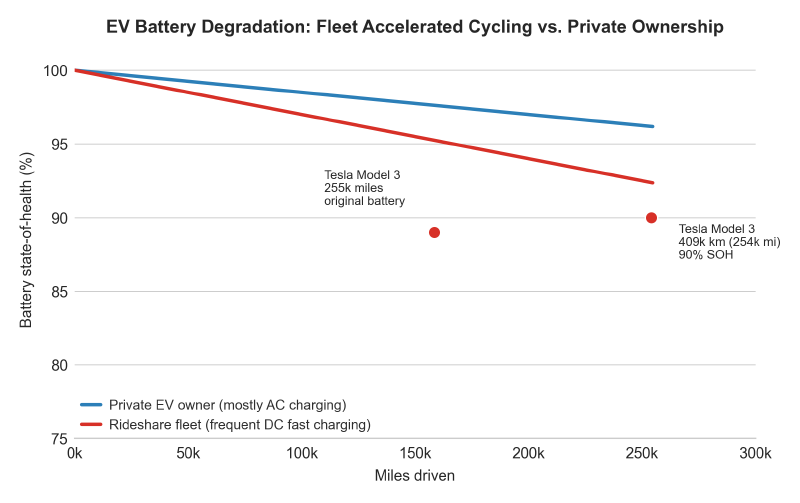
The degradation trajectory of a fleet EV that depends heavily on DC fast charging is steeper than that of a privately owned EV that sits plugged into a Level 2 charger for most of its life. Recurrent’s data shows that vehicles that rely on DC fast charging for more than 30 percent of their energy intake experience noticeably faster capacity loss. The physics is straightforward: high‑rate charging generates heat, and heat accelerates the chemical degradation of the electrolyte and the growth of the solid‑electrolyte interphase layer on the anode. A rideshare driver who Supercharges twice a day, every day, is stress‑testing the battery in a way that a commuter who charges overnight in a garage never will.
Yet even under those conditions, the absolute level of degradation is lower than many analysts predicted five years ago. The Tesla Model 3 and Model Y, which use nickel‑cobalt‑aluminium (NCA) or lithium‑iron‑phosphate (LFP) chemistry depending on the variant, appear to be capable of retaining 80 percent or more of their original capacity well past 300,000 kilometres — provided the battery management system functions correctly and the thermal management loop (the liquid cooling that keeps the pack at an optimal temperature) stays intact.
This is not the same as “batteries will last forever in fleet use.” It is, rather, evidence that the battery degradation problem, while real, is not the fleet‑killer that industry sceptics feared. The more urgent durability questions, it turns out, lie elsewhere in the vehicle.
The New Failure Modes: Everything Around the Battery#
If you tear down a Toyota Camry Hybrid at 500,000 kilometres, you will find a drivetrain that is mechanically tired but fundamentally intact. The engine’s compression may be slightly low, the hybrid battery’s capacity may have declined by 10 or 15 percent, but the failure points — the things that actually stopped the car — have been almost entirely limited to consumables: brake pads, tires, 12‑volt accessory batteries, occasionally a water pump or a wheel bearing.
When you tear down a high‑mileage Tesla, a different pattern emerges. The battery and motor are often in remarkable condition — the core of the EV is more durable than its internal‑combustion counterpart. But the periphery of the car — the suspension bushings, the control‑arm ball joints, the door handle actuators, the HVAC compressor, the touchscreen — is failing at a rate that the Camry’s equivalent components simply do not.
Carlos’s motor mount replacement at 255,000 miles is the tip of an iceberg that fleet operators are mapping in real time. Tesla’s electric motor delivers instantaneous torque, and that torque places enormous repeated stress on the mounting points, the drive‑unit bushings, and the entire suspension structure. The Model 3’s rear‑drive unit is housed in a subframe that isolates vibration from the cabin, but the rubber components that perform that isolation degrade faster under the rapid torque reversals of urban driving than they would in a privately owned car that spends most of its time cruising at a steady speed.
Suspension wear more broadly is emerging as the dominant fleet‑level failure mode for EVs. The additional weight of the battery pack — a Model 3 Long Range weighs over 1,800 kilograms, roughly 200 kilograms more than a Camry Hybrid — increases the static and dynamic loads on every bushing, joint, and damper. The frequency of stop‑start driving in rideshare service multiplies the number of load cycles. The result is that control‑arm bushings that might last 250,000 kilometres in a private vehicle begin to crack and clunk at 120,000 kilometres in a fleet Tesla. The parts themselves are not expensive, but the cumulative labour to replace them — and the downtime that Carlos’s fleet‑operator counterpart dreads — adds up.
Then there are the uniquely EV‑specific peripheral failures. The door handles on a Tesla 3 are electrically actuated; when they fail, the repair is not a mechanical linkage fix but a module replacement and software re‑pairing. The central touchscreen, which serves as the instrument cluster, the climate control, and the entertainment system, is a custom‑engineered computer that runs a Linux‑based operating system. The eMMC flash memory in early versions was subject to wear‑out from excessive logging, a problem that Tesla eventually addressed with a recall, but the fact remains: a fleet vehicle whose climate control cannot be adjusted because the screen has crashed is a vehicle that is, for practical purposes, out of service.
These failures do not show up in the early‑owner satisfaction surveys that shape the public reputation of Tesla and other EV brands. Like the German lease‑return cars we examined in Part 3, EVs are primarily assessed by their first owners — who sell them before the suspension degrades and who charge them gently in their garages. The fleet environment is the first context in which the full‑lifecycle failure profile of the modern EV becomes visible.
The Waymo Extreme: A Dataset the World Can’t Yet Read#
If the rideshare fleet is an accelerated durability test, the Waymo autonomous fleet is an experiment in vehicle ageing at a velocity that has no precedent. Waymo’s vehicles — a mix of Jaguar I‑PACE electric SUVs and, increasingly, a purpose‑built platform from Chinese‑Swedish brand Zeekr — operate in Phoenix, San Francisco, and Los Angeles on a schedule that makes Uber’s hardest‑working drivers look idle. The fleet runs with 98.4 percent uptime, according to Waymo’s own operational data, deploying vehicles in shifts that can exceed 20 hours per day. The sensor suite — lidar, radar, cameras — draws continuous power, and the air‑conditioning system runs even when the vehicle is empty because the computers must stay cool.
By March 2026, the Waymo fleet had accumulated over 170 million real‑world miles (274 million kilometres) of autonomous operation. That fleet‑wide distance is still smaller than the total distance driven by all Toyota Camrys on the planet, but it is growing exponentially, and every mile is logged with a granularity that makes a traditional fleet manager’s spreadsheet look like crayon on a napkin.
What do those 170 million miles tell us about EV durability? The public record is frustratingly thin. Waymo does not publish raw battery degradation data; it has no incentive to, and the data is commercially sensitive. What it does publish — and what third‑party auditors verify — is safety performance.
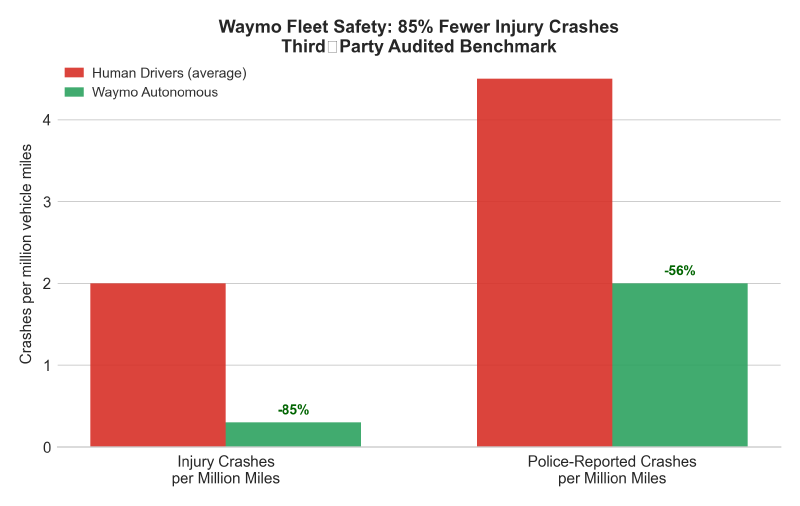
The safety figures are, by any standard, remarkable: an 85 percent reduction in injury crashes and a 57 percent reduction in police‑reported crashes compared to human drivers in the same ZIP codes, as verified by Swiss Re. For the purposes of this series, however, the safety data is a proxy for a deeper reliability story: a fleet that experiences frequent sensor failures, drive‑system faults, or communication dropouts would not achieve these safety results. The fact that Waymo vehicles operate at this level of safety while being run 20 hours a day implies that the fundamental vehicle hardware — the battery, the motor, the power‑electronics cooling — is holding up under a load that no private EV will ever see.
Some indirect battery data exists. A German testing firm, Dekra, inspected six used Jaguar I‑PACE units — the same model that formed Waymo’s first‑generation EV fleet — with between 180,000 and 260,000 kilometres on the odometer. The battery state‑of‑health ranged from 95 to 97 percent. That is a striking finding, especially against the backdrop of the I‑PACE’s well‑documented problems: multiple battery fires caused by thermal runaway in early packs led Jaguar to institute a buyback program and issue a recall. The I‑PACE’s battery management system, it seems, could keep a pack healthy for a very long time — until, in a small number of cases, it couldn’t. The catastrophic failure mode, not the gradual degradation, is the fleet operator’s nightmare, and the I‑PACE example illustrates that a single thermal event can overshadow a thousand uneventful charge cycles.
Waymo’s next‑generation Zeekr platform will be the first purpose‑built autonomous EV to accumulate fleet data at scale. When — or whether — that data becomes public is unknown, but it will represent the most extreme durability dataset ever generated for a battery‑electric vehicle. For now, the most reliable dataset we have is from the rideshare drivers, and they are producing signals that the industry ignores at its peril.
What We Don’t Yet Know#
The chorus of EV durability data is growing, but it is not yet a symphony. The unknowns are structural and they matter.
First, we do not know the shape of the battery degradation curve beyond roughly 400,000 kilometres. The data points we have — Carlos’s car, the Australian Uber driver’s car, a smattering of others — are inspiring, but they are individually anecdotal and collectively sparse. The Recurrent dataset, while valuable, is biased toward vehicles that have been well maintained and that are driven by owners willing to plug in a monitoring device. The true population of fleet EVs includes cars that have been abused, neglected, and fast‑charged into oblivion. Their battery health is largely invisible to the public.
Second, we do not know what happens to an EV’s electronics when they are subjected to continuous thermal cycling for a decade. The Toyota Camry Hybrid’s longevity is partly a function of its relative simplicity: the hybrid system adds a battery and a motor‑generator, but the vehicle’s core electronics — the infotainment, the climate control, the body modules — are relatively straightforward and can be replaced individually. A modern EV, and especially a Tesla, is a computer on wheels. The touchscreen, the domain controllers, the over‑the‑air update system, and the dozens of body‑control modules form an interdependent electronic organism. When the organism ages, the failure mode is not a leaking gasket. It is a corrupted memory chip or a cracked solder joint on a circuit board. Those failures are harder to diagnose, harder to repair, and potentially very expensive.
Third, we do not know how the second‑hand market will value a 400,000‑kilometre EV. The wholesale auction data that serves as a reliability benchmark for the Camry does not yet exist in volume for high‑mileage Teslas. The vehicles are too new. When they begin to cross the block in significant numbers in the late 2020s, the prices they command will be the market’s definitive verdict on EV longevity. A Tesla with 500,000 kilometres and 85 percent battery health might fetch a surprising premium — or it might be treated as electronic waste, a product whose battery replacement cost exceeds the vehicle’s value. The truth will be visible in the auction lanes, and it will not be kind to speculation.
The Interim Verdict#
The fleet data on electric vehicles is incomplete, but it is not blank. The shape of the emerging picture is this: the electric drivetrain — the battery and motor — is proving more mechanically robust than many expected, capable of matching or exceeding the longevity of the best internal‑combustion powertrains under the right charging conditions. The risk is not that the battery will suddenly die at 200,000 kilometres, but that the car around it — the suspension, the electronics, the ancillary systems — will degrade in ways that are expensive to fix and that undermine the vehicle’s usefulness long before the battery is exhausted.
This is a mirror image of the German luxury problem we diagnosed in Part 3, but for different reasons. The German car’s drivetrain is often the weak point, undone by thermal stress and a design margin calibrated to the lease term; the EV’s drivetrain is the strong point, while the periphery is the unvalidated margin. The fleet data exposes both.
The Camry Hybrid remains, for now, the undisputed king of accelerated‑lifecycle durability, because it has proven both a robust drivetrain and a robust periphery. The Tesla Model 3, judged by the same fleet standard, is a promising work‑in‑progress that can deliver extraordinary mileage at low per‑kilometre energy cost — but whose total cost of ownership, once suspension overhauls and electronic repairs are included, is not yet settled.
The Waymo fleet, running in the background of this whole experiment, is writing the true durability textbook for electric vehicles. The industry, and the public, will learn its lessons only when the data is shared — or when the vehicles start to fail.
Coming in Part 5: What Buyers Should Actually Use — How the information asymmetry between manufacturers and buyers can be closed by the one actor who has already done it: the fleet operator. A structural argument for using fleet TCO data, not consumer review scores, to make the biggest financial decision most households will ever face.