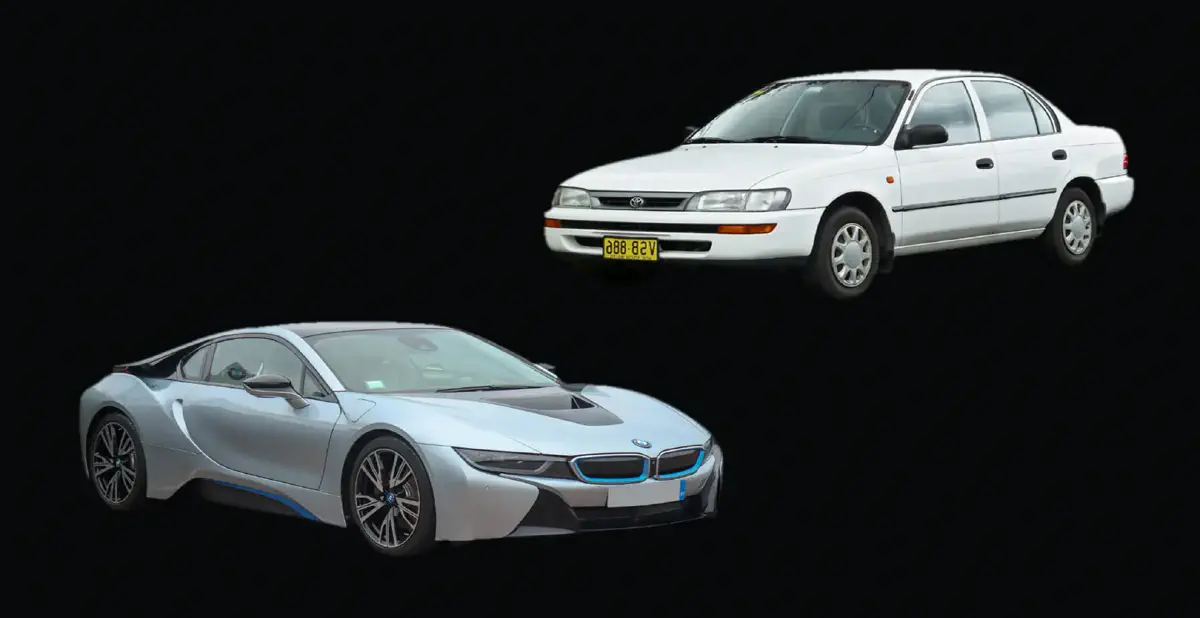
In late 2023, a wholesale auction in Mannheim, Germany, offered a 2019 BMW 530d xDrive with 178,000 kilometres on the clock. The car was a single‑owner corporate lease return, serviced at a main dealer on schedule, never crashed. Its original list price had been €67,000. The bidding stalled at €18,400. In the next lane, a 2019 Toyota Camry Hybrid with 203,000 kilometres — an ex‑taxi, white paint, cloth seats, no options to speak of — drew €22,100 and sold to a used‑car dealer from Frankfurt who had bought 12 identical units that month.
The Camry was a year older in service. It had more kilometres. It had been driven by people who did not own it. Yet the market valued it higher than a pampered BMW. The German dealer, asked why, gave a one‑word answer: Reparaturanfälligkeit. Repair proneness.
This scene replays every week at auctions across Europe and North America. The vehicles that earn the highest ratings in enthusiast magazines, that win the comparison tests, that define “premium” in the consumer imagination, systematically underperform the market’s most objective durability test: how much a professional buyer — someone who will have to stand behind the car’s reliability when they resell it — is willing to pay for a high‑mileage example.
The gap between the Camry and the BMW is not an anomaly. It is the natural consequence of a business model that has, over three decades, shaped German automotive engineering into something brilliant at delivering short‑term satisfaction and disastrous at surviving long‑term stress. To understand why, we must start not with the cars themselves but with the financial instrument that defines the German premium market: the lease.
The 3‑Year Lease and Its Perverse Incentives#
In Germany, roughly 65 percent of new premium cars are leased, not purchased. In the United States, the figure for BMW and Mercedes hovers around 55 to 60 percent. The typical term is 36 months. At the end of that term, most vehicles are returned to the manufacturer’s captive finance arm, which resells them as certified pre‑owned (CPO) units with a warranty that extends a few more years. The manufacturer absorbs the residual‑value risk, which means the manufacturer has a direct financial interest in what the car is worth at the 3‑year mark.
This structure creates a set of incentives that are perfectly rational for the manufacturer — and perfectly misaligned with the interests of anyone who will own the car after year five.
A vehicle that will be returned to the manufacturer at 36 months needs to perform flawlessly during those 36 months. It needs to feel solid and refined on the test drive. It needs to generate zero warranty claims that would show up in JD Power’s Initial Quality Survey, because those scores are marketed aggressively. It needs to impress the automotive press, whose reviews shape the perceptions of the lease customers who keep the whole machine running.
What it does not need to do is survive 400,000 kilometres of rideshare duty. It does not need to have a water pump that lasts 200,000 kilometres or a timing chain guide that resists brittleness after a decade of heat cycles. It does not need to be cheap to repair when an air‑suspension strut fails, because that failure will occur — if it occurs at all — well after the manufacturer has washed its hands of the vehicle.
The result is an engineering philosophy that optimises for the test drive and the first‑owner experience, at the direct expense of long‑cycle durability. The design margins are set to survive the lease term with a comfortable buffer, and no further. This is not a conspiracy. It is the outcome of a market that has organised itself around a 3‑year product cycle, and it is thoroughly rational within its own logic. The problem is that the rest of us live with the consequences.
Complexity as a Luxury Signal#
German manufacturers do not just build cars to survive the lease term. They build cars that are, by their very nature, more complex than the Toyota and Honda products that dominate the fleet hierarchy, and they deploy that complexity as a luxury signal. More systems mean more points of failure; more components mean more interactions that can go wrong; but more features also mean more reasons for a lease customer to choose the German car over a Japanese alternative that might have fewer things to break.
Consider the modern luxury sedan’s feature list: adaptive air suspension, active anti‑roll bars, multi‑chamber pneumatic seats with massage functions, soft‑close doors, electrically retractable door handles, dual‑screen infotainment with gesture control, 48‑volt mild‑hybrid systems, electrically heated windscreens, night‑vision cameras, laser headlights. Every one of these adds a control module, a wiring harness, a set of sensors and actuators, and a failure mode that will manifest after the warranty clock runs out.
In a Camry, the door handle is a piece of plastic attached to a mechanical linkage. It will work for the life of the vehicle. In a Mercedes S‑Class, the door handle contains a motor that pushes it out from the body when the key is detected. When that motor fails — and fleet data suggests it will, somewhere between 100,000 and 200,000 kilometres — the repair is not a $50 part and 20 minutes of labour. It is a $1,200 assembly that requires removing the door panel and reprogramming the body control module. A fleet operator who runs 200 vehicles cannot absorb a steady trickle of $1,200 door‑handle repairs; a private owner who bought the car used for $25,000 cannot stomach them either.
The complexity arms race has accelerated over the past decade as German brands competed with each other — and now with Tesla — on the perception of technological advancement. The 2024 Mercedes E‑Class, for example, features an “MBUX Superscreen” that spans the entire dashboard, a selfie camera for Zoom calls, and a light‑show projection system embedded in the grille. None of these features will improve the car’s ability to move passengers from point A to point B at 500,000 kilometres. All of them will, statistically, fail at some point after the lease expires.
The Fleet Verdict in Hard Numbers#
The fleet data we presented in Part 2 already established the broad hierarchy: Toyota at the top, Honda close behind, and German brands absent from the fleet‑procurement conversation. Now it is time to put a price on that absence.
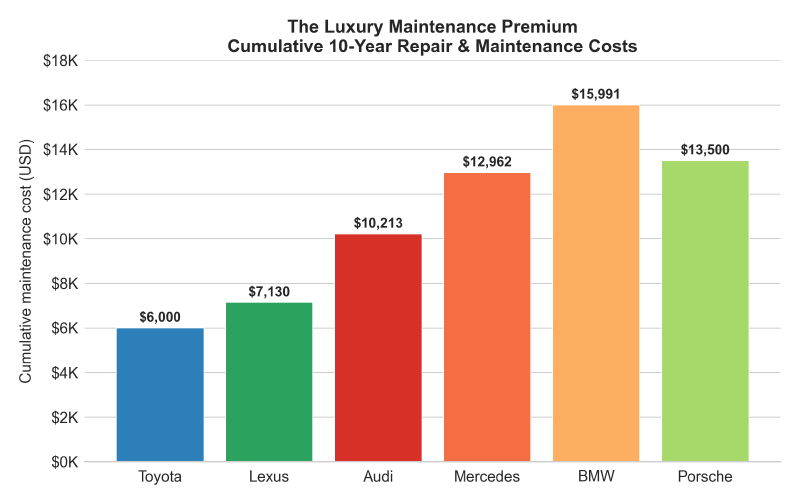
The 10‑year maintenance‑cost curve captures the divergence in a single image. Toyota’s cumulative cost settles around $6,000. Lexus — Toyota’s luxury division, built on the same engineering philosophy but with nicer materials — comes in at $7,130. Audi breaches $10,000. Mercedes‑Benz passes $12,900. BMW pushes toward $16,000.
The gap between a BMW and a Lexus over a decade is nearly $9,000 — and that is for a vehicle driven at private‑owner mileage of roughly 19,000 kilometres per year. If you accelerate that mileage to the rideshare duty cycle of 80,000 kilometres per year, the absolute figures multiply. More importantly, the failure modes that appear at the 7‑ or 8‑year mark in a private BMW appear at the 2‑year mark in a rideshare unit. The luxury car that private owners report as “surprisingly reliable” at 60,000 kilometres becomes a maintenance catastrophe at 250,000.
The major‑repair probability tells a parallel story:
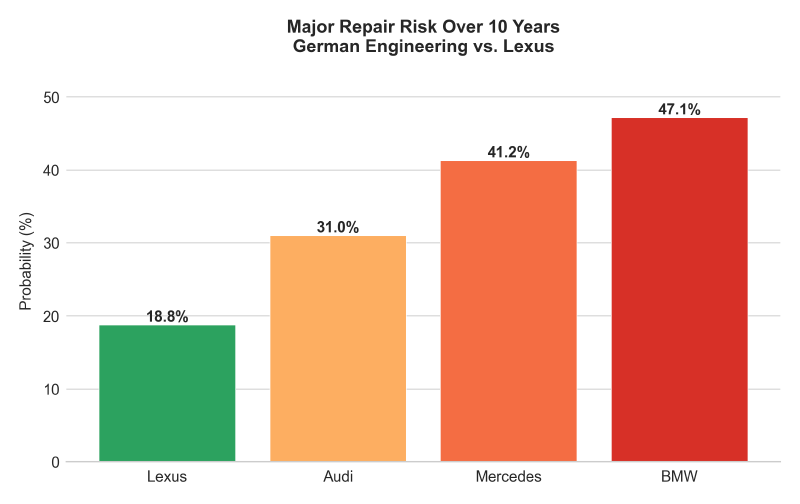
Lexus: 18.75 percent chance of a major repair within 10 years. Audi: nearly 31 percent. Mercedes: over 41 percent. BMW: more than 47 percent. A BMW owner is two and a half times more likely to face a major, wallet‑draining repair than a Lexus owner — and the definition of “major” here is a repair costing more than a few hundred dollars.
A fleet manager reading these numbers sees more than risk. They see downtime. A vehicle that is in the shop for a major repair is not earning fares, and a fleet operator who has promised a driver a reliable vehicle is now absorbing the cost of a rental replacement while the BMW’s transmission is being rebuilt. The Camry’s transmission, with its planetary gearset and lack of wear‑prone clutches, simply does not fail at 150,000 kilometres. It does not fail at 300,000 kilometres. It may not fail at 500,000 kilometres. That is not a claim Toyota makes in its advertisements. It is a fact that fleet managers have learned from experience, and it is the reason BMWs do not appear in their procurement spreadsheets.
Engineered for the Review, Not the Road#
The gap between German and Japanese engineering is not primarily a question of competence. German engineers are among the best in the world. The difference is in what they are told to optimise for.
A Toyota engineer working on the Camry’s suspension bushings knows that the vehicle will be sold in 100 countries, that a significant minority of those units will end up as taxis in developing markets, and that Toyota’s brand reputation — its single most valuable asset — depends on those taxis not failing. The bushings are specified with a safety factor that assumes worst‑case roads, worst‑case maintenance, and a service life of 300,000 kilometres or more. The engineering brief says: this component must survive forever.
A German engineer working on a 3‑Series suspension bushing faces a different brief. The vehicle must deliver precise steering feel and a supple ride on German autobahns and American interstates. It must not degrade noticeably during the 3‑year lease term. The safety factor is calculated for a service life of 150,000 kilometres under assumed good‑road conditions, because that is what the financial model requires. If the bushing begins to crack at 180,000 kilometres, the manufacturer does not bear the cost. The second or third owner does.
This asymmetry plays out across every system in the vehicle. The German engine’s cooling system uses plastic components — thermostat housings, water‑pump impellers, expansion tanks — that are dimensionally stable and easy to manufacture, but which become brittle after repeated heat cycles. By year six or seven, the expansion tank cracks, the coolant leaks, the engine overheats, and the owner is facing a $2,000 repair. The Toyota cooling system uses a different plastic compound, or metal where the German car would use polymer, because the Toyota engineer’s brief includes the 10th owner.
The BMW N63 twin‑turbo V8, introduced in 2008 and installed in everything from the 5‑Series to the X5, is a case study in what happens when short‑cycle optimisation meets real‑world heat. The engine’s “hot‑vee” design placed the turbochargers between the cylinder banks, improving throttle response but creating a thermal environment so hostile that valve‑stem seals hardened, oil consumption spiked, and timing chains stretched. BMW issued multiple service bulletins and a class‑action settlement in the United States, but the fundamental design was not fixed for years. The engine performed brilliantly in magazine tests. It was a nightmare for anyone who bought one used. Fleet operators never touched it.
The Lexus Exception#
The presence of Lexus in the reliability data — a luxury brand that costs $7,130 to maintain over 10 years, less than any German marque and only slightly more than Toyota itself — is the proof that the German problem is not about being “premium.” It is about the incentive structure.
Lexus is an arm of Toyota Motor Corporation. Its vehicles share platforms, powertrains, and supply chains with Toyota’s mainstream models. The Lexus ES is essentially a Camry with more sound insulation, real wood trim, and a longer list of standard features — but the mechanical bones are identical. The Lexus RX shares its hybrid system with the Toyota Highlander. This platform‑sharing strategy means that the engineering margins built into the Toyota fleet‑workhorse parts bin are inherited by the luxury division.
When a Lexus LS owner presses the starter button, the engine that fires is a Toyota V6 that has been validated for 500,000‑kilometre taxi service. The touchscreen might be more elaborate, the leather might be semi‑aniline, but the water pump is the same one that has been running in Camrys for a decade. The result is that Lexus delivers the luxury experience — quiet cabin, smooth ride, high‑quality materials — without the catastrophic long‑term cost curve of the German brands.
The German manufacturers cannot replicate this, not because they lack engineering talent, but because their premium business model structurally requires differentiation at the mechanical level. If a BMW 3‑Series shared its engine and transmission with a Toyota Camry, it would not be a BMW. The brand equity — engineered, marketed, and defended over decades — rests on the idea that the German car is fundamentally different under the skin: rear‑wheel drive, longitudinally mounted engine, bespoke suspension geometry, unique electronics architecture. That bespoke quality is exactly what makes the car expensive to maintain when the design margins are set to the 3‑year lease horizon.
The Information Asymmetry#
The lease‑customer who returns a BMW after 36 months has a superb experience and a strong incentive to tell everyone they know about it. The car was silent, fast, and impeccably finished. It never broke. The JD Power survey arrives in the mail, and the customer checks “no problems” — truthfully, because within the 36‑month window, there were none.
The third owner of that same vehicle, who buys it at 140,000 kilometres for $18,000 and discovers that the air suspension needs $4,000 in repairs at 160,000 kilometres, does not receive a JD Power survey. Their experience is not aggregated by Consumer Reports. They are invisible to the data streams that shape the industry’s public reputation. They might post on an internet forum, but their complaint is one voice among millions, easily dismissed as anecdotal.
This information asymmetry is the structural reason that German luxury brands enjoy high consumer satisfaction scores while failing the fleet durability test. The satisfaction surveys capture the experience of the first owner, who is precisely the owner the manufacturer optimised the car for. The fleet data captures the experience of the vehicle across its entire useful life, including the years when the manufacturer’s financial interest has evaporated.
The fleet operator is the only actor in this ecosystem who systematically closes the information gap. They see the maintenance invoices from year one through year eight. They know the exact cost per mile of a BMW versus a Camry over a 500,000‑kilometre life. They act on that knowledge, and their actions produce the market signals — auction prices, fleet composition, TCO rankings — that the private buyer, if they knew to look, could use to make a genuinely informed decision.
The Cultural Component#
The structural storyline — lease cycle, complexity signalling, engineering briefs — explains the broad pattern, but it would be incomplete without acknowledging a cultural dimension. German automotive engineering has a philosophical commitment to the idea that a car should be a machine of precision, and precision, in the German engineering tradition, often means many fine‑tuned parts working in close tolerance. This approach produces vehicles that feel extraordinary when they are fresh — the door closes with a vault‑like thunk, the steering is weighted with exactness, the suspension isolates without floating.
The Japanese engineering tradition — and specifically the Toyota tradition — has a different emphasis. It values simplicity, over‑engineering rather than precision‑engineering, and a kind of mechanical robustness that tolerates neglect. The Toyota production system, with its famous jidoka (automation with a human touch) and kaizen (continuous improvement), is built on the idea that a machine should be easy to build correctly and hard to break. In a Toyota factory, a worker who finds a defect can stop the entire production line. That mentality, applied over millions of vehicles, produces a Camry whose transmission will work even if the fluid is never changed and whose engine will survive a skipped oil change.
Neither approach is morally superior, but they produce vastly different outcomes at high mileage. The precision‑engineered German car is like a fine mechanical watch: beautiful, intricate, and intolerant of deferred maintenance. The robust‑engineered Japanese car is like a quartz watch: less romantic, but it keeps time through conditions that would shatter the mechanical movement.
The fleet data does not judge the romance. It only counts the cost.
What This Means for the Private Buyer#
A reader who has no intention of ever driving a taxi or an Uber might wonder whether this entire discussion is academic. It is not. The fleet data is, in effect, an accelerated stress test that predicts what will happen to your car in years eight, ten, and twelve — the years when you will have paid off the loan and might reasonably hope to enjoy a few years of repair‑free driving.
If you buy a Camry — or a Lexus ES, which is the same car wearing a nicer suit — the fleet data tells you that your probability of a major repair before 300,000 kilometres is vanishingly small. The car will bore you. It will not make your heart beat faster on an on‑ramp. But it will start every morning, it will not leak coolant into your driveway, and when you finally sell it, the used‑car market will pay you a price that reflects its remaining life.
If you buy a used German luxury sedan, the fleet data tells you that you are rolling a 40 percent die on a major repair within the next few years — a probability that rises steeply with mileage. The car will delight you when it works. The steering will feel alive, the engine will pull hard, the cabin will be a lovely place to spend time. But you are buying an asset that was engineered to impress its first owner, not to serve its last one. The discount you get on the used market is not a bargain. It is a risk premium, correctly priced by a market that knows more than the car reviews will tell you.
The Next Unknown#
The fleet data we have examined so far — the Camry’s mechanical invincibility, the Prius’s frugal longevity, the German brands’ steep cost curves — reflects a world of internal combustion. That world is receding. The next great durability experiment is running right now, in the same rideshare fleets and taxi companies and autonomous‑vehicle operations, but with a different powertrain: the battery electric vehicle.
The early data is trickling in, and it does not fit neatly into the patterns we have established. Tesla’s Model 3 is accumulating high‑mileage fleet records that challenge the “EVs degrade fast” assumption, while simultaneously revealing a new category of non‑drivetrain failures that the Camry never suffers. The Waymo autonomous fleet is generating a dataset that may eventually eclipse everything we know about vehicle durability — but the company is not sharing it.
That is where the series goes next.
Coming in Part 4: The EV Unknown — What early fleet data shows about battery electric vehicle durability under accelerated cycling. Tesla in rideshare. The Waymo dataset. And why everything the industry thought it knew about EV longevity is being rewritten by Uber drivers in California.