
The modern American full-size pickup is a statistical marvel. The average transaction price for a new one now hovers near $60,000, with top-tier models like the Ford F-150 Limited or GMC Sierra Denali Ultimate easily exceeding $90,000. They are among the most profitable mass-produced consumer goods in the world. This financial reality has cemented their role not as mere vehicles, but as the primary engines of capital for the Detroit Three.
This economic dominance creates a profound vulnerability. In the first quarter of 2022, Ford’s “F-Series” trucks alone generated over 40% of the company’s global automotive revenue. This concentration makes corporate strategy hostage to the pickup’s continued success. Every investment in electrification or autonomy is, in effect, a bet funded by pickup truck profits. The industry is in the paradoxical position of using the profits from gasoline-dependent leviathans to finance their own eventual replacement.
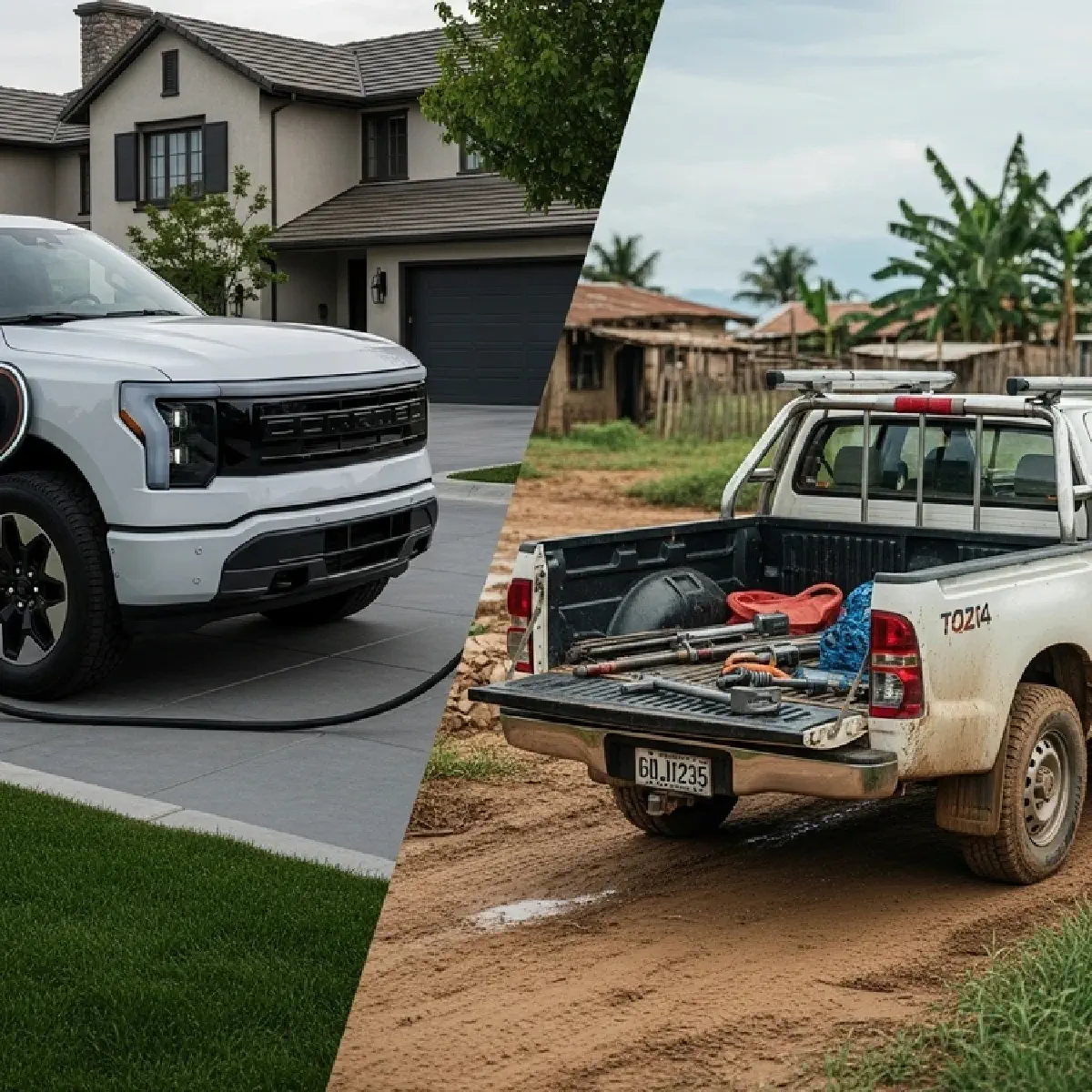
The response has been the electric pickup, a vehicle that embodies the final stage of the paradox. Models like the Ford F-150 Lightning, Rivian R1T, and Chevrolet Silverado EV are not designed as efficient, right-sized urban runabouts. They are, with few exceptions, larger, heavier, and faster than their gasoline predecessors. They leverage electric powertrains not to promote sustainability, but to amplify the existing truck ethos: instant, monstrous torque for towing, futuristic “frunk” (front trunk) storage, and power export capabilities for tailgating or job sites. The electric pickup is not a rejection of the truck’s recent history, but its apotheosis—the same vehicle, now with a guilt-reduced (but far from eliminated) carbon footprint and even more extreme performance.
The Global Ripple Effects of a Protected Behemoth#
The American pickup’s journey has never been confined to its home market. Its protected development created a distinct product that now exerts force globally. The Chicken Tax effectively exported a specific automotive ideal: that a pickup should be large, powerful, and luxurious. In markets from the Middle East to Latin America, the American full-size pickup is a potent status symbol, often imported at great cost.
Conversely, the rest of the world developed along a different path. In Asia, Africa, and Europe, small, efficient, unibody pickups like the Toyota Hilux, Ford Ranger, and Isuzu D-Max dominate. These are true global workhorses, designed for efficiency, maneuverability, and durability in developing economies. The divergence is stark: the best-selling vehicle in America is the Ford F-Series, a behemoth. In Thailand, it’s the Toyota Hilux, a rugged tool.
This split has concrete consequences. American manufacturers, optimized for building body-on-frame giants, have struggled to compete in the global small-truck market. Meanwhile, the safety incompatibility between these vehicle classes is a global concern. When a 2.5-ton Ford F-150 collides with a 1.5-ton Toyota Hilux, the laws of physics are unforgiving. The American truck’s size, a product of protected domestic evolution, becomes a lethal export.
Cascading Consequences: The Externalized Costs of Dominance#
The societal footprint of the pickup’s triumph is vast and often hidden. Their weight accelerates road wear exponentially; damage to pavement scales to the fourth power of axle weight. A single 6,000-pound pickup causes over 16 times the road damage of a 3,000-pound sedan. This cost is socialized, paid by all taxpayers through infrastructure budgets.
Their size reshapes our environment. They require longer, wider parking spaces, pushing parking lots to consume more land. Their high front ends and long hoods create massive front blind zones, directly contributing to a crisis in pedestrian safety. A 2023 study by the Insurance Institute for Highway Safety found that pickups and SUVs were 45% more likely than cars to hit pedestrians when making turns.
Furthermore, the pickup’s fuel appetite has macro-economic implications. The light truck segment’s resistance to efficiency gains has made it a persistent drag on national fuel economy averages, increasing US dependence on oil. The profits from this segment flow overwhelmingly to domestic manufacturers and their shareholders, creating a concentrated economic benefit while the costs—pollution, infrastructure strain, safety risks—are distributed broadly across society.
The Unresolved Paradox#
The pickup truck stands as a monumental contradiction. It is a luxury good masquerading as a tool, a personal expression vehicle classified as commercial equipment, and a product of global trade wars sold as a symbol of national identity. Its story is a century-long case study in how policy, psychology, and profit can warp a product’s evolution far from its utilitarian origins.
The “Chicken Tax” (Policy and Critique) created the initial conditions. The exploitation of consumer psychology—the desire for safety, status, and capability—fueled its transformation. The trade and supply chains were distorted to serve this protected market, and the entire saga is a rich historical case study in unintended consequences.
Today, the paradox is entering a new phase with electrification. Can the electric pickup resolve these contradictions, or will it simply perpetuate them with a different powertrain? The answer depends on whether we see it as a tool for a sustainable future or as the latest, most expensive costume for a vehicle whose true purpose has always been to reflect—and profit from—the complex ambitions of the market it was artificially designed to dominate. The farm implement is gone. In its place is a financial instrument on wheels, and its final destination is still unknown.