In 1956, General Motors executive Harlow Curtice unveiled a radical new concept to the American public: the annual model change. The goal was not technological improvement, but economic obsolescence. “Our job,” he stated, “is to hasten obsolescence.” This philosophy crystallized the modern automotive economy’s central truth: the primary profit is not in selling you a car, but in selling you car ownership—a continuous, multi-decade financial relationship. The gleaming vehicle on the showroom floor is not a product; it is the entry point to a labyrinthine financial ecosystem.
The sticker price, that focal number of negotiation, is a masterful diversion. It captures less than half of the total cost of ownership for a typical new vehicle over its first five years. The real economic engine of automobility lies in the downstream rivers of revenue: interest payments to captive finance arms, parts sales to dealerships, proprietary software licenses, and the inevitable flow of trade-ins feeding the certified pre-owned machine. This system is meticulously architected to obscure true costs, lock in dependencies, and maximize lifetime revenue extraction from each metal box that rolls off the assembly line.
This financial architecture creates a profound power asymmetry. The individual owner, facing a complex, infrequent purchase, is pitted against multinational corporations with decades of data on depreciation curves, repair frequency, and financing elasticity. The result is an economy where the most expensive consumer good most people will ever buy is also the one where the full cost is most deliberately hidden. To understand the automobile’s true economics, we must ignore the spotlight on the purchase price and instead follow the money into the shadows of ownership.
The Sticker Price as a Strategic Loss Leader The modern automotive sale is a multi-layered financial transaction designed to maximize long-term yield, often at the expense of short-term margin on the metal. This is executed through a sophisticated playbook of price obfuscation and payment elongation.
First, the manufacturer’s suggested retail price (MSRP) is a psychological anchor, not a market price. It establishes a perceived value from which “discounts,” dealer incentives, and customer rebates are subtracted, creating a sense of victory for the buyer while preserving the fiction of the car’s worth. More critically, the profit on the new vehicle sale itself has been compressed. A 2023 study by the National Automobile Dealers Association showed the average net profit on a new vehicle sale was just $308, a margin of less than 1%. The dealership’s real profit centers are the finance and insurance (F&I) office and the service bay.
This is where the ownership economy truly activates. Over 85% of new vehicles in the United States are financed. Captive finance companies—GM Financial, Toyota Financial Services, Ford Credit—are not ancillary services; they are profit powerhouses. They earn interest over the loan term, but more strategically, they create a locked-in customer. A buyer with a five-year loan is far more likely to return to the brand for service (to protect the warranty) and for their next purchase. The financing profit can eclipse the vehicle profit. In some quarters, Ford Credit contributes over 40% of Ford Motor Company’s total global profits, despite originating loans almost exclusively for Ford products.
The Depreciation Tax The single largest cost of new car ownership is not fuel, insurance, or repairs; it is depreciation. The moment a new car is titled, it loses 20-30% of its value. Within three years, the average vehicle has shed 40-50% of its purchase price. This is not an inevitable law of physics; it is a manufactured economic outcome.
Automakers actively manage this curve through production volume, fleet sales, and lease structuring. A high-volume production run floods the market, accelerating depreciation for private buyers but supplying the lucrative rental and corporate fleet channels. Lease terms are carefully calculated to project a high “residual value” at lease-end, making monthly payments appear artificially low. When the vehicle is returned, the captive finance arm now owns a depreciated asset it can funnel into its certified pre-owned (CPO) program, where it is re-sold at a significant markup. The automaker profits twice: first on the lease payments, then on the CPO sale. The lessee, having paid for the steepest part of the depreciation curve, owns nothing.
This system externalizes the risk of value collapse onto the first private owner. It also creates a powerful incentive for rapid turnover. A culture of leasing, promoted by low monthly payments, entrenches a 3-year replacement cycle, turning the car from a durable good into a subscription service.
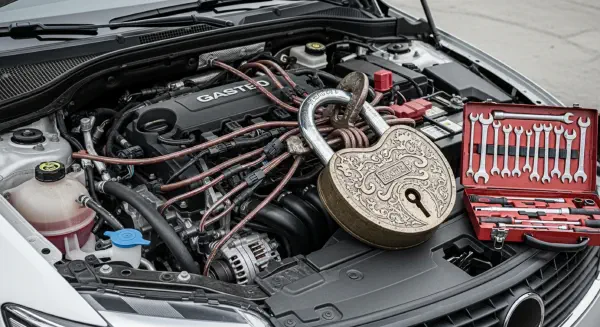
The Maintenance Lock-In The final pillar is the service revenue stream. Modern vehicles are rolling computers, with over 100 million lines of code. This software controls everything from engine timing to window operation. Access to the proprietary diagnostic systems and software updates is tightly controlled by manufacturers through restrictive licensing agreements with dealerships.
This creates a repair monopoly in the critical early years of a vehicle’s life. Independent shops often cannot access the necessary tools or codes to perform complex repairs, a practice critics label as “parts pairing” or “software locking.” A 2021 study by the Public Interest Research Group found that post-warranty repair costs at dealerships were 30-50% higher than at independent shops for identical services. The manufacturer thus guarantees a high-margin revenue flow from maintenance and repairs long after the thin profit from the initial sale is banked.
The Engineered Illiquidity of the Automotive Asset This tripartite system—financing, managed depreciation, and repair control—transforms the automobile from an asset into a liability with engineered illiquidity. The owner is trapped in a cycle of payments and brand-locked services, while the industrial system harvests predictable, recurring revenue. The much-touted “total cost of ownership” calculators offered by automakers are not consumer tools for transparency; they are marketing instruments designed to highlight favorable comparisons (e.g., fuel economy) while obscuring the systemic costs they control.
The power asymmetry is cemented by information asymmetry. The manufacturer knows the statistical likelihood of every part failure, the real depreciation trajectory, and the optimal financing terms. The consumer faces a one-time, high-stakes decision with incomplete data. Policy often reinforces this, with tax structures that favor new purchases over maintenance and regulations that allow software locks on repair access.
The consequence is an automotive economy optimized for cash flow extraction, not owner value. It is a machine where the fiction of the sticker price is necessary to initiate a decades-long financial relationship whose true cost remains deliberately, and profitably, opaque. The car you own is, in a very real sense, still owned by the system that built it.