

Key Takeaways
- Military Origins to Luxury Icon: The Mercedes G-Wagen evolved from a $10,000 military utility vehicle to a $350,000 luxury SUV, demonstrating how functional design can become cultural capital.
- Preserved Engineering Heritage: Key mechanical features like portal axles and ladder frame remain, but are now marketed as symbols of rugged authenticity rather than practical necessity.
- Luxury as Theater: The G63's value derives from its ability to signal exclusivity and capability, even when those capabilities are rarely used in real-world conditions.
- Design Alchemy: The transformation shows how crude functionality can support extraordinary luxury when original constraints become unnecessary but signaling power becomes priceless.
- Cultural Artifact Status: The G-Wagen represents a future where certain vehicles become valued primarily as cultural expressions rather than transportation solutions.
The Ghost in the Machine#
In 1979, the same year Sony introduced the Walkman and the first cellular network launched in Tokyo, a very different kind of machine emerged from a joint venture between Daimler-Benz and Steyr-Daimler-Puch. The Geländewagen—literally “cross-country vehicle”—was engineered to a military specification so austere that its development budget was reportedly just one-tenth of a typical Mercedes passenger car program. The design brief was functional poetry: create a vehicle that could be driven into a river, submerged to its door handles, and continue running; that could be repaired in field conditions with basic tools; that would survive extremes from Saharan heat to Arctic cold. The interior featured rubber floors, vinyl seats, and manual windows. This was not a product for consumers but a tool for armies, aid organizations, and industrial users.
Forty-five years later, the Mercedes-AMG G63 4×4² retails for approximately $350,000. Its portal axles—originally developed for Unimog military trucks to increase ground clearance under punishing conditions—now lift it over Beverly Hills curbs. Its hand-stitched Nappa leather interior features massaging seats and a Burmester 3D surround sound system. The same basic steel body, now painted in exclusive “designo” colors, houses a twin-turbocharged V8 producing 577 horsepower. Yet the ghost of that 1979 military specification remains visible in every squared-off body line, every exposed door hinge, every upright windshield. This is not evolution; it is alchemy. The Geländewagen represents one of industrial design’s most dramatic value inversions: a machine engineered for maximum utility has been systematically transformed into a symbol of maximum exclusivity. The question is not how this happened, but what this transformation reveals about how functional heritage becomes cultural capital, and why crude foundations can support extraordinary luxury when their original constraints are no longer necessary but their signaling power becomes priceless.
“The superscript ‘²’ in its model designation — Mercedes’ notation for extreme, expedition-grade capability — becomes less a technical specification than a badge of symbolic excess: four-wheel drive, squared.”
The Architecture of Austerity#
The original Geländewagen’s design emerged from a specific historical and geopolitical context. In the 1970s, multiple Western militaries sought to replace aging light utility vehicles. The design requirements read like a manifesto against civilian automotive norms: approach and departure angles optimized for vertical obstacles rather than parking curbs; a separate ladder frame capable of withstanding torsional stress from extreme articulation; three mechanically locking differentials for maximum traction; portal axles (on some versions) that raised gearboxes above axle centers, increasing ground clearance. Every decision prioritized function over form, durability over comfort, repairability over complexity.

This was engineering as ideology: the vehicle would be built to survive not just operational conditions but the worst conceivable scenarios. The design philosophy was captured in the German term “Überleben”—survival. Every component was selected for its ability to function after immersion in water, exposure to extreme temperatures, or impact with heavy objects. The result was a vehicle that looked crude by civilian standards but represented the pinnacle of military-industrial engineering.
The Luxury Overlay#
The transformation began in the 1990s when Mercedes began offering civilian versions of the G-Wagen. Initially positioned as a premium SUV for affluent buyers seeking something more distinctive than typical luxury sedans, the G-Class gradually acquired the trappings of high-end automotive culture. By the 2000s, it had become a canvas for Mercedes’ most extravagant customization options: hand-painted “designo” exteriors costing tens of thousands, interiors featuring exotic woods and precious metals, and performance packages that transformed a utilitarian workhorse into a boulevard bruiser.
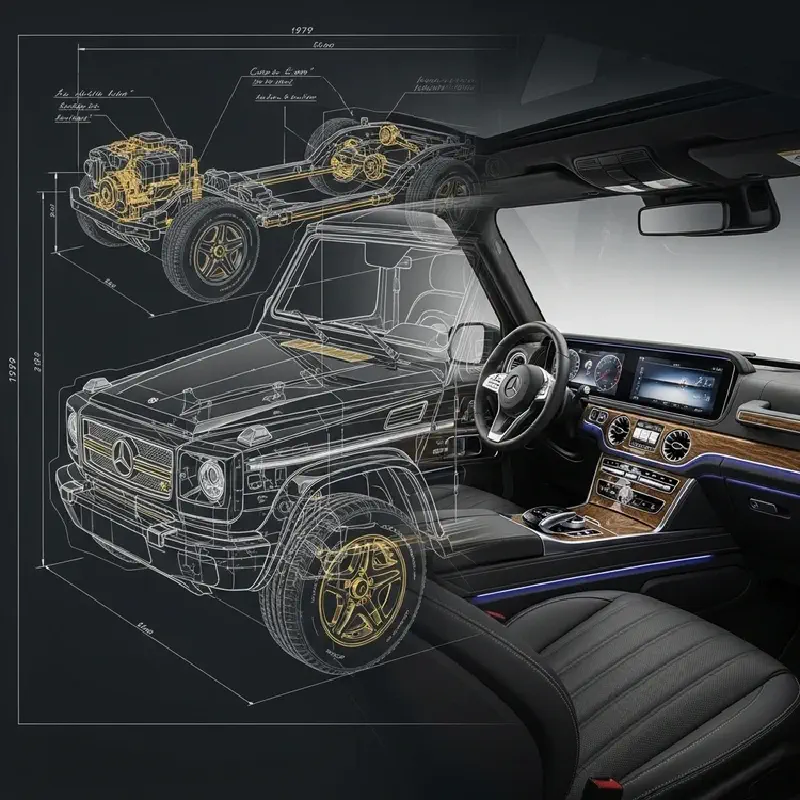
The G63 AMG variant, introduced in 2013, represented the culmination of this transformation. With a 5.5-liter twin-turbo V8 producing 563 horsepower and 0-60 mph acceleration in under 5 seconds, it became the most powerful SUV ever produced at the time. Yet the fundamental architecture remained unchanged: the same ladder frame, the same live axles, the same mechanical complexity that made it expensive to build and maintain. The difference was that these traits, once liabilities in the civilian market, now became assets—symbols of authenticity and heritage in an automotive landscape increasingly dominated by electronic nannies and computer-controlled everything.
The Semiotics of Survival#
What makes the G-Wagen’s transformation particularly fascinating is how Mercedes has managed to preserve the vehicle’s functional heritage while simultaneously marketing it as luxury theater. The portal axles, once essential for traversing boulder-strewn Saharan trails, now serve primarily to increase ground clearance for city driving and provide visual interest. The exposed hinges and squared-off styling, originally chosen for durability and ease of repair, now signal “rugged authenticity” in a market saturated with plastic cladding and aerodynamic curves.

This creates a fascinating semiotic inversion: features engineered for survival become aesthetics of exclusivity. The vehicle’s ability to ford streams becomes a metaphor for overcoming obstacles in business and life. Its military heritage becomes a narrative of triumph over adversity. The G-Wagen doesn’t just transport its owner; it transports them into a story of capability and endurance.
The G-Wagen’s endurance may point toward a future where certain vehicle types become cultural artifacts as much as transportation devices. Their value derives not from how efficiently they perform their nominal function, but from what they communicate about their owners and how they connect to specific narratives and identities. In this sense, the G63 4×4² may be less a vehicle and more a mobile monument—to engineering heritage, to a particular aesthetic sensibility, to the idea of capability over compromise.
This future poses interesting questions for design and engineering. If certain vehicles become valued primarily as cultural expressions rather than transportation solutions, how should they be engineered? The G-Wagen’s path suggests an answer: preserve the external design language and certain iconic mechanical features while relentlessly updating everything else to contemporary standards of performance, safety, and luxury. This creates products that feel simultaneously timeless and modern—a difficult balance that the G-Wagen has arguably achieved better than any other vehicle.
The ultimate lesson of the Geländewagen’s transformation may be about the elasticity of meaning in designed objects. A machine designed to withstand battlefield conditions has been reimagined as a symbol of personal achievement. Features engineered for survival have become aesthetics of exclusivity. What began as a tool for collective endeavor (military units, aid organizations) has become an expression of individual distinction. This transformation tells us less about automotive design than about human psychology—about our need to connect with narratives of capability and endurance, even (or especially) when our daily lives are largely insulated from such challenges.
The ghost of that 1979 military specification still haunts every G63 4×4² that glides silently through a city street, its portal axles lifting it over imperfections its owners may never notice. The aristocratic transplant has taken root, but it draws sustenance from utilitarian roots that run deeper than luxury’s superficial soil. In this unlikely grafting, we see not just the story of a vehicle, but a pattern of how societies preserve, reinterpret, and ultimately cherish functional beauty when its original function is no longer required but its form continues to speak in a language we still understand, even if we no longer need to speak it ourselves.
References#
- Adler, D. (2019). Mercedes-Benz G-Wagen: A History. Crowood Press.
- Baudrillard, J. (1994). Simulacra and Simulation. University of Michigan Press.
- Forty, A. (1986). Objects of Desire: Design and Society Since 1750. Thames & Hudson.
- Frank, R. H. (1999). Luxury Fever: Why Money Fails to Satisfy in an Era of Excess. Free Press.
- Heilbrunn, B. (2006). Brave New Luxury: The Cultural Economy of Luxury Branding. Design Management Review, 17(1), 16-21.
- Holt, D. B. (2004). How Brands Become Icons: The Principles of Cultural Branding. Harvard Business School Press.
- Julian, M. (2015). Mercedes-Benz Unimog and G-Wagen: The Complete Story. The Crowood Press.
- McCracken, G. (1990). Culture and Consumption: New Approaches to the Symbolic Character of Consumer Goods. Indiana University Press.
- Petroski, H. (1992). The Evolution of Useful Things. Alfred A. Knopf.
- Veblen, T. (1899). The Theory of the Leisure Class. Macmillan.