Timeline of Main Events in China's Automotive History
Timeline of Main Events in China's Automotive History#
1945–1952
China focuses on rebuilding basic industrial capacity following post-war constraints.
1949–1979
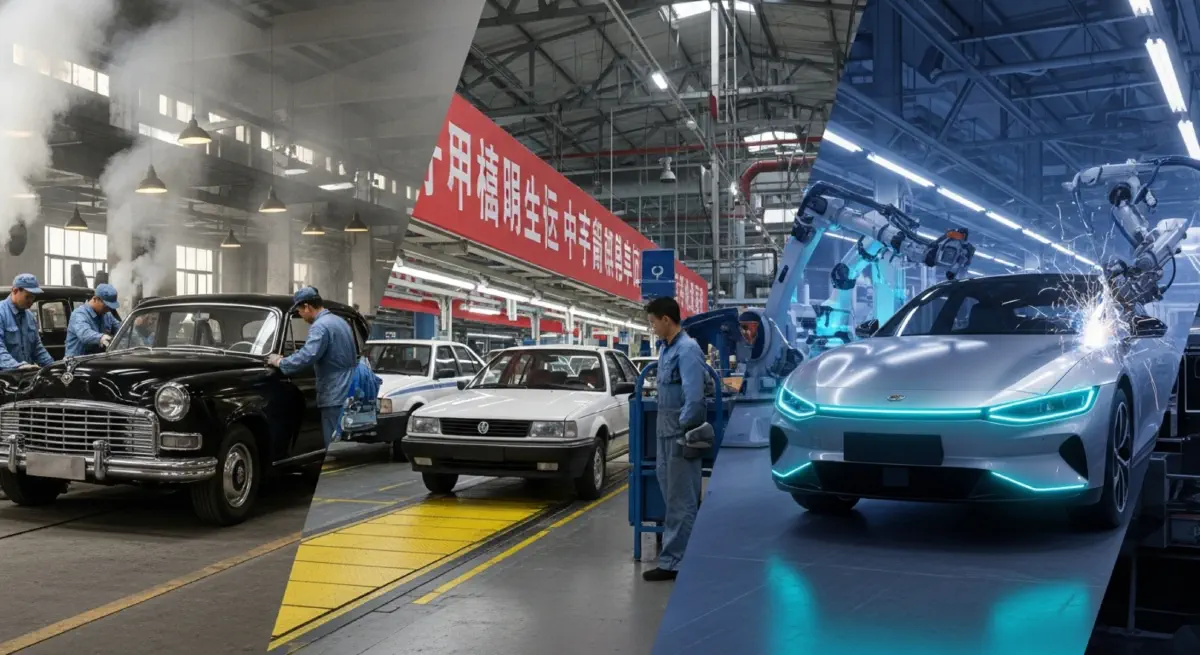
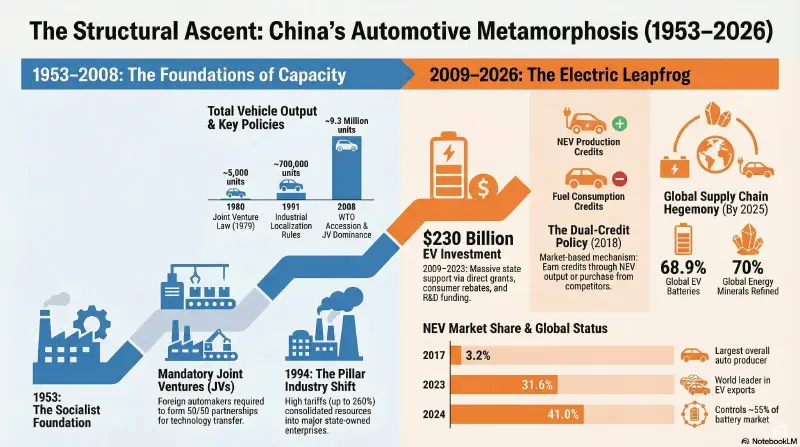
**Central Planning Phase** – nascent industry with total vehicle output of ~5,000 units by 1980.
1953
FAW Group
First Auto Works (FAW) established with Soviet assistance under the First Five-Year Plan. Average yearly production: 3,206 units (1953–1957).
1953–1978
Production remains centrally planned, focused on domestic models like the Shanghai and Red Flag for state officials.
1955
SAIC Motor and GAC Group are established.
1958
BAIC Group is established.
1969
Dongfeng Motor is established.
July 1979
Market for Technology
China enacts the Law on Joint Venture Using Chinese and Foreign Investment, opening the door for foreign capital and technology. Foreign ownership capped at 50%.
Early 1980s
High protectionist trade barriers: import tariffs on vehicles reach 250–260%.
1983
First Sino-foreign JV
Beijing Jeep (BAIC / AMC) established. AMC invests USD 16 million for a 31.35% stake.
1984
SAIC-Volkswagen joint venture formed (initial capital RMB 160 million). Great Wall Motor founded.
1986
The 7th Five-Year Plan declares the automotive industry a **"pillar industry"** for the first time.
1994
Automobile Industry Policy
Formalisation of the “Market for Technology” strategy, 50% foreign ownership cap, and minimum 40% local content requirement for joint ventures.
1995
BYD founded as a battery manufacturer.
1997
Geely established; SAIC-GM joint venture formed.
2000
Annual vehicle production reaches approximately **2 million units**.
2001
WTO Accession
China joins the WTO, leading to phased tariff reductions (import tariffs fall to 25% by 2010). The 10th Five-Year Plan first emphasises New Energy Vehicles (NEVs).
2003
BYD enters passenger vehicle production; FAW-Toyota and Changan-Ford joint ventures established.
2009
World's Largest Auto Market
China surpasses the U.S. to become the world's largest automotive market and producer. Government launches massive EV subsidies and the “1,000 EVs in 10 cities” pilot.
2009–2023
State-led investment in the NEV sector totals an estimated **$230.9 billion** through subsidies, tax cuts, and industrial master plans.
2010
Geely acquires Volvo Cars for $1.8 billion.
2014
EV startup NIO is founded.
2015
The **"Made in China 2025"** initiative identifies NEVs as a strategic sector for global dominance.
April 2018
Dual-Credit Policy
The Dual-Credit Policy (CAFC and NEV credits) replaces direct subsidies. Foreign ownership caps for NEVs are lifted, enabling Tesla’s wholly owned Shanghai plant.
2020
The **Hefei Model** of state investment is highlighted by the city’s 7‑billion‑yuan rescue of NIO.
2023
China produces a record **30.16 million vehicles** and becomes a leading global exporter with **4.91 million units** shipped.
2024
NEVs reach approximately 41% of the domestic market share; public charging points exceed 2.5 million.
2025
EV Battery Dominance
Six Chinese manufacturers control 68.9% of the global EV battery market (led by CATL at 38.1%), and 90% of rare earth refining.
2026
Huawei and Xiaomi emerge as major disruptive forces in the tech-led “New Force” of automotive manufacturing.
The Leapfrog Doctrine: China’s Automotive Rise From Industrial Policy to Global Dominance -
This article is part of a series.
Deconstructs the myth of the sticker price, revealing how automakers and financial systems profit from the long-tail costs of depreciation, financing, and maintenance.
Exposes the engineered economics of vehicle repair, from proprietary software and parts locking to the systematic dismantling of the independent repair sector.
Analyzes how industrial power, policy, and planned technological turnover conspire to accelerate vehicle replacement cycles, creating a perpetual motion machine of consumption.