
Overcapacity, Tariffs, and the 2030 Horizon#
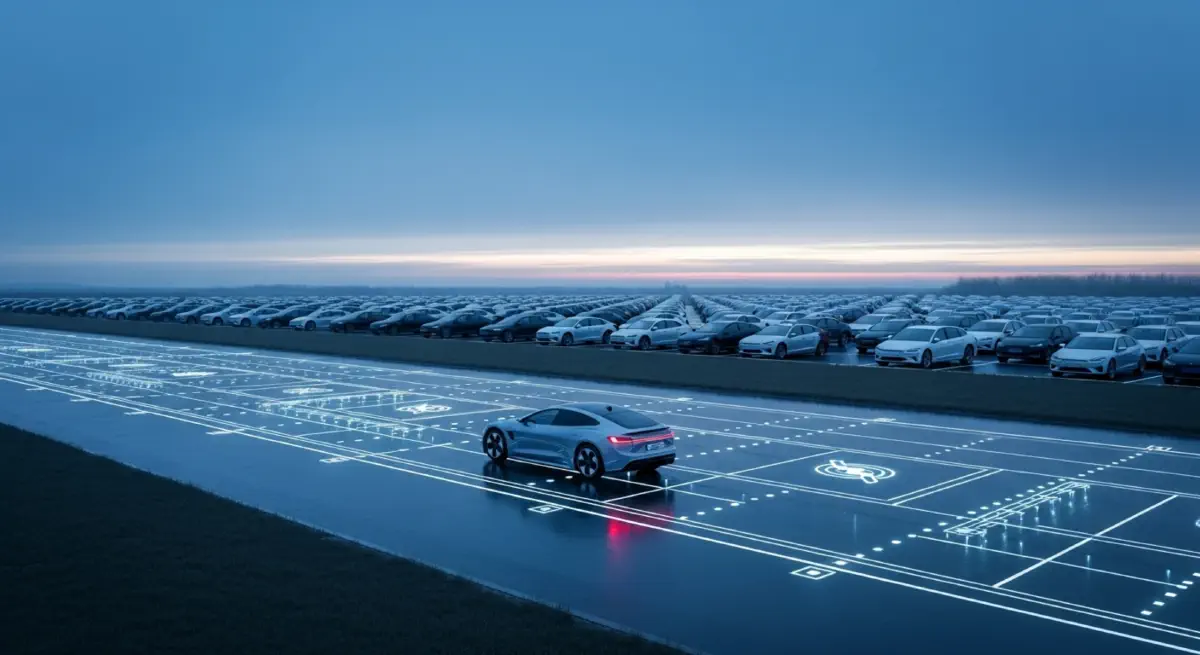
In a quiet industrial park outside of Nanjing, rows of nearly identical electric SUVs sit in perfect geometric grids, their paint reflecting a twilight that none of them will ever see from a customer’s driveway. They are the physical remains of a $230.9 billion bet that has, in some sense, worked too well. By the end of 2024, China officially became the first country to exceed 10 million New Energy Vehicle (NEV) units in a single year, a milestone that should signal the absolute triumph of the Leapfrog Doctrine. Yet, the atmosphere in the boardrooms of the 129 remaining EV brands is one of intelligent resignation rather than celebration. The industry is not merely expanding; it is entering a brutal phase of structural rationalization where the state-led machine is beginning to consume its own surplus. The future of the Chinese car is no longer a question of whether it can dominate the world, but whether it can survive the weight of its own success.
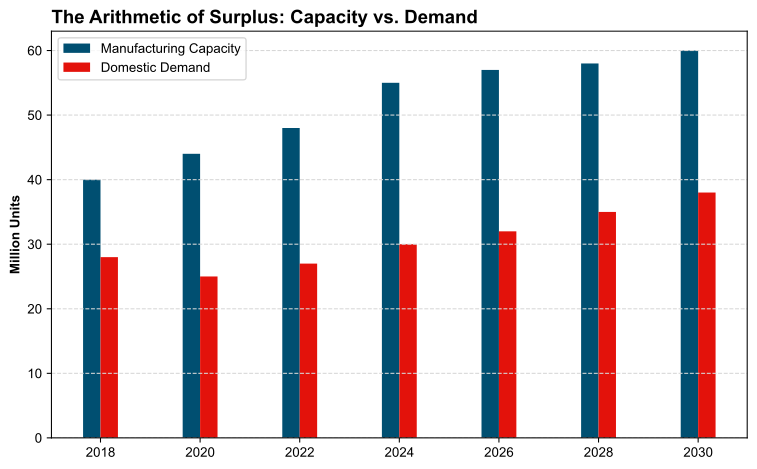
The most immediate constraint on the 2030 horizon is the arithmetic of overcapacity. Current annual manufacturing capacity in China is estimated at between 50 million and 60 million vehicles, a figure that is nearly double the current domestic demand of 30.09 million units. This is not an accident of the market; it is a feature of a selective industrial policy that, since the 2009 revitalization plans, has treated plant construction as a mandatory component of regional GDP growth. Local governments, operating under the Hefei Model, competed to anchor supply chains by offering low-cost land and subsidized credit, resulting in a landscape where factories were built to satisfy political targets rather than consumer orders. The result is a structural tailspin. In the mid-2020s, the industry's gross turnover rate reached 32–40%, an industrial churn that guarantees that of the hundreds of firms currently competing, only a small minority—perhaps as few as 15 brands—will exist by 2030.
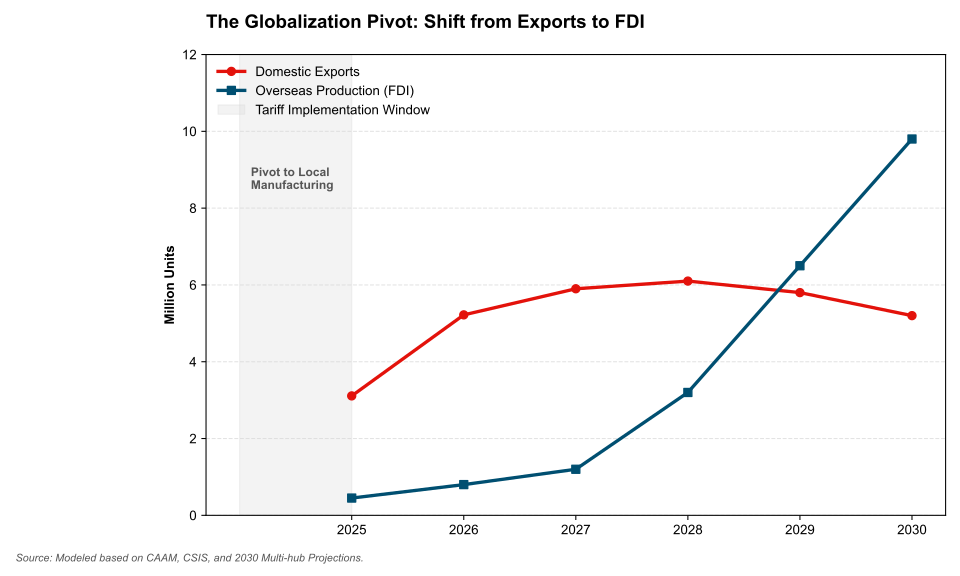
This internal pressure is forcing a radical shift in how China views the global market. Having overtaken Japan and Germany to become the world’s largest exporter, shipping 5.9 million vehicles in 2024, China has hit a wall that cannot be bypassed with battery chemistry. The 100% tariffs imposed by the United States and Canada, and the rising provisional duties in the European Union, have effectively ended the era of "export-led dominance." The data suggests that these trade barriers cause substantial welfare losses for Chinese manufacturers, and the response is already visible in the strategic pivot toward overseas Foreign Direct Investment (FDI). Market access in the late 2020s will no longer hinge on the efficiency of the port at Ningbo, but on the ability of Chinese firms to build greenfield plants in Hungary, Thailand, and Mexico. The industry is transitioning from a national export engine into a globalized, multi-hub ecosystem, paradoxically increasing local dependence on Chinese technology while bypassing the political friction of direct trade.
While China has secured the "heart" of the modern car through its 68.9% control of the global battery market, it faces a "silicon ceiling" that remains its most dangerous technological bottleneck. As the vehicle is redefined as a high-compute consumer electronic device—a process often called "Foxconnisation"—the importance of the powertrain is being superseded by the software stack. Here, the precision of the Chinese machine falters. Self-sufficiency in critical automotive semiconductors is remarkably low: computing and control chips account for less than 1% of domestic production, while power and storage chips hover around 8%. The industry remains heavily reliant on foreign systems-on-a-chip from Nvidia, Qualcomm, and Mobileye for advanced driver-assist systems (ADAS) and infotainment. By 2026, firms like Xiaomi and Huawei were matching the performance of global leaders in software integration, but the underlying hardware—the mature-node 14–28 nm chips produced by SMIC—remains stuck several generations behind the frontier required for full autonomy.
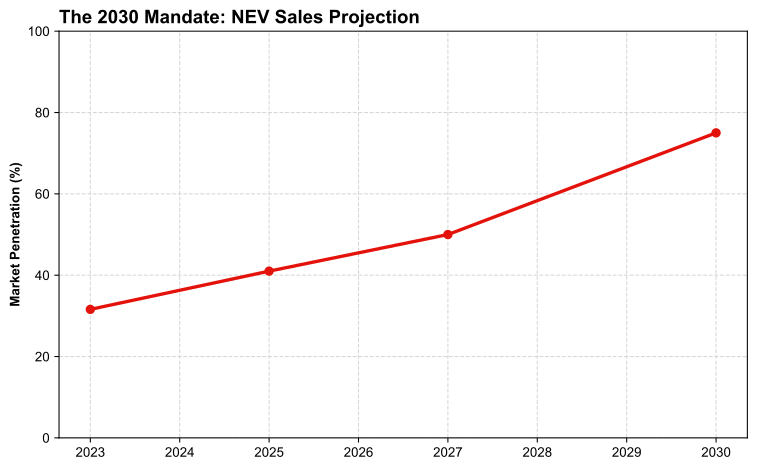
Despite these constraints, the statistical targets for 2030 remain unfailingly ambitious. Forecasting models consistently project that total vehicle sales will climb to approximately 40 million units annually, with NEV penetration exceeding 75%. This is the 2030 Mandate: a future where the internal combustion engine is a minority relic, relegated to less than 25% of new sales. The transition is being fueled by a relentless build-out of infrastructure that treats charging as a national utility. By the end of 2025, China recorded over 20.09 million charging units, providing over 3 kW (~4 HP) of public capacity per vehicle—more than double the infrastructure density found in the United States. This network has effectively removed range anxiety as a barrier to purchase, allowing NEV sales to maintain a 35–38% year-on-year growth rate even as direct subsidies have been phased out in favor of the market-based Dual-Credit Policy.
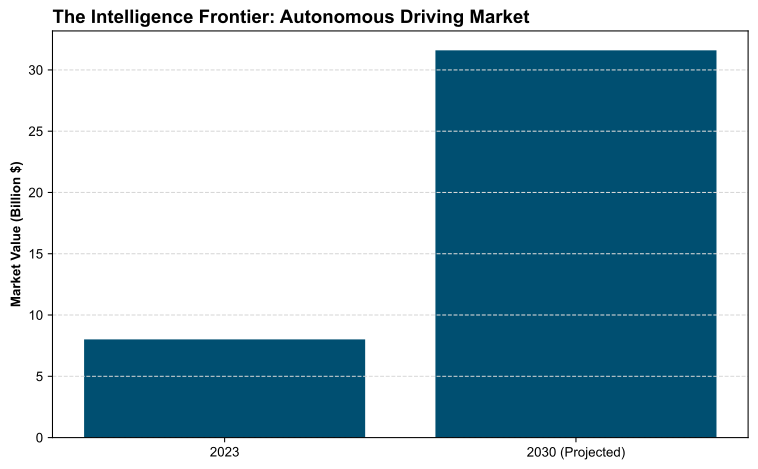
The next frontier is not just electrification, but intelligence. The Chinese autonomous driving market is projected to grow at a compound annual rate of 21.66%, reaching $31.60 billion (~€29.8 billion) by 2030. The government’s roadmaps target a nationwide intelligent vehicle system by 2035, with 20% of all cars sold by 2030 expected to be fully autonomous. Already, 18 million EVs are connected to a national monitoring platform, providing a real-time data stream that informs both industrial policy and urban planning. Robotaxis are no longer a pilot project; they are commercial realities in Beijing, Shanghai, and Guangzhou. Yet, the technical reliability of these systems in the chaotic traffic environments of second-tier Chinese cities remains insufficient. The future of autonomy in China will likely rely on "cooperative automation"—a system where the burden of intelligence is shared between the car and the "smart" infrastructure of the road itself, a shift that moves the cost of innovation from the manufacturer to the public treasury.
As the domestic market enters a phase of slow growth and high competition, the nature of the Chinese firm is evolving toward vertical disintegration. The industry is moving away from the "Big Three" state-owned conglomerates that defined the 20th century and toward specialized production networks. New alliances are emerging between battery titans like CATL, which holds a 39.2% global market share, and tech-led "New Force" automakers. This specialization allows for a modularity in production that enables firms to iterate on a new car model in less than half the time required by a traditional Western OEM. However, this fragmentation also increases the risk of capital misallocation, as dozens of firms continue to scale battery production for a global market that is increasingly hostile to Chinese imports.
The environmental promise of this electric horizon remains contingent on the decarbonization of the grid. While NEVs reduce urban air pollution—a critical goal in a nation where pollution contributes to over 1 million premature deaths annually—the lifecycle emissions of a Chinese EV are still heavily influenced by coal-heavy electricity generation. The 2030 peak carbon and 2060 neutrality goals mean that the automotive sector’s transition must occur in parallel with a massive shift toward renewable energy. Environmental regulations are tightening, and by 2035, the government aims to phase out the sale of all new traditional internal combustion engine vehicles, but the implementation will be a complex negotiation between environmental necessity and the survival of the millions of workers still employed in the legacy manufacturing sector.
Ultimately, the future of China's automotive industry will be defined by a grand consolidation. The era of the "1,000 EVs in 10 cities" is over, replaced by a "survival of the fittest" contest overseen by high-ranking officials acting as Chain Leaders. These officials are tasked with eliminating administrative friction for the champions while allowing the weaker, subsidized firms to fail. The industry that emerges in 2030 will be smaller in firm count but larger in global influence, anchored by a few "National Champions" like BYD and Geely that possess the scale to operate as global multi-nationals. The risk is no longer that China will fail to build a world-beating industry; it is that the industry has become so large that its continued growth requires the colonization of foreign markets through FDI, a move that will test the limits of global geopolitical tolerance.
We are witnessing the final act of a seventy-year industrial drama. What began as a Soviet-style factory in Changchun has become a globalized machine that dictates the energy density of batteries and the software architecture of the 2030s. The overcapacity, the trade wars, and the chip bottlenecks are not signs of failure; they are the growing pains of a system that has outgrown its own borders. The outrage and the tariffs belong to a world that is discovering the scale of this machine for the first time. For those who have read the plans, the only surprise is that anyone is surprised at all. The 30-million-unit machine is now a global ecosystem, and the electric horizon it has created is one from which there is no return.