Why China Succeeded Where Others Structurally Failed#
In the 1990s, Mexico was the darling of the global automotive supply chain. Under the promise of North American integration, its factories hummed with the assembly of foreign designs, yet three decades later, Mexico remains a high-functioning assembly hub with no indigenous brand to call its own. This is the "Mexican Syndrome": a state of industrial development where a nation attracts massive foreign direct investment but remains trapped as a low-cost subcontractor, unable to develop its own design capabilities or technological sovereignty. While Mexico, Brazil, and India navigated the same global markets, China alone executed a strategy that transformed it from a marginal producer of five thousand vehicles in 1980 to an industrial machine churning out over thirty million units by 2023. The disparity is not a result of labor costs or geography; it is the outcome of a deliberate, multi-decade bypass of the global industrial order.
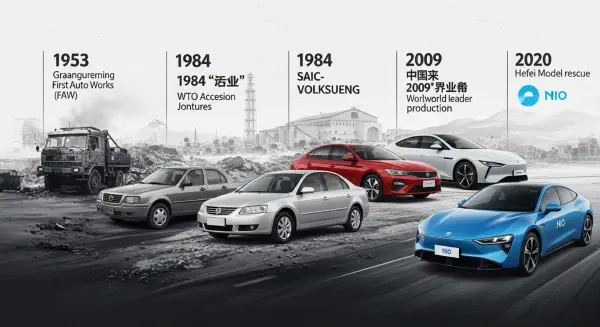
The primary divergence begins with the concept of "Obligated Embeddedness." Unlike smaller developing nations that were desperate for any form of foreign capital, China’s domestic market was so immense that it could treat access as a geopolitical bargaining chip. Starting with the 1994 Automobile Industry Policy, the government mandated a 50% foreign ownership cap on all joint ventures, effectively forcing global giants like Volkswagen and General Motors to trade their engineering soul for a seat at the table. Foreign firms were not merely invited to build factories; they were required to transfer technology, train a domestic workforce, and raise the performance standards of the local parts-supplier ecosystem. In Mexico and Brazil, liberalization followed a "hands-off" neoliberal model that resulted in foreign-led production and limited domestic capability upgrading. China, by contrast, used the joint venture as a conduit for "systemic industrial upgrading," ensuring that by the late 1990s, most parts in a joint-venture vehicle—the engine, the body, the chassis—were produced by Chinese firms.
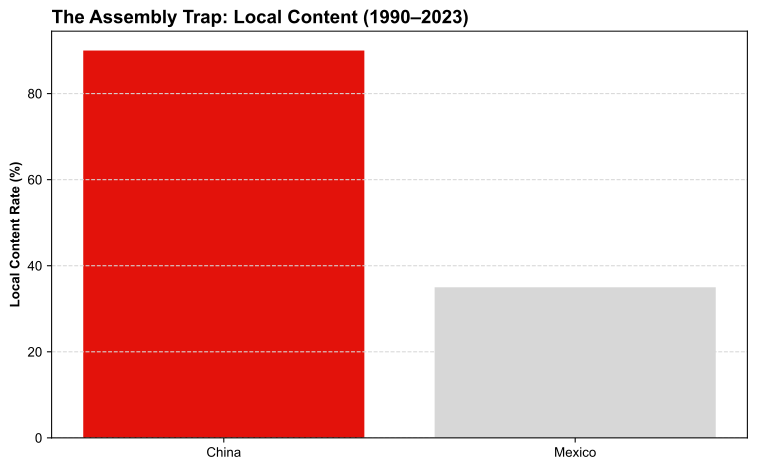
This leverage was only possible because of China’s scale as an industrial "incubator." Smaller nations like Malaysia, which attempted to build indigenous brands through Proton and Perodua, found their growth permanently constrained by a small domestic demand base. They lacked the gravitational pull required to force technology transfers or to achieve the economies of scale necessary to compete on price. China’s status as the world’s most populous country allowed domestic firms to achieve massive production volumes at home before ever facing the scrutiny of the global market. This domestic scale diluted fixed R&D costs and reduced unit prices to levels Western firms could not match. By the time a company like BYD or Geely entered the global stage, they were not "startups" in the Western sense; they were battle-hardened survivors of a domestic market that entered and exited firms at a rate of 13.7% annually.
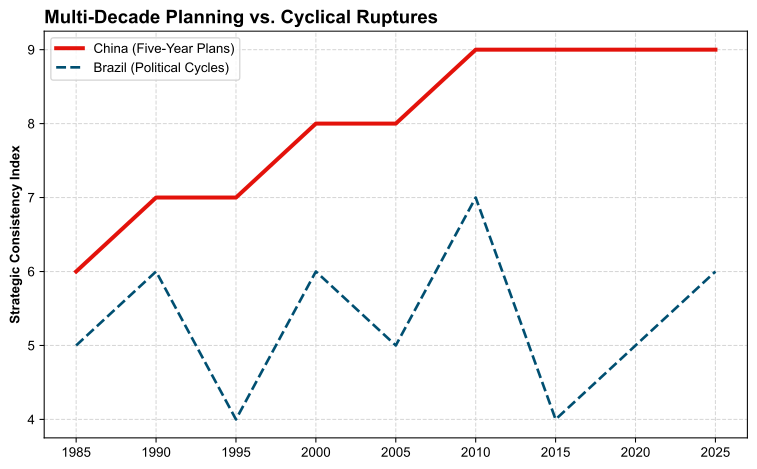
The second structural pillar of China’s success is the anomaly of policy consistency. In democratic emerging markets like Brazil and India, industrial development is frequently a victim of the election cycle. Brazil’s automotive strategy suffered severe ruptures across different administrations, while India’s reforms advanced gradually through institutional fragmentation and uneven implementation. China, conversely, operated under the "The Leapfrog Doctrine"—a centrally coordinated plan that ran in multi-decade cycles. Since the 1986 designation of the automotive sector as a "pillar industry," the strategy has been updated every five years with a cold, administrative precision. This coordination allowed for the long-term buildup of industrial clusters, such as the thousands of suppliers in Zhejiang and Chongqing, that would have been impossible under a system characterized by cyclical policy ruptures.
When the limits of the internal combustion engine (ICE) became apparent, China did not double down on a losing hand. Instead, it recognized that domestic firms could never overcome the decades of patent protection held by German and Japanese giants in traditional powertrain engineering. This is where Malaysia and others lagged; they remained stuck trying to win a race that had already been finished. Beijing’s response was a strategic "leapfrog"—pivoting aggressively to electrification to render legacy expertise in gearboxes and pistons obsolete. Between 2009 and 2023, the state invested an estimated $230.9 billion into the New Energy Vehicle (NEV) sector, creating a new industrial paradigm where China could establish a technological moat. By the time Western manufacturers realized the race had changed, China already controlled roughly 70% of the world’s refining capacity for energy-related minerals and nearly 69% of the global EV battery market.
The mechanism for this transformation was not just central planning, but innovative state governance exemplified by the "Hefei Model". While traditional local governments in countries like India struggled with administrative fragmentation, Hefei’s municipal government acted like a venture capital firm. They identified high-risk, high-potential startups and took equity stakes, most notably in the 2020 rescue of NIO. This was complemented by the "Chain Leader" system, where high-ranking officials were personally responsible for eliminating administrative friction—resolving bottlenecks in site acquisition and licensing with a speed that institutionalized bureaucracies in Brazil or Mexico could never replicate. The state was not merely subsidizing the industry; it was co-authoring the industrial ecosystem.
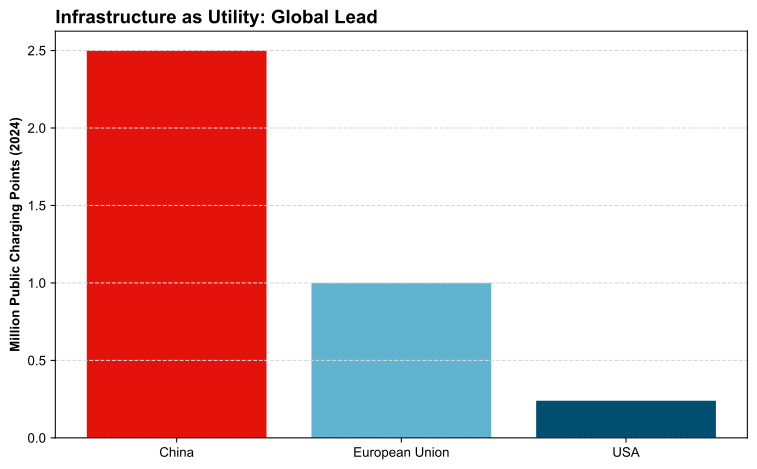
Finally, China treated the transition to electric mobility as a national utility rather than a fragmented commercial service. In most developing nations, the lack of charging infrastructure became a permanent barrier to EV adoption. China responded by recording over 2.5 million public charging points by 2024—accounting for over 60% of the global stock. This massive deployment removed consumer range anxiety and accelerated the domestic collapse of the ICE market faster than in any other nation. In Mexico, the infrastructure is dictated by market demand; in China, the infrastructure was built to create the demand.
The conclusion of this industrial narrative is not a scandal, but a description of high-capacity state systems. China succeeded where others failed because it combined a massive, unified domestic market with a durable multi-decade policy consistency and a strategic capacity to mobilize resources that fragmented democratic systems were unable to replicate. While Brazil and Mexico remained integrated with the North American or commodity-based value chains that limited their autonomy, China moved up-market by active, state-guided technology acquisition. The "Chinese Miracle" in the automotive industry is simply the arithmetic of a state that possessed the structural capacity to coordinate, discipline, and mobilize an entire industry until it achieved global dominance. The outrage belongs to the competitors who assumed the old rules would last forever; the resignation belongs to those who have read the documents and realized the machine was always designed to win.