Engineering a “Market for Technology” via Industrial Design#
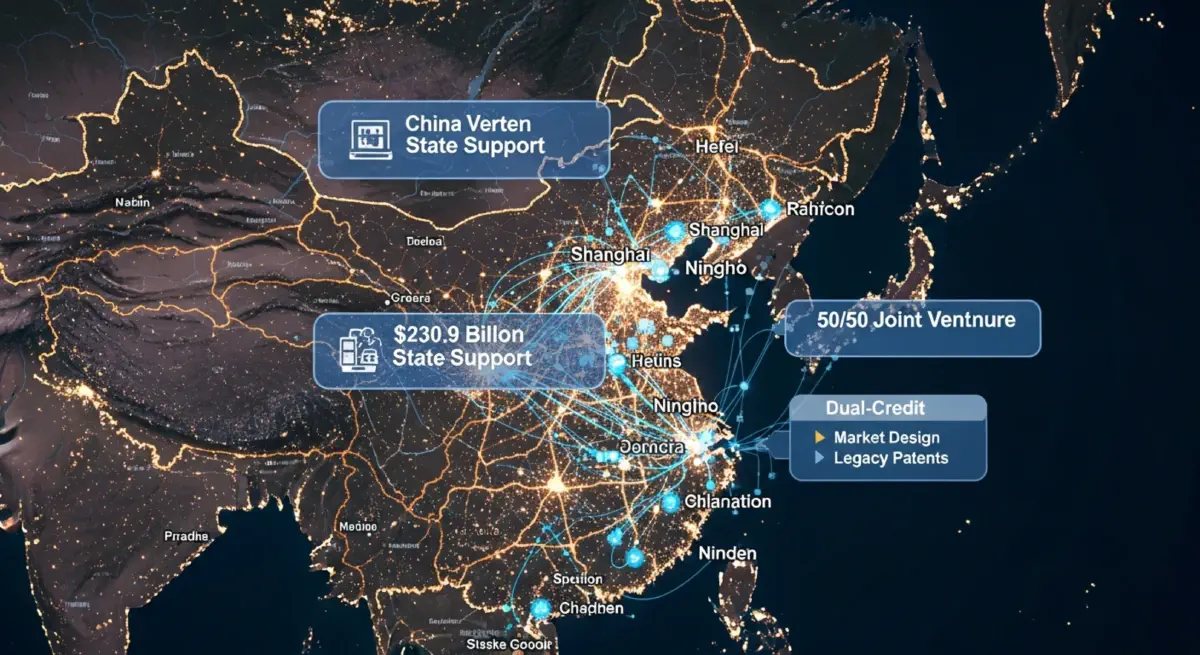
In 1994, the Chinese State Planning Commission released the Automobile Industry Policy, a document that effectively codified the terms of a seventy-year industrial heist. It was not a invitation to trade, but a price list for entry into the world’s most populous market. The core of the mandate was the 50% foreign ownership cap— a legal tripwire that ensured no global automaker could manufacture on Chinese soil without handing half the keys to a state-owned enterprise. For the giants of Wolfsburg and Detroit, the joint venture (JV) was a "cash cow" that funded global balance sheets; for Beijing, it was a systemic industrial upgrading program designed to extract the engineering soul of the West. The architecture of this ascent was never about simple assembly; it was about the orchestrated transition from technological dependence to supply chain hegemony.
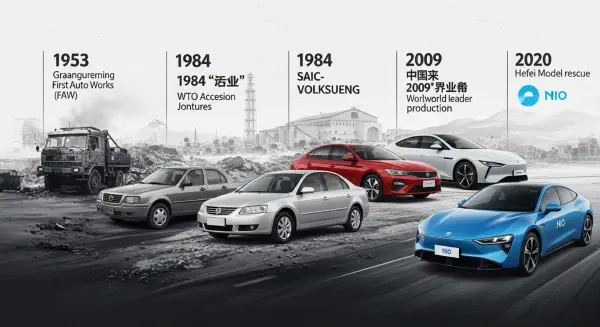
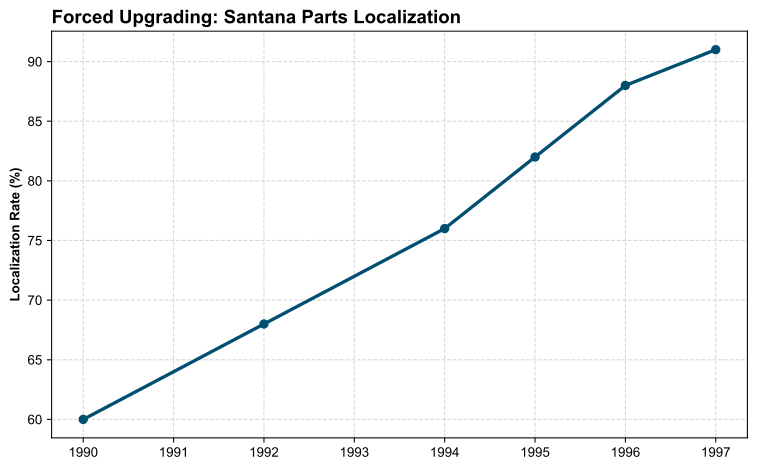
The joint venture system was the first layer of the "Market for Technology" leverage. By mandating 50/50 partnerships, the state created a conduit for "forced" knowledge spillover. Foreign firms were obligated to transfer manufacturing know-how, train a domestic workforce, and, most critically, localize their supply chains. In the 1980s, the first JVs—like Beijing Jeep and SAIC-Volkswagen—operated largely as "knock-down" assembly plants. However, the state-led tightening of local content requirements transformed these outposts into indigenous manufacturing hubs. The case of the Volkswagen Santana is the classic metric of this forced evolution: parts localization rose from roughly 60% in the early 1990s to over 90% by 1997. By the time the world entered the new millennium, the engines, bodies, and chassis of the world’s leading cars were being produced by a Chinese supplier ecosystem that had been raised to international performance standards by the very competitors it would eventually displace.
While the West viewed these restrictions as a cost of doing business, the Chinese state treated them as a capital injection for its own independent "self-owned" brands. The earnings from profitable JVs provided the state-owned giants—FAW, SAIC, and Dongfeng—with the liquidity to fund their own research initiatives. By 1991, some industrial analyses suggested that the foreign presence had accelerated China's automotive development by approximately thirty years. This was the "backbone" of the system: a public-sector-led innovation model where the state used foreign capital to incubate the champions of the 2020s.
When the realization took hold that Chinese firms could not easily breach the thicket of patents protecting internal combustion engine (ICE) technology, the architecture shifted from imitation to an aggressive "Leapfrog Doctrine". The 10th Five-Year Plan in 2001 first began to emphasize New Energy Vehicles (NEVs) as a unique "window of opportunity". This was a strategic devaluing of a century of Western mechanical expertise in favor of a new paradigm centered on battery chemistry and software. The government did not merely hope for this transition; it funded it with a financial bluntness that traditional markets cannot replicate. Between 2009 and 2023, the Chinese state provided an estimated $230.9 billion to $231 billion in support for the NEV sector.
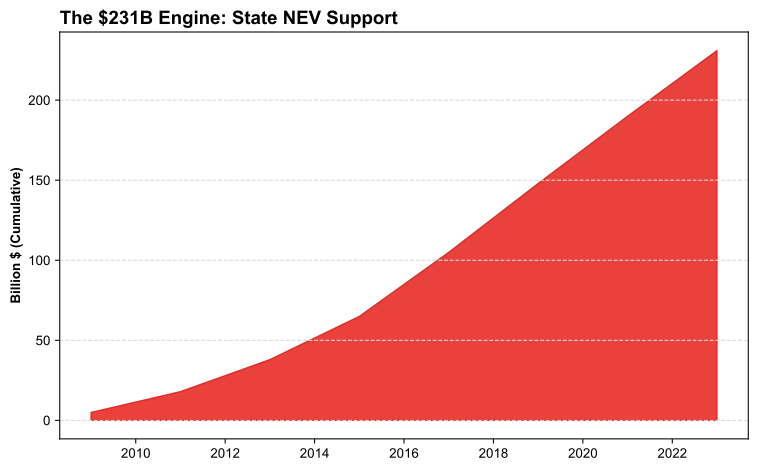
This investment was not a monolith of simple handouts, but a sophisticated mix of supply-side support and demand-side engineering. On the supply side, the state provided direct grants, low-interest loans, subsidized electricity, and low-cost land for gigafactories. On the demand side, consumer rebates—which once averaged $14,000 per vehicle (~13,115 €)—tax exemptions, and the exemption of EVs from vehicle purchase taxes removed the price barriers to adoption. In congested first-tier cities, the state used administrative friction as a sales tool: while gasoline car buyers faced years of lottery waitlists for license plates, NEV buyers were often granted fast-tracked registration. The result was an artificial but undeniable collapse of the ICE market in favor of an electric fleet that now accounts for 41% of domestic sales.
As direct subsidies began to phase out after 2019, the architecture evolved into a market-based regulatory machine: the "Dual-Credit Policy". Introduced in 2018, this policy required automakers to meet both fuel efficiency and NEV production targets; those who failed were forced to purchase credits from competitors who had a surplus. This created a closed-loop financial boon for dedicated EV makers like BYD and Tesla, effectively mandating that legacy manufacturers fund the R&D of their own executioners. It was a stroke of administrative genius that shifted the fiscal burden of industrial transformation from the state treasury to the balance sheets of the global automotive establishment.
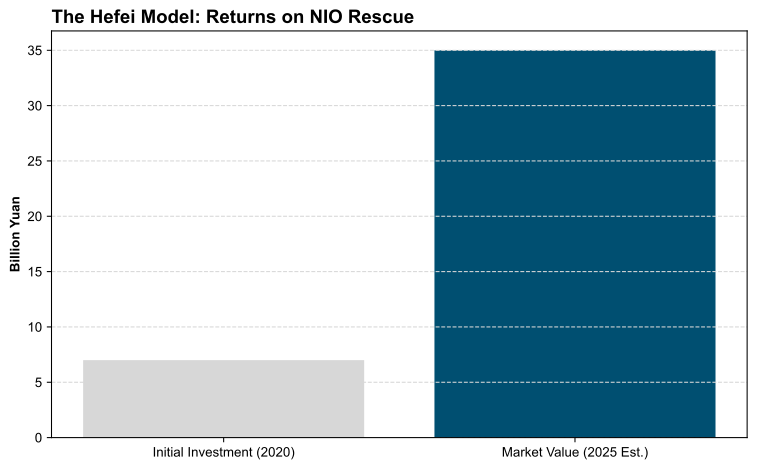
The execution of this plan required more than central decrees; it required a new form of local governance known as the "Hefei Model". Originated in the capital of Anhui Province, this model transformed the local state into a venture capitalist. Instead of offering passive subsidies, Hefei’s investment platforms took direct equity stakes in strategically important, high-risk startups. The landmark 2020 rescue of the EV startup NIO—where Hefei invested 7 billion yuan (~$1 billion)—not only saved a national champion from a liquidity crisis but realized market gains exceeding five times the original investment. This model anchored an entire industrial chain in the region, co-locating semiconductors, displays, and batteries to minimize logistics friction.
Supporting these local clusters was the "Chain Leader" system, where high-ranking officials like mayors personally served as the fixers for specific industrial value chains. These leaders were responsible for "eliminating administrative friction," resolving bottlenecks in site acquisition, licensing, and infrastructure development with a speed that institutionalized bureaucracies in the West find impossible to match. This was "state capacity" in action: the ability to coordinate, discipline, and mobilize an entire industry until it achieved the scale necessary for global dominance.
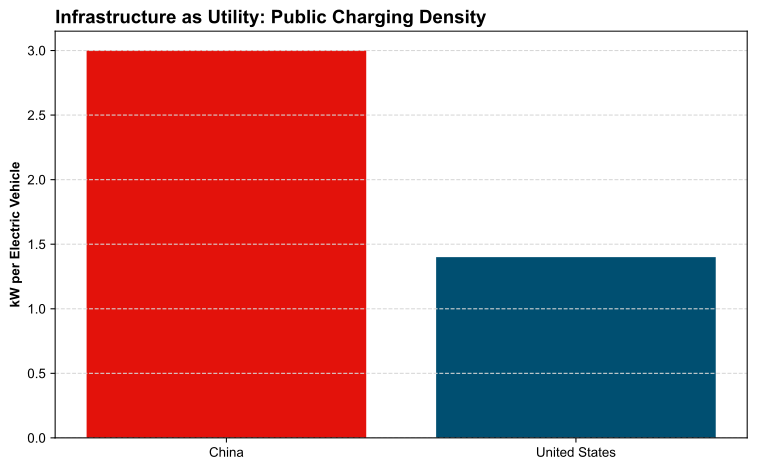
The final layer of the execution was the treatment of infrastructure as a strategic national utility. While other nations allowed charging networks to develop through fragmented commercial services, China built the world’s most expansive grid. By the end of 2025, China recorded over 20.09 million charging units, including 4.72 million public chargers. This network provides more than double the public charging capacity per vehicle compared to the United States, offering over 3 kW (~4 HP) of capacity for every electric vehicle on the road. By removing range anxiety through state-led deployment, Beijing ensured that the domestic market became an "incubator" of such gravitational force that no manufacturer could afford to ignore it.
The current phase of the architecture involves the "Foxconnisation" of production, where the car is redefined as a high-compute consumer electronic device. Tech giants like Xiaomi and Huawei have entered the sector, integrating advanced software ecosystems and AI-powered autonomous driving systems that challenge the sales myths of legacy brands. By 2026, firms like Xiaomi were matching the performance of global leaders in automotive semiconductors, while traditional makers struggled to adapt their rigid software architectures.
The architecture of China's automotive rise is a description of a system that operated with a structural detachment from the cycles of democratic politics or market whims. It was a coordinated, multi-decade strategy of "Obligated Embeddedness" that used market access as a weapon of technology capture. The 30-million-unit machine of 2024 is the inevitable output of a design that prioritized strategic necessity over fiscal comfort. The outrage of the competitors who are only now realizing they were part of someone else’s plan is not a scandal, but a confirmation that the execution was flawless.