Why Beijing Bet the Future on the Automobile#
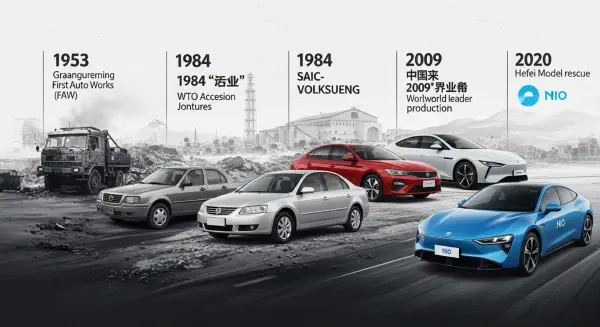
In the mid-1980s, the Chinese leadership faced a crisis that had nothing to do with ideology and everything to do with the mathematics of national insolvency. Following the 1978 economic opening, rising household incomes triggered a sudden, uncontrolled surge in vehicle imports that threatened to drain the country’s precarious foreign exchange reserves. The central leadership realized that if they did not build a domestic car industry, the very act of national modernization would bankrupt the state as citizens traded their savings for foreign-made engines. This was the first-order strategic necessity: a domestic automotive industry was not a luxury for a developing nation, but a defensive wall built to protect national reserves and ensure that the capital generated by Chinese labor stayed within Chinese borders.
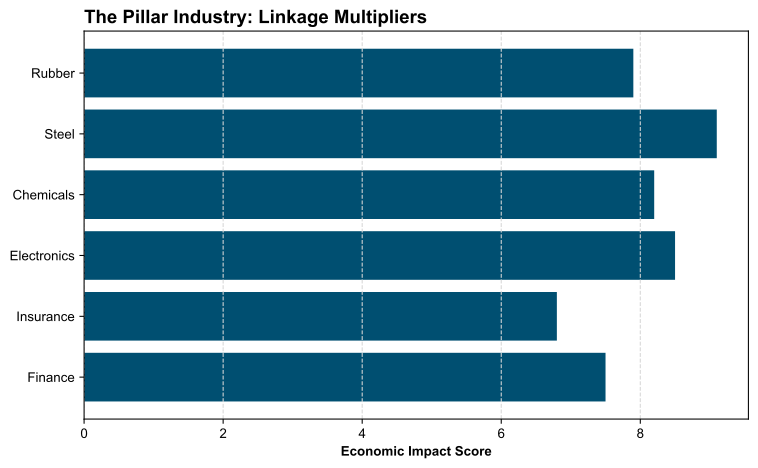
By 1986, this reactive defense was codified into a proactive industrial offensive. The 7th Five-Year Plan formally designated the automotive sector as a "pillar industry," a term of art in Chinese planning that signals an industry is essential for the modernization of the entire national economy. The choice was calculated. Beijing recognized that the automobile is perhaps the world's most effective economic multiplier. It provides massive backward linkages to heavy industries like steel, chemicals, glass, and rubber, while simultaneously generating forward linkages to high-value service sectors like financing, insurance, and maintenance. To build a car was to force the modernization of a dozen other sectors at once.
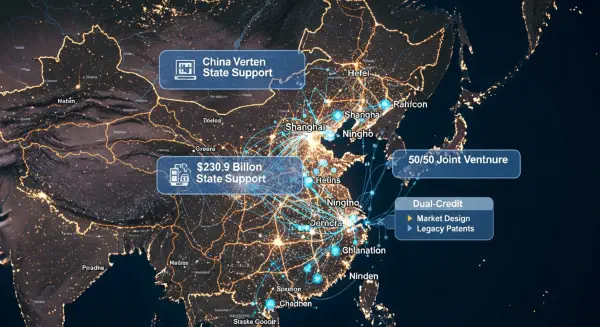
The decision to become a global leader, rather than a mere participant, was driven by a rejection of what economists call the "Mexican Syndrome." Many developing nations had successfully attracted foreign car factories but remained trapped as low-cost assembly hubs, never developing their own brands or indigenous technology. China viewed this passive assembly model as a form of industrial subordination. The mandate was clear: China would not just assemble the world’s cars; it would own the technology, the brands, and the supply chains, ensuring that the high-value engineering and design work occurred in cities like Shanghai and Changchun rather than Wolfsburg or Detroit.
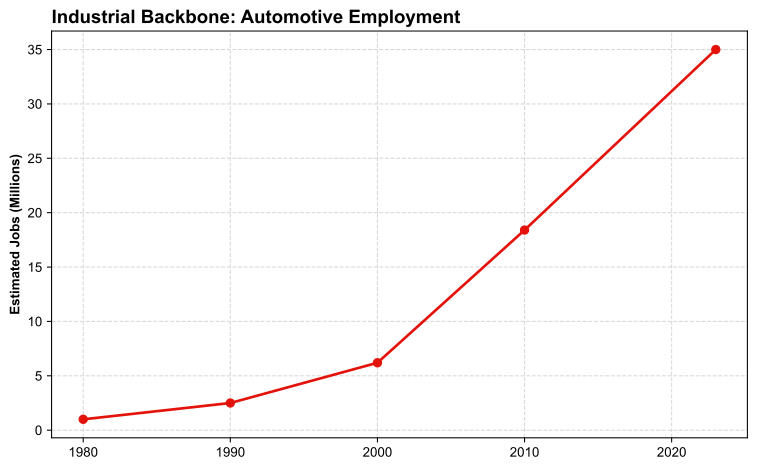
This pursuit was inextricably linked to social stability and the management of a massive demographic transition. The automotive industry is one of the world's primary providers of industrial employment, and Beijing understood that a leading automotive sector could support millions of jobs. These were not just factory-line positions; they were the foundation for a rising middle class, providing the high-wage employment necessary to absorb rural labor migrating to urban centers. The car was the vehicle for the "Chinese Dream," and the industry was the machine that would manufacture the social stability required for the party’s long-term survival.
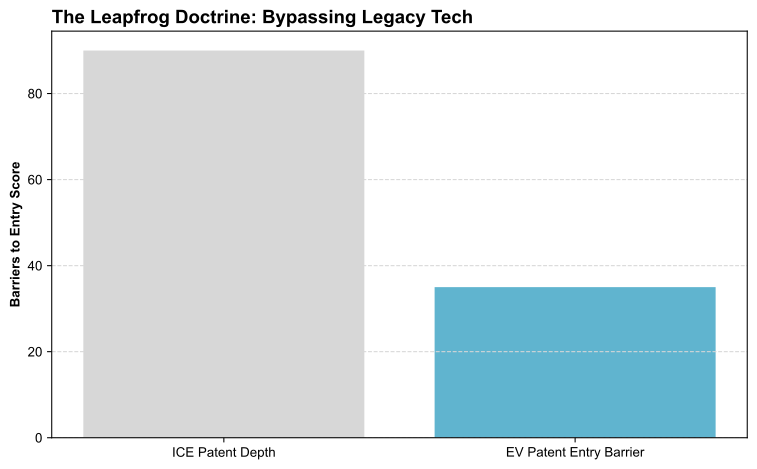
As the industry developed, the strategic rationale shifted toward the problem of the "technological deadlock." By the late 1990s, Chinese planners realized that attempting to catch up with the West in internal combustion engine (ICE) technology was a fool’s errand. The patents were too deep, the engineering expertise too concentrated, and the precision manufacturing gap too wide to bridge through incremental improvements. China was a latecomer in a race that had already been finished. This realization birthed the "Leapfrog Doctrine": if China could not win the ICE race, it would change the race entirely by pivoting to New Energy Vehicles (NEVs).
This pivot was not merely about environmentalism; it was a bid for technological sovereignty. By centering the future of the industry on battery chemistry and software—areas where the playing field was relatively level—China could bypass the legacy advantages of Japan and Germany. The 10th Five-Year Plan in 2001 first began to emphasize NEVs as a unique "window of opportunity". This strategy devalued a century of Western expertise in pistons and transmissions and replaced it with a paradigm where China could establish a technological moat that global competitors could not easily cross.
The final layer of the strategic mandate was national security. For a nation that is the world’s largest oil importer, a transportation fleet powered by liquid fuel is a systemic vulnerability. Electrification offered a path to energy security, allowing the nation to power its mobility with domestic coal, hydro, and solar energy rather than oil shipped through vulnerable maritime choke points. Furthermore, by establishing supply chain hegemony over 70% of the world's energy-related mineral refining, China aimed to determine the economic terms of the post-carbon global economy.
Beijing chose to lead the automotive industry because it viewed the car as the central gravity of modern power. It was the tool used to save foreign exchange in the 1980s, the engine of industrial linkages in the 1990s, the provider of social stability in the 2000s, and the weapon of technological leapfrogging in the 2010s. Today, the industry is the physical manifestation of China’s ambition to move from the periphery of the global industrial order to its absolute center. The choice was never just about making cars; it was about engineering a future where the world’s most complex consumer product is built, designed, and defined by the state that prioritized its dominance above all else.