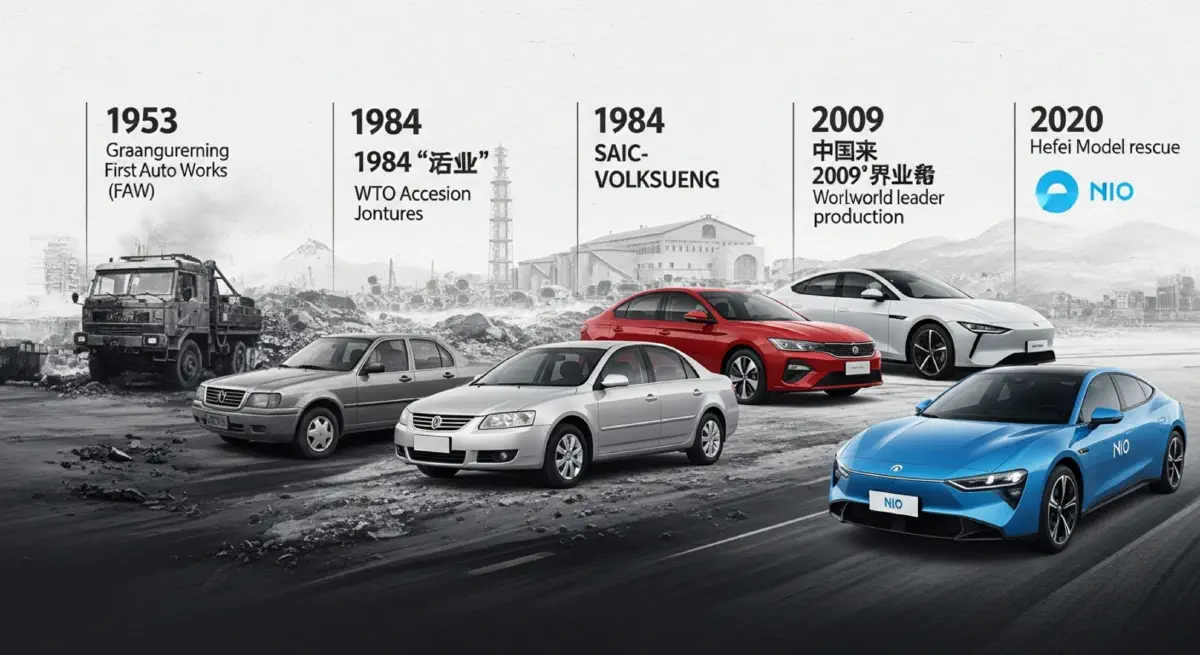
A Causal Chronology of the Chinese Automotive Ascent#
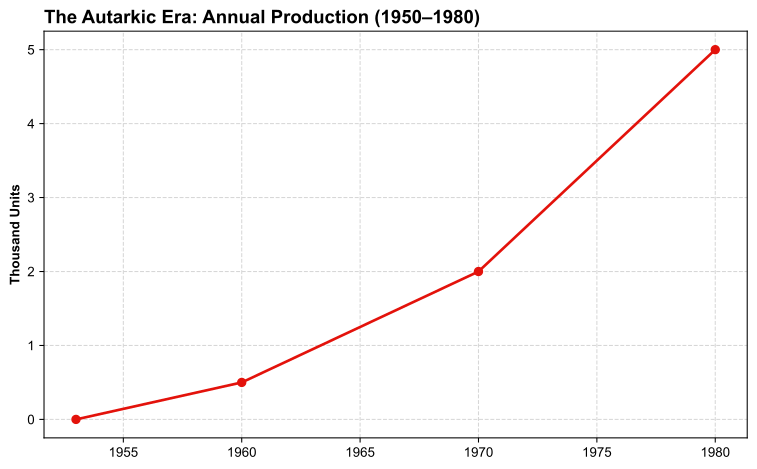
In 1953, the First Auto Works (FAW) broke ground in Changchun, Jilin Province. It was not a product of market demand or entrepreneurial risk, but a Soviet transplant, established with technical assistance from Moscow during the height of the Cold War. For twenty-five years, this industrial embryo existed in a state of autarkic suspended animation, producing a minuscule number of vehicles—primarily the "Shanghai" sedan and the "Red Flag" limousine—designed for the exclusive transport of state officials. By 1980, the total annual output of the entire Chinese nation was approximately five thousand units. To look at the 30-million-unit machine of 2024 is to witness a metamorphosis that was not merely rapid, but fundamentally engineered through four distinct, causal phases of state-led development.
The first phase, spanning from the 1953 founding to the 1978 opening, was the era of the "Soviet Foundation." The records show that the "Big Three" state-owned enterprises (SOEs)—FAW, SAIC Motor, and Dongfeng Motor—were all products of this period, incubated within a centrally planned system that viewed the automobile as a tool of the state rather than a commodity of the masses. Manufacturing infrastructure during this time was underdeveloped and capacity was minimal, yet it established the vertical production models and regional clusters that would later be repurposed for global competition. The industry was isolated, inefficient, and technologically stagnant, but it provided the physical footprint upon which the modern era would be built.
The transition to the second phase, "Inward Internationalization" (1978–2001), was triggered by a realization within the central leadership that technological isolation was a terminal condition. In July 1979, China enacted the Law on Joint Venture Using Chinese and Foreign Investment, a move that effectively auctioned off access to its domestic market in exchange for the engineering soul of the West. The 1983 establishment of Beijing Jeep—a partnership between AMC/Chrysler and Beijing Auto—marked the first major breach in the autarkic wall. This was followed quickly by SAIC-Volkswagen in 1984 and the founding of Great Wall Motor in the same year.
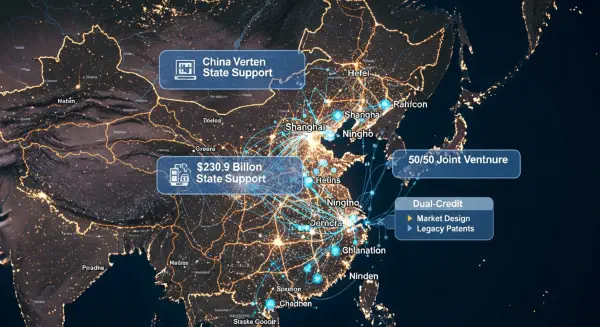
By 1986, the 7th Five-Year Plan formally codified the automotive sector as a "pillar industry," a designation that remains the North Star of Chinese industrial policy today. However, the influx of foreign cars led to a surge in imports that threatened national foreign exchange reserves. The government’s response was the 1994 Automobile Industry Policy, which introduced the now-famous 50% foreign ownership cap. This was the "Market for Technology" bargain: foreign firms were required to form 50/50 joint ventures (JVs) with Chinese SOEs, transfer their manufacturing know-how, and localize their supply chains. For the foreign giants, these JVs became "cash cows" that funded global operations; for the Chinese, they were a systemic industrial upgrading program that raised the performance standards of local parts suppliers by decades.
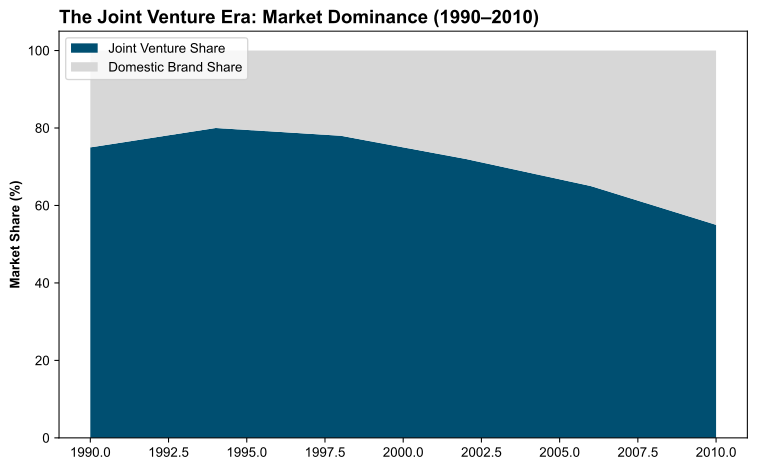
The third phase began in 2001, when China joined the World Trade Organization (WTO). This period, "Scale Expansion and WTO Integration" (2001–2014), was characterized by a brutal rationalization of the industry. Phased tariff reductions, which saw import duties on vehicles fall from over 200% in the 1980s to 25% by 2010, forced a shift from simple assembly to genuine manufacturing. In 2000, production had reached 2 million units; by 2009, China surpassed the United States to become the world’s largest automotive market and producer. This was the decade when the "Big Three" SOEs were joined by private upstarts like Geely (1997) and BYD (2003), who brought a level of agility the state giants lacked.
It was during this period of explosive growth that the limits of the internal combustion engine (ICE) became apparent. Chinese firms realized they could not easily overcome the decades of patent protection and precision engineering advantages held by Western and Japanese rivals in ICE technology. Instead of attempting to win a race that had already been finished, the 10th Five-Year Plan in 2001 first began to emphasize New Energy Vehicles (NEVs). In 2009, the government launched massive EV subsidies and the "1,000 EVs in 10 cities" pilot program, signaling the end of the ICE-led expansion and the beginning of the "Leapfrog Doctrine".
The fourth and current phase, the "Electric Pivot and Technological Leap" (2014–Present), is where the strategy of bypassing incumbent advantages moved from policy to the pavement. The 2014 founding of NIO and the 2015 launch of "Made in China 2025" identified NEVs as a strategic sector for global dominance. This was no longer about catching up; it was about setting the agenda. The government’s support was unprecedented, totaling an estimated $230.9 billion for NEV development between 2009 and 2023. In 2018, the introduction of the Dual-Credit Policy replaced direct subsidies with a market-based mandate, forcing every manufacturer to produce EVs or pay their competitors to do it for them.
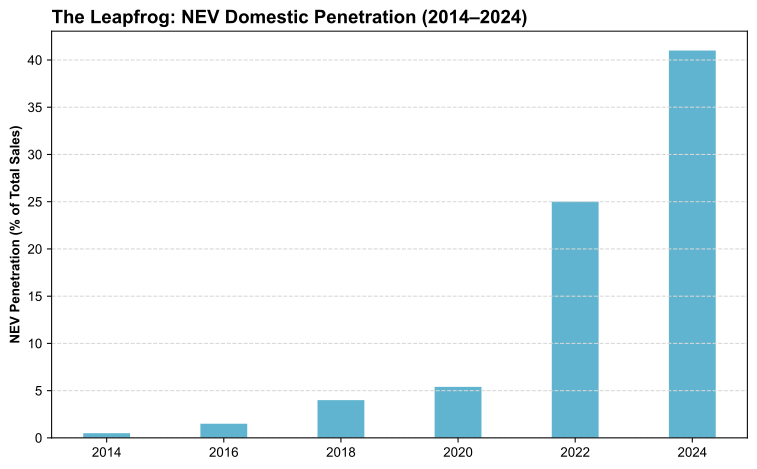
The culmination of this seventy-year ascent occurred between 2020 and 2024. In 2020, the "Hefei Model" was highlighted by the city’s $1 billion (~7.14 billion yuan) rescue of NIO, an act of "state-as-venture-capitalist" that anchored a complete EV supply chain in Anhui Province. By 2023, China produced a record 30.16 million vehicles and became the world’s leading automotive exporter, shipping 5.9 million units in 2024. Today, the "New Force" is defined by tech giants like Huawei and Xiaomi, who are redefining the car not as a machine of pistons and gears, but as a high-compute consumer electronic device integrated into an AI-powered ecosystem.
The records indicate that as of 2026, six Chinese manufacturers control 68.9% of the global EV battery market. The industry has moved from Soviet transplants to "Market for Technology" joint ventures, and finally to a state of supply chain hegemony where China refines roughly 70% of the world’s energy-related minerals. What began in a factory in Changchun with a handful of state-official limousines has become a global industrial machine that now produces half of the world's electric vehicles. The chronology is not a story of accidental growth, but of a calculated, multi-decade bypass of the global industrial order.